

Key Points
The Volcano Group arson attack Germany has triggered one of Berlin’s most disruptive infrastructure incidents in recent years, cutting electricity to tens of thousands of homes and businesses at the height of winter. Beyond the immediate inconvenience and safety concerns, the episode highlights deeper economic and business vulnerabilities tied to energy infrastructure security in Europe’s largest economy.
On Saturday, an arson attack in southwest Berlin caused a widespread power outage affecting approximately 50,000 households and around 2,000 businesses. The far-left activist network Volcano Group later claimed responsibility, stating that its intended target was the fossil fuel industry. Authorities have since classified the group’s claim as authentic, launching a high-level investigation into what officials have described as a deliberate and dangerous act.
For businesses, investors, and policymakers, the incident serves as a case study in how political extremism, energy systems, and economic resilience increasingly intersect.
What Happened in Berlin
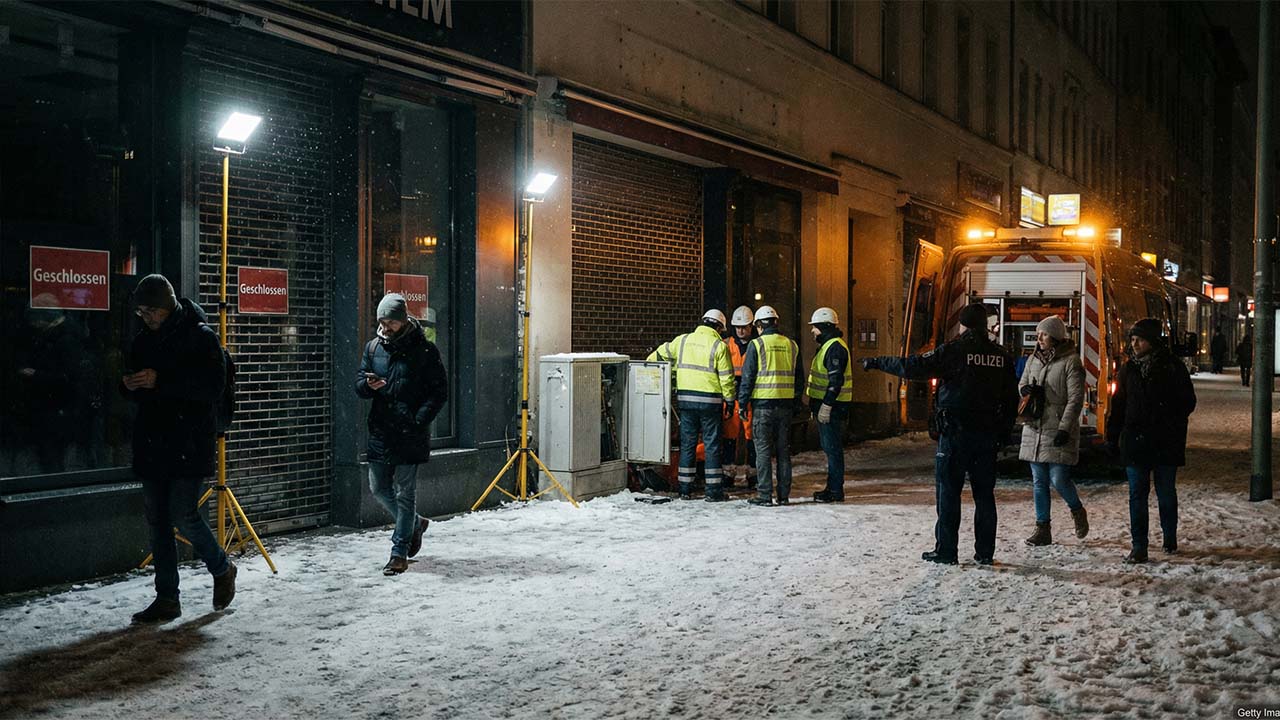
The blackout unfolded after an arson attack damaged critical components of Berlin’s electricity network in the city’s southwest. The outage immediately disrupted daily life across residential neighborhoods and commercial districts, forcing shops to close and straining emergency services.
By Saturday night, grid operator Stromnetz Berlin had restored power to roughly 7,000 households and 150 businesses. Another 3,000 households were expected to regain electricity on Sunday. However, as of the latest update, about 38,000 households and nearly 2,000 businesses remained without power, with full restoration potentially taking until January 8.
Compounding the impact, the outage also affected mobile phone service and heating systems in some areas. Temperatures in the German capital had dropped below freezing, and snowfall blanketed the city, increasing risks for vulnerable populations and raising the stakes of a prolonged disruption.
Hospitals and retirement homes were forced to relocate patients and residents, while emergency lighting was installed in train stations and public spaces to maintain basic safety.
Who Is Involved and Official Responses
Berlin’s Interior Minister Iris Spranger condemned the attack in strong terms, calling it “inhumane” and confirming that authorities consider the activist group’s letter to be authentic. The investigation remains ongoing, with security agencies treating the incident as a serious threat to public safety.
Mayor Kai Wegner went further, warning that suspected left-wing extremists had knowingly endangered lives, including those of hospital patients, elderly residents, and families. He said the city could consider enlisting military support to manage the fallout and protect critical infrastructure.
The activist group itself issued a statement expressing limited sympathy for wealthier residents in affected neighborhoods, a tone that has drawn widespread condemnation across the political spectrum.
Why This Matters Now
The Volcano Group arson attack Germany arrives at a sensitive moment for the country’s energy system and economy. Germany is in the midst of a complex energy transition, balancing climate goals, industrial competitiveness, and grid stability. Infrastructure resilience has become a central concern as electrification increases dependence on reliable power networks.
This incident also follows a pattern. German domestic intelligence services have linked the Volcano Group to several arson attacks in Berlin and Brandenburg since 2011. Most notably, the group claimed responsibility for a March 2024 attack that disrupted the power supply to Tesla Inc.’s factory in Grünheide, near Berlin.
Taken together, these events underscore how targeted infrastructure sabotage can ripple through supply chains, manufacturing output, and investor confidence.
Business Impact: Immediate Losses and Operational Risk
Local business groups have warned that the blackout could cost companies millions of euros in lost revenue. Shops were forced to shut their doors, refrigeration systems failed, and digital payment systems went offline. For small and medium-sized enterprises, even a single day without power can strain cash flow and disrupt customer relationships.
Manufacturers and logistics-dependent businesses face even higher risks. Interruptions to electricity can halt production lines, damage sensitive equipment, and delay deliveries. In a just-in-time economy, these delays can cascade through supplier networks.
Service-sector firms, including restaurants, healthcare providers, and care facilities, faced acute operational challenges. Hospitals and retirement homes incurred additional costs relocating patients and residents, while ensuring continuity of care under emergency conditions.
Market and Economic Implications
From a broader economic perspective, the outage highlights a less visible but critical risk factor: infrastructure security as a component of economic stability.
Germany’s reputation as a reliable industrial and business hub rests partly on dependable infrastructure. Repeated or prolonged disruptions — especially those linked to political extremism — can raise concerns among investors evaluating long-term commitments.
While markets did not immediately react to the Berlin outage, such incidents contribute to a cumulative risk narrative. For insurers, lenders, and corporate risk managers, infrastructure sabotage increases the cost of doing business, potentially leading to higher premiums, more stringent security requirements, or delayed investment decisions.
The timing also matters. The blackout occurred during freezing conditions, amplifying the economic and social cost of disruption. Energy reliability during winter is not just a convenience issue; it is a core component of public safety and economic continuity.
Energy Infrastructure Under Pressure
The Volcano Group arson attack Germany exposes how energy infrastructure has become a focal point for activist action. Power grids, substations, and distribution networks are increasingly seen as symbolic and strategic targets.
For grid operators, the incident underscores the challenge of protecting sprawling, often exposed infrastructure from deliberate attacks. Even localized damage can have outsized effects when systems are tightly interconnected.
Stromnetz Berlin’s warning that full restoration could take several days echoes a similar blackout in September that also required an extended repair timeline. Each such incident adds pressure on operators to invest in redundancy, monitoring, and rapid-response capabilities.
Implications for Policy and Regulation
The attack is likely to intensify debate around infrastructure protection and the role of state security in safeguarding essential services. Mayor Wegner’s suggestion of potential military involvement signals how seriously authorities are viewing the threat.
For policymakers, the challenge lies in balancing civil liberties with enhanced security measures. Increased surveillance, physical protection of grid assets, and coordination between civilian and security agencies may all come under consideration.
At the same time, the incident raises questions about how energy transition policies intersect with security planning. As grids become more complex and decentralized, ensuring resilience against both technical failures and deliberate attacks becomes more demanding.
What Businesses Can Learn
For companies operating in Germany — and across Europe — the Berlin blackout offers several practical lessons:
First, contingency planning matters. Businesses with backup power systems, emergency protocols, and flexible operations were better positioned to manage the disruption.
Second, geographic concentration of critical operations can amplify risk. Firms with diversified locations or remote capabilities may be more resilient when localized infrastructure fails.
Third, engagement with local authorities and utilities is essential. Clear communication channels can help businesses respond more effectively during outages and recover more quickly once service is restored.
Forward-Looking Insight
While the immediate focus remains on restoring power and completing the investigation, the broader significance of the Volcano Group arson attack Germany lies in what it reveals about modern economic risk.
Infrastructure is no longer just an engineering challenge; it is a strategic asset vulnerable to political, social, and security pressures. For businesses and investors, understanding and managing these risks is becoming as important as monitoring market trends or regulatory changes.
As Germany continues to navigate its energy transition and economic priorities, incidents like the Berlin blackout will likely shape future discussions on resilience, security, and the true cost of disruption in a highly electrified economy.