

Key Points
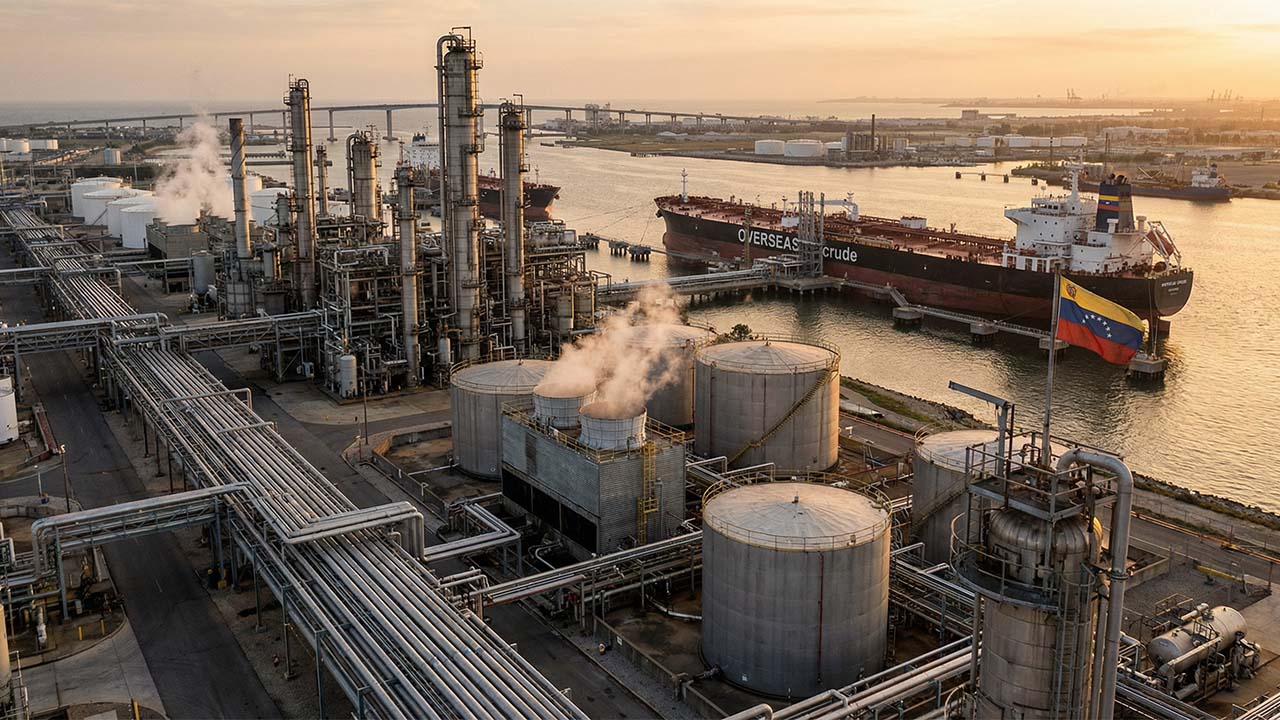
The US Venezuelan oil sales impact is already rippling through American energy markets, reshaping refinery economics and investor expectations in ways that go far beyond a single geopolitical headline. Shares of Valero Energy Corp surged to an all-time high this week after the Trump administration confirmed plans to sell millions of barrels of Venezuelan crude — a move that directly benefits a narrow but powerful group of US refiners.
At the center of the rally is a simple but crucial reality: Venezuelan oil is among the heaviest in the world, and not all refineries can process it. For companies that can, access to cheaper heavy crude has historically translated into wider margins, stronger cash flow, and greater pricing flexibility in fuel markets. Investors appear to be betting that the reopening of Venezuelan oil flows could restore a structural advantage that US refiners have lacked in recent years.
What Happened and Who Is Involved
Valero shares climbed as much as 5.3% in a single session, making the company one of the top performers in the S&P 500. The rally followed the administration’s disclosure that the US intends to control and sell Venezuelan oil exports indefinitely, effectively reopening supply from a country with the world’s largest proven oil reserves.
The market reaction was not limited to Valero. Rival refiners Marathon Petroleum Corp and Phillips 66 also moved higher, underscoring how concentrated the benefits of Venezuelan crude access are within the refining sector.
Since US forces captured Venezuelan President Nicolas Maduro in a nighttime operation days earlier, Valero has climbed roughly 14%, while Marathon and Phillips 66 gained more than 7% and 9%, respectively. The gains reflect investor confidence that Venezuelan oil could once again become a reliable feedstock for US refiners designed for heavy crude.
Why Venezuelan Oil Matters So Much
To understand the US Venezuelan oil sales impact, it’s important to understand the unique characteristics of Venezuelan crude. The country’s fields produce exceptionally thick, sulfur-heavy oil that requires specialized equipment to process efficiently. Over decades, select US refiners invested billions to handle this type of crude because it typically trades at a discount to lighter oil.
That discount is critical. When refiners can buy cheaper heavy crude and turn it into high-value products like gasoline and diesel, profit margins widen significantly. The loss of Venezuelan supply over the past decade forced many US refiners to rely on alternative heavy grades, often at higher cost or lower availability.
The prospect of Venezuelan barrels returning to the market restores a competitive dynamic that had been missing — one that heavily favors companies like Valero that are already equipped to process this oil at scale.
The Market Context: Why This Matters Now
This development arrives at a delicate moment for global energy markets. Refiners are navigating volatile fuel demand, tightening environmental regulations, and rising operational costs. Access to cheaper crude feedstock offers a rare lever to protect profitability without raising consumer prices.
For investors, the reopening of Venezuelan oil flows helps explain why refinery stocks have diverged from broader energy markets. While upstream oil producers face uncertainty around prices and production levels, refiners benefit when input costs fall relative to refined product prices.
The US Venezuelan oil sales impact also highlights how policy decisions can quickly reshape sector-level economics. Unlike long-term infrastructure investments, crude supply shifts can influence earnings almost immediately.
California Complication: Valero’s Strategic Balancing Act
Adding another layer to Valero’s rally is its evolving strategy in California, one of the most challenging fuel markets in the US. On the same day as the oil announcement, Valero said it plans to increase gasoline imports into the San Francisco Bay Area as it moves forward with shutting down parts of its Benicia refinery.
The company will begin closing some operating units in February, with a full wind-down expected by the end of April. However, Valero stopped short of a full exit from Northern California, signaling that it intends to maintain a presence through imports.
In a statement, Valero said it remains committed to fulfilling contractual supply obligations in California and anticipates importing additional gasoline volumes in the near term. That assurance helped calm fears of supply disruptions in a state already vulnerable to price spikes.
Political Response Signals a Shift
California Governor Gavin Newsom publicly praised Valero’s approach, calling it a “constructive development” compared with earlier scenarios that included a complete market exit in early 2026.
Newsom’s response marks a notable shift in tone. The governor, long critical of fossil fuel companies, has softened his stance amid concerns over gasoline affordability and supply stability. Over the past year, his administration has engaged more directly with refiners to avoid sudden capacity losses that could drive prices higher.
The governor’s office confirmed ongoing communication between the state and Valero as the company evaluates long-term options for the Benicia facility.
Business Impact: Refiners Regain Pricing Power
From a business perspective, the US Venezuelan oil sales impact strengthens refiners’ negotiating position across multiple fronts. Cheaper crude improves margins, but it also allows refiners to better manage supply obligations in volatile regional markets like California.
For companies importing gasoline rather than refining locally, access to discounted crude elsewhere in their network can offset higher logistics costs. This flexibility is especially valuable as regulatory pressure continues to reshape where and how fuels are produced.
The development also reinforces the strategic value of refinery complexity — an often overlooked metric that determines which facilities can process heavy crude efficiently. Investors are increasingly rewarding companies that made those investments years ago.
Market and Investor Implications
Equity markets responded swiftly because the implications are tangible and near-term. Unlike speculative energy transitions or long-range production forecasts, Venezuelan oil sales represent immediate changes to supply economics.
For investors, refinery stocks have become a way to express a view on policy-driven supply shifts without taking direct exposure to crude price volatility. The strong performance of Valero, Marathon, and Phillips 66 suggests that markets see sustained benefits rather than a one-time trade.
The rally also reflects confidence that US control over Venezuelan exports will provide a level of predictability that had been absent under previous sanctions regimes.
Consumer Impact: Indirect but Meaningful
While consumers may not notice immediate price changes at the pump, the US Venezuelan oil sales impact could help limit future price spikes. Lower refinery input costs reduce pressure on fuel prices, particularly in constrained markets like California.
For policymakers, this underscores the role of supply stability in managing inflationary pressures tied to energy. While refined fuel prices depend on many factors, access to cheaper crude remains a foundational element.
A Forward-Looking Perspective
The reopening of Venezuelan oil sales does not eliminate the structural challenges facing the refining industry, from environmental regulations to long-term demand uncertainty. However, it restores a crucial advantage for a subset of US refiners at a time when flexibility and cost control matter more than ever.
The market reaction suggests that investors see this as a recalibration rather than a temporary boost. For businesses, it reinforces the value of operational readiness. For policymakers, it highlights how energy decisions can ripple quickly through markets.
Ultimately, the US Venezuelan oil sales impact serves as a reminder that in the energy sector, access — not just production — can define winners and losers.