

Key Points
Financial markets rarely react to political headlines alone. They move when confidence in the system itself is questioned. That line was tested this week as the Federal Reserve independence market impact became visible across stocks, currencies, bonds, and commodities following confirmation that the central bank had been served grand jury subpoenas tied to renovations at its headquarters.
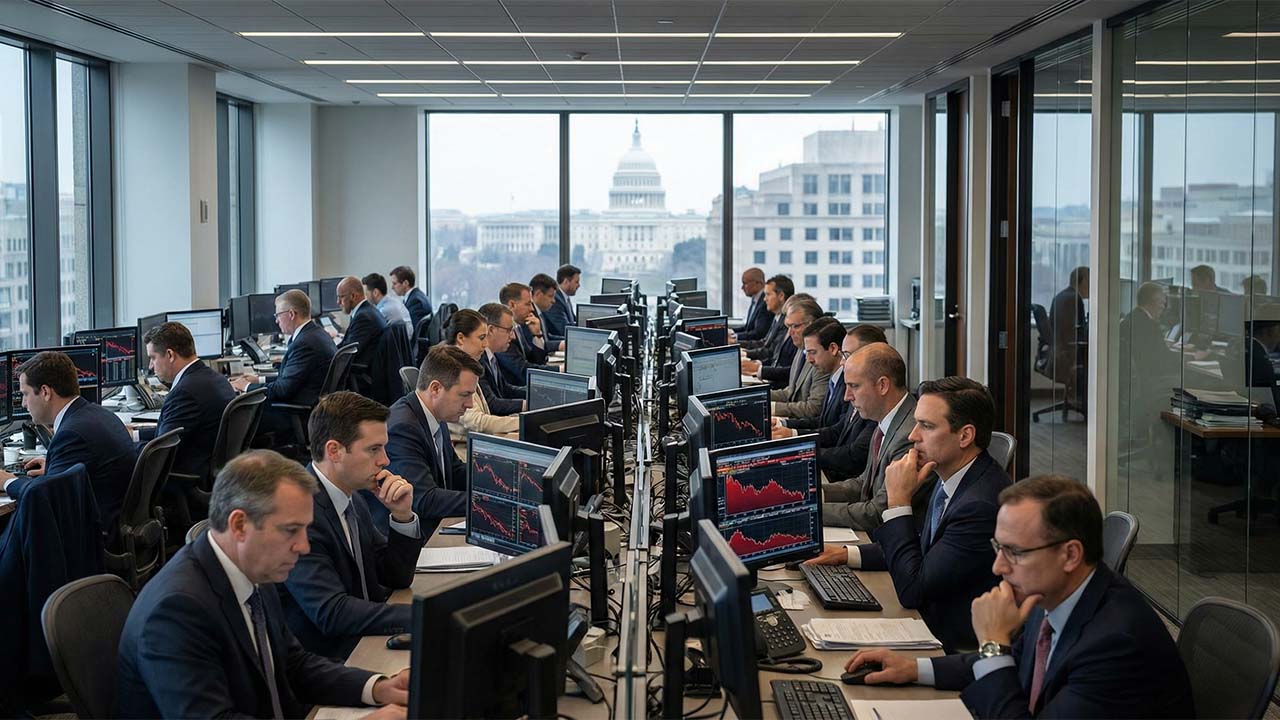
The immediate reaction was swift and broad. US stock futures declined, the dollar weakened sharply, long-term Treasury yields rose, and gold surged to a new all-time high. Investors were not responding to a change in interest rates or economic data. Instead, they were recalibrating risk around the credibility and autonomy of the US central bank — a cornerstone of global financial stability.
What Happened in Markets
US equity futures fell as investors reduced exposure to American assets. Contracts on the S&P 500 slipped about 0.5%, while Nasdaq 100 futures dropped closer to 0.7%. The move coincided with comments from Federal Reserve Chair Jerome Powell, who said the subpoenas were linked to policymakers’ refusal to align interest-rate decisions with White House preferences.
Currency markets delivered a clearer verdict. The Bloomberg Dollar Spot Index posted its largest decline since the Christmas break, reflecting renewed doubts about the long-term stability of US policy institutions. Safe-haven alternatives outperformed, including the Swiss franc and gold, which rallied more than 2% to a record high.
Bond markets signaled a different but related concern. Long-dated Treasury yields rose as investors priced in the risk that political pressure could eventually lead to looser monetary policy. The 30-year yield climbed to around 4.85%, while the 10-year yield edged higher as well. Rising long-term yields alongside falling equities underscored a growing risk premium rather than optimism about growth.
Why Federal Reserve Independence Matters
Central bank independence is not an abstract concept. It is the foundation that allows markets to believe monetary policy decisions are made based on inflation, employment, and financial stability — not political timelines or electoral pressure.
When investors question that independence, several things happen at once:
- Risk premiums rise on US assets
- The dollar weakens as global investors reassess safe-haven status
- Inflation expectations become less anchored
- Long-term borrowing costs increase, even without rate hikes
This week’s moves reflected all four dynamics. As Jan Hatzius, chief economist at Goldman Sachs Group Inc., noted, concerns about the Fed’s independence were “reinforced” by the criminal investigation. While expectations remain that policy decisions will still be data-driven, markets are reacting to the possibility — not the certainty — of political interference.
That distinction matters. Markets trade probabilities, not outcomes.
Stocks: Pressure Without Panic
Equities declined, but the selloff was measured rather than disorderly. That suggests investors are adjusting positioning rather than fleeing risk altogether.
Technology shares underperformed, with semiconductor and hardware names falling more than 1% in early trading. These stocks tend to be sensitive to long-term interest rates, which rose as investors demanded higher compensation for holding US debt.
Financial stocks showed mixed performance. Banks with heavy exposure to credit-card lending fell sharply after President Donald Trump renewed calls to cap interest rates for a year. Citigroup, American Express, and Capital One retreated, while European-listed banks such as Barclays also declined.
At the same time, broader bank performance over recent quarters has remained strong. Large US lenders have outperformed the S&P 500 over the past year, supported by robust investment-banking fees and deal activity. This divergence highlights an important nuance: political risk can pressure valuations even when fundamentals remain intact.
Banks and Earnings: A Crucial Test Ahead
The timing of the Fed controversy is significant. Wall Street’s biggest banks are about to unofficially kick off earnings season, and investors are watching closely to see whether strong results can offset rising macro uncertainty.
Institutions such as JPMorgan Chase & Co., Citigroup, and Bank of America are expected to report slower revenue growth as trading gains normalize. However, investment-banking pipelines remain active following a wave of mergers and acquisitions.
If earnings confirm resilience, banks could still emerge as market leaders in 2026. If not, concerns about regulatory pressure, rate caps, and political interference may weigh more heavily on valuations.
The Dollar: Confidence Is the Currency
The dollar’s decline was one of the clearest expressions of the Federal Reserve independence market impact. For decades, the US currency has benefited from trust in American institutions, particularly the Fed’s ability to act independently during crises.
That trust was tested this week. As one Bloomberg strategist noted, the risk premium embedded in the dollar has room to rise further if investors revive last year’s “Sell America” narrative — especially if inflation data remains sticky or policy leadership appears increasingly politicized.
A weaker dollar can provide short-term relief for US exporters, but sustained depreciation raises import costs and complicates inflation control. For global investors, it reduces the appeal of US assets relative to alternatives.
Gold and Silver: A Vote of No Confidence
Gold’s rally to a new record was not driven by inflation data or geopolitical escalation alone. It reflected a broader search for assets insulated from policy uncertainty.
Gold and silver both benefited from repeated political attacks on the Fed throughout 2025, and that dynamic appears to be carrying into the new year. Silver surged above $80 an ounce alongside gold’s advance, reinforcing the message that investors are hedging institutional risk rather than chasing growth.
For consumers, higher gold prices often signal caution rather than prosperity. For investors, they serve as a reminder that confidence — once questioned — is expensive to rebuild.
Bonds: The Long-Term Warning Signal
Perhaps the most important signal came from the long end of the Treasury curve. Rising long-term yields suggest investors are demanding compensation for future inflation risk and policy uncertainty.
This is a critical distinction. Short-term yields are controlled by the Fed. Long-term yields reflect trust in the Fed.
When those yields rise during market stress, it indicates concern that political pressure could eventually undermine the central bank’s ability to keep inflation in check. That scenario would raise borrowing costs for businesses, households, and the federal government alike.
What This Means for Businesses
For businesses, the immediate takeaway is not panic — but preparation.
Higher long-term yields translate into more expensive financing, particularly for capital-intensive industries. Currency volatility complicates planning for firms with international exposure. And regulatory uncertainty adds another layer of risk for financial services companies.
Executives and CFOs may respond by delaying large investments, hedging currency exposure, or maintaining higher cash buffers until policy clarity improves.
What It Means for Investors
For investors, the episode reinforces the importance of diversification and risk management.
Market reactions show that political risk can affect multiple asset classes simultaneously. Stocks, bonds, currencies, and commodities all moved in response to the same catalyst. That underscores the value of balanced portfolios rather than reliance on any single asset or region.
Investors are also watching upcoming inflation data, Supreme Court rulings on tariffs, and speeches from regional Fed presidents for signals that institutional credibility remains intact.
Looking Ahead: Confidence Is the Real Policy Tool
The Federal Reserve’s power does not come from subpoenas, speeches, or even interest rates alone. It comes from trust.
This week’s market moves illustrate how quickly that trust can be tested — and how widely the effects can spread when it is. The Federal Reserve independence market impact is not about one investigation or one administration. It is about the credibility of a system that underpins global finance.
Markets will continue to function. Earnings will be reported. Data will be released. But until confidence in institutional independence is reaffirmed, investors are likely to remain cautious, pricing risk more conservatively and favoring assets perceived as insulated from political influence.
That, more than any single market move, is the lasting signal from this episode.