

Key Points
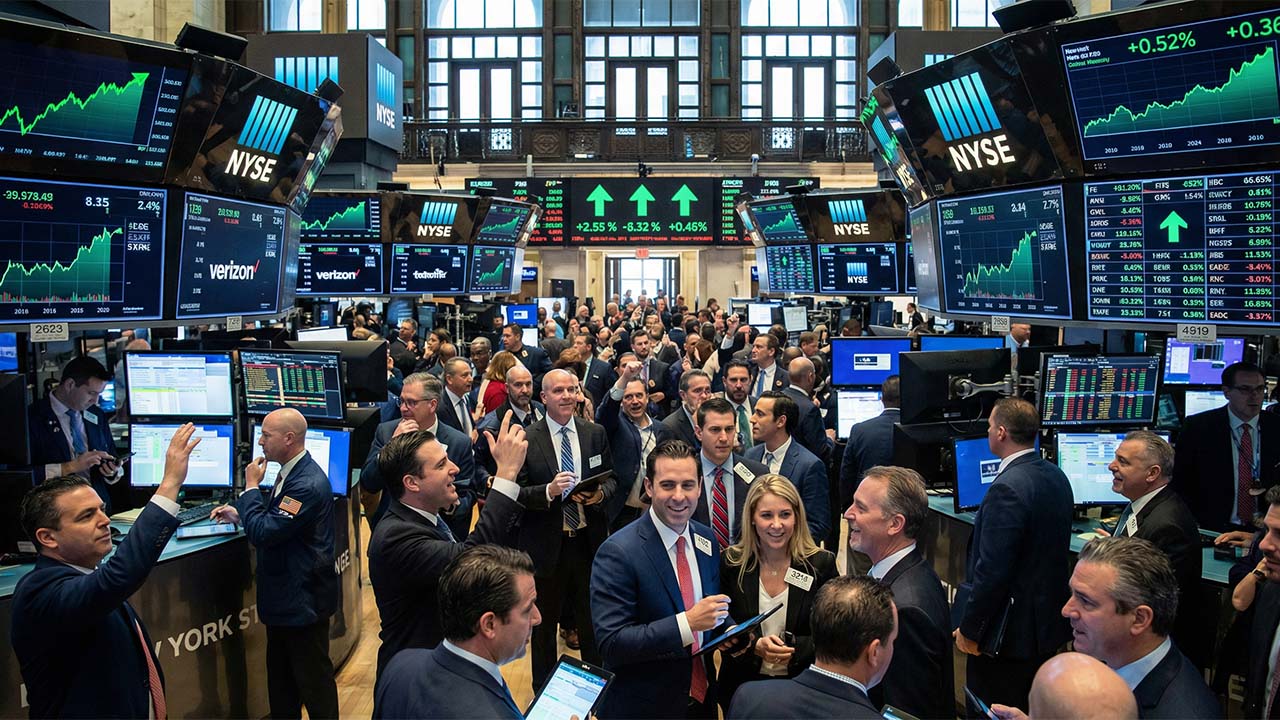
The US stock market rally today delivered a powerful signal to investors as Wall Street opened the new trading year with renewed momentum, pushing major indexes higher and sending the Dow Jones Industrial Average to an all-time record. The gains came as investors balanced geopolitical shocks, shifting energy expectations, and revived confidence in artificial intelligence demand—an unusual but revealing mix that underscores how markets are recalibrating risk in early 2026.
On Monday, the rally was broad enough to lift industrials, energy producers, and technology heavyweights simultaneously. The blue-chip Dow Jones Industrial Average climbed roughly 600 points, briefly crossing the 49,000 mark for the first time in history. The S&P 500 and Nasdaq Composite also advanced, reflecting steady risk appetite rather than speculative excess.
What makes the US stock market rally today notable is not just the size of the gains, but the reasons behind them—and what they suggest for businesses, investors, and consumers heading into a critical quarter for the US economy.
What Drove the US Stock Market Rally Today
At the center of Monday’s market reaction was the US military operation in Venezuela and the capture of President Nicolás Maduro. While geopolitical events often inject volatility, markets responded in a counterintuitive way: energy stocks surged, and broader equities moved higher rather than retreating.
Investors interpreted the development as a potential reset for Venezuela’s oil sector, one that could eventually benefit US energy companies through infrastructure rebuilding and renewed production partnerships. That optimism outweighed concerns about near-term instability.
Shares of major US oil firms rallied sharply. Chevron gained about 5%, while oilfield services leader Halliburton jumped more than 8%. The move signaled investor belief that any long-term restructuring of Venezuela’s energy industry could favor companies with scale, capital, and technical expertise.
At the same time, the US stock market rally today was reinforced by a revival of enthusiasm for artificial intelligence-linked stocks—an important driver after a volatile end to 2025.
AI Optimism Returns to Wall Street
Technology stocks found fresh footing as optimism around AI demand strengthened. Semiconductor and hardware suppliers tied to large-scale AI deployment were among the strongest performers.
Shares of Nvidia rose as investors responded to positive developments across its supplier ecosystem. Analysts pointed to improving visibility on data center spending and enterprise AI adoption, themes that had come under pressure late last year.
The rally extended to Nvidia’s key partners. Taiwan Semiconductor Manufacturing Company, better known as TSMC, climbed after Goldman Sachs raised its price target, citing expectations for another year of solid growth. Meanwhile, electronics manufacturing giant Foxconn reported record fourth-quarter revenue, driven largely by demand for AI servers.
For markets, the takeaway was clear: despite concerns about valuations, the AI investment cycle remains intact, and companies with proven execution continue to attract capital.
Why This Rally Matters Now
The timing of the US stock market rally today is especially significant. It arrived as investors entered the first full trading week of the year facing multiple uncertainties: geopolitical tensions, a slowing labor market, and questions about the durability of economic growth.
Yet rather than retreating, markets leaned higher. Strategists largely downplayed the immediate economic fallout from Venezuela, framing it as a localized geopolitical shock rather than a systemic risk. That perspective allowed investors to refocus on fundamentals—earnings visibility, sector leadership, and interest rate expectations.
The rally also reflects a broader recalibration of risk. Investors appear willing to tolerate geopolitical noise as long as it does not directly threaten global supply chains or US economic stability. This mindset has meaningful implications for asset allocation in 2026.
Business Impact: Energy, Tech, and Corporate Planning
For businesses, the US stock market rally today highlights where investor confidence is flowing—and where caution remains.
Energy companies stand to benefit from renewed attention on supply security and infrastructure investment. Any long-term restructuring of Venezuela’s oil industry could open opportunities for US firms in engineering, services, and logistics. While timelines remain uncertain, markets are already pricing in the strategic optionality.
Technology firms, particularly those tied to AI hardware and infrastructure, are seeing sentiment stabilize after months of volatility. For corporate planners, this reinforces the importance of aligning capital spending with AI-driven productivity gains rather than experimental deployments.
Meanwhile, companies outside these sectors may face a higher bar for investor enthusiasm. The rally was selective, rewarding firms with clear growth narratives rather than lifting all boats indiscriminately.
Market and Economic Signals Beneath the Rally
Beyond equities, other asset classes offered clues about how investors are interpreting risk. Gold prices moved higher, reflecting a hedge against geopolitical uncertainty, while the US dollar strengthened modestly.
US Treasury bonds also attracted buyers. The benchmark 10-year yield slipped toward 4.15%, putting bonds on track for their first weekly gain in some time. This combination—rising stocks alongside falling yields—suggests investors are positioning for slower but stable growth rather than overheating.
The US stock market rally today, therefore, does not appear to be driven by expectations of accelerating inflation or aggressive monetary tightening. Instead, it reflects cautious optimism paired with selective defensiveness.
What Investors Are Watching Next
Despite the strong start, investors remain focused on incoming economic data. The return of a full slate of US indicators this week, including the closely watched jobs report, could test the durability of the rally.
Economists surveyed by Dow Jones expect payroll growth of around 55,000 in December—a figure that would signal cooling but not contraction. For markets, that outcome could reinforce expectations of a gradual normalization rather than a sharp slowdown.
Investors are also looking ahead to the Consumer Electronics Show in Las Vegas, where Jensen Huang is set to deliver a keynote address. The event often serves as a tone-setter for technology sentiment, and any signals about enterprise AI adoption or product roadmaps could influence tech stocks in the days ahead.
Consumer Implications: Confidence and Costs
For consumers, the US stock market rally today carries mixed but meaningful signals. Rising equity markets tend to support household wealth and confidence, particularly for retirement accounts and long-term savings.
However, gains driven by energy and geopolitical developments could also translate into volatility in fuel prices over time. While markets currently see potential long-term benefits, consumers remain sensitive to short-term price fluctuations.
In the near term, lower Treasury yields may help stabilize borrowing costs, offering some relief for mortgages and consumer loans after a volatile rate environment in recent years.
The Bigger Picture
The US stock market rally today is less about a single headline and more about how markets are repricing risk at the start of 2026. Investors are signaling confidence in select growth engines—energy infrastructure and artificial intelligence—while maintaining caution through bonds and safe-haven assets.
For businesses, the message is clear: clarity of strategy matters more than ever. For investors, selectivity remains essential. And for consumers, the rally offers reassurance that markets continue to see resilience in the US economy, even as global uncertainties persist.
As the year unfolds, this early surge may serve as a benchmark—not for unchecked optimism, but for how markets respond when geopolitical shocks collide with long-term structural trends.