

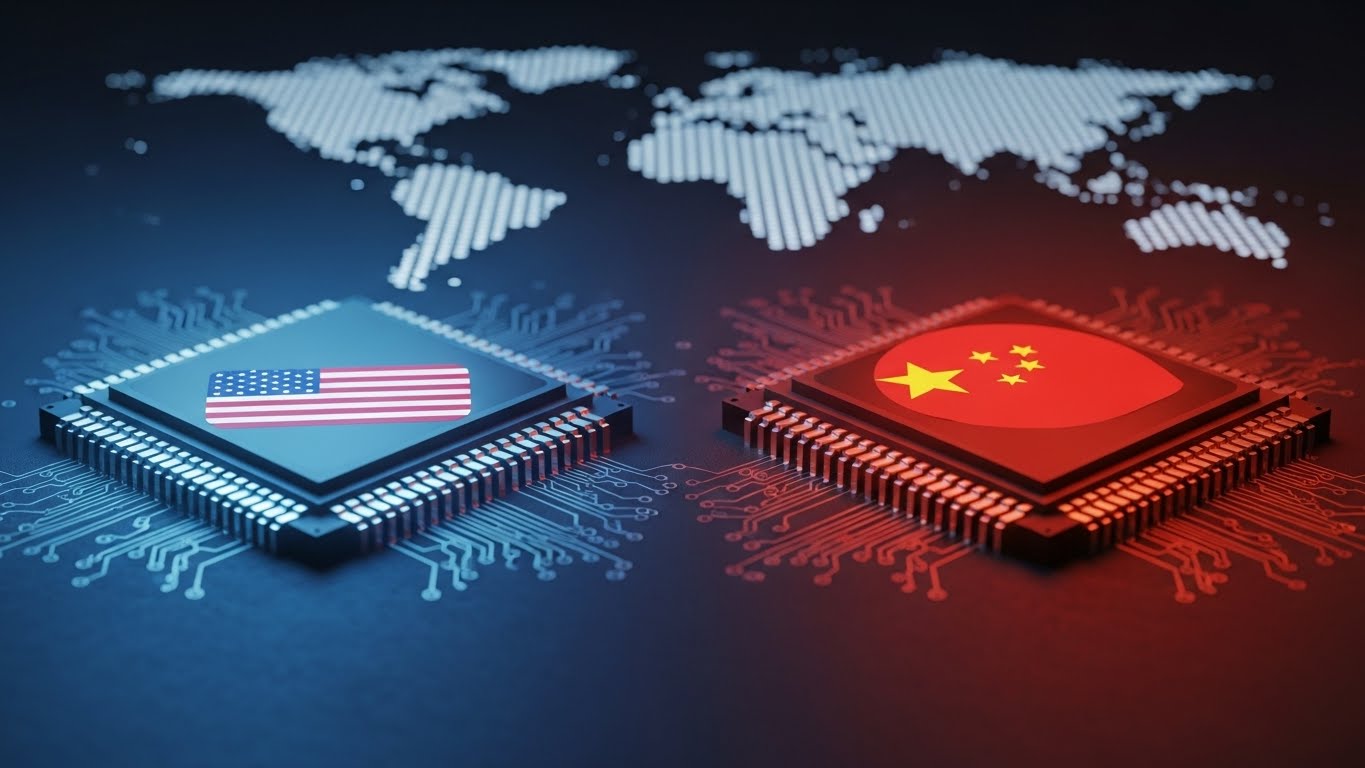
U.S. AI competition with China is becoming a growing concern among industry leaders, as a prominent American technology executive warned that the United States is effectively surrendering the world’s second-largest technology and AI market. In a candid conversation, the speaker emphasized that the absence of American firms in China has not hindered China’s AI ambitions — in fact, it has accelerated them.
Key Points
The remarks reflect a broader unease within the U.S. technology community, where leaders increasingly acknowledge that China’s rapid progress in semiconductors and artificial intelligence poses a strategic challenge. For years, policymakers and industry executives believed restricting exports would slow China’s advancement. But the latest assessment suggests the result has been the opposite.
A Market the U.S. “Cannot Replace”
The executive underscored a difficult reality: no other country can replace China’s scale or market potential. “We have conceded essentially the second largest AI market in the world,” he said, adding that U.S. firms cannot simply redirect those opportunities elsewhere.
He compared China’s significance to the global desire to sell goods to the United States — a marketplace so large and influential that losing access cannot be offset by gains elsewhere. “We are singular in the world,” he said. “You’re not going to replace China.”
This sharp assessment highlights the stakes. By stepping back from China, the U.S. is surrendering not just customers but also influence over global technology norms, supply chains, and platform ecosystems.
Respect for Huawei’s Capabilities
Despite ongoing geopolitical tensions, the executive spoke with notable respect for China’s leading technology companies — especially Huawei. He described Huawei as “one of the most formidable technology companies the world has ever seen,” citing their speed, agility, and technical sophistication.
“We compete with this company. They are formidable,” he said. His acknowledgment goes against years of political rhetoric that sought to minimize Huawei’s capabilities in the international market.
Instead, he argued for a realistic appraisal of the competitive landscape. While Huawei benefits from domestic support, the speaker stressed that the company has earned its position through aggressive innovation and rapid execution cycles.
Predictions About China’s AI Setback Proved Wrong
For years, some U.S. analysts claimed that blocking American technology exports would stall China’s AI industry. But the executive made clear that such predictions have not materialized.
“It absolutely has not happened,” he said. “As a result, their semiconductor industry has doubled, doubled, doubled.”
This exponential growth contrasts sharply with the West, where the semiconductor sector grows at 20% to 30% annually. Although those rates are strong, they are nowhere near the pace required to keep up with an industry effectively doubling every year.
The compounding effect, he noted, means that China’s semiconductor expansion will outpace Western efforts much faster than many anticipated. It’s a warning that the U.S. no longer has the luxury of assuming technological dominance.
Semiconductors at the Center of U.S.–China Competition
The rapid rise of China’s chipmaking industry is central to the larger story of U.S. AI competition with China. Semiconductors power everything from advanced AI models to smartphones, sensors, and robotics. The country that leads in semiconductor production shapes the foundation for global technology leadership.
While the U.S. and its allies remain ahead in frontier chip design and high-end fabrication, China is catching up in manufacturing scale, supply chain depth, and domestic innovation — areas once considered out of reach.
The executive emphasized that doubling annual output in semiconductors is not a trivial achievement. Compounding growth at that rate compresses timeframes dramatically, shortening the window for the U.S. to maintain its edge.
A Call to Re-Enter — Not Retreat From — China
Throughout his remarks, the speaker argued that the U.S. should not abandon engagement with China’s technology market. “We shouldn’t concede the entire market to them,” he said. Instead, he urged American companies and policymakers to rethink strategies that isolate rather than engage.
His argument isn’t about overlooking geopolitical risks but acknowledging that global leadership requires presence in global markets — especially those as large and strategically consequential as China.
To compete effectively, he suggested, the U.S. must:
- Reassess export restrictions that unintentionally accelerate Chinese self-sufficiency
- Strengthen domestic innovation without assuming Chinese stagnation
- Foster partnerships and market access strategies that maintain U.S. technological influence
- Approach competition with respect rather than underestimation
Conclusion
The stark warning signals a pivotal moment in the U.S. AI competition with China. The United States has long relied on its innovation leadership and global market dominance. But China’s rapid semiconductor growth, unmatched domestic scale, and rise of formidable firms like Huawei are reshaping the global technology landscape.
As the executive made clear, stepping away from China is not slowing its progress — it is accelerating it. The bigger question now is whether the U.S. will adapt its strategy in time or continue conceding ground in what may be the most consequential technological competition of the century.