

Key Points
Stocks rise after Trump Greenland remarks, marking a sharp reversal from one of the most turbulent market sessions since October and underscoring how sensitive global investors remain to geopolitical signals from Washington.
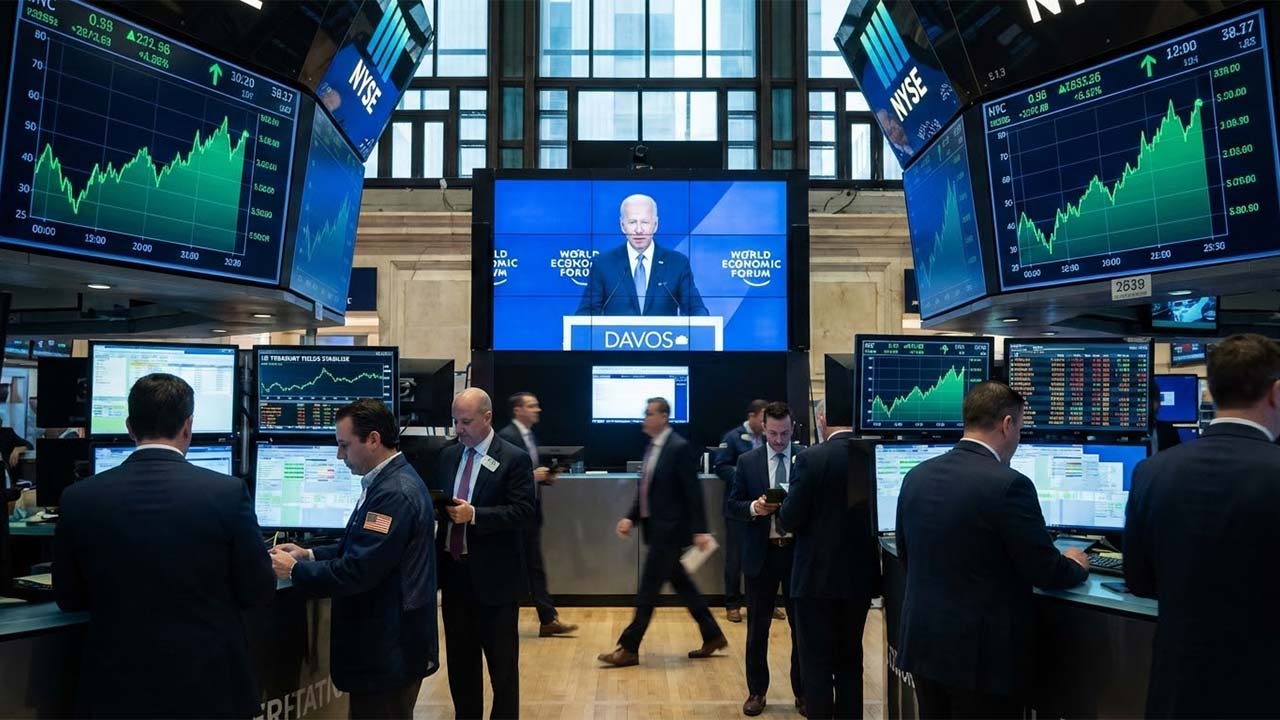
U.S. equity futures climbed, Treasury prices stabilized, and risk appetite cautiously returned after President Donald Trump said the United States does not intend to use excessive force in pursuing discussions over Greenland. The comments, delivered during a high-profile address to business and political leaders at the World Economic Forum in Davos, helped soothe fears that had sparked a broad-based selloff across stocks, bonds, and currencies just a day earlier.
The rebound highlights a deeper reality for markets in 2026: investor confidence is increasingly shaped not just by economic data, but by political tone, diplomatic signals, and perceived stability in U.S. global leadership.
What Happened in Markets
Following their biggest drop in months, U.S. stocks were poised for recovery. S&P 500 futures rose roughly 0.5%, while Nasdaq 100 and Dow Jones futures also posted gains. The move came after a volatile session that some traders described as a revival of the so-called “Sell America” trade, in which investors rapidly reduce exposure to U.S. assets amid political uncertainty.
Treasury bonds, which had been under pressure alongside Japanese government bonds, rebounded modestly. The 10-year Treasury yield slipped back toward 4.27%, signaling renewed demand for U.S. government debt after concerns briefly pushed yields higher. The dollar fluctuated, reflecting lingering uncertainty even as risk sentiment improved.
This partial recovery was not driven by new economic data or earnings surprises. Instead, it was the result of political clarification — a reminder that markets are currently trading on confidence as much as fundamentals.
Why Trump’s Greenland Remarks Mattered
Trump told delegates in Davos that the U.S. is seeking immediate talks regarding Greenland, framing the potential acquisition of the Danish territory as essential to collective security. Crucially for markets, he downplayed the risk of military escalation and emphasized diplomacy over force.
That distinction mattered. Investors had reacted sharply the previous day amid fears that aggressive rhetoric could further strain NATO relations, disrupt transatlantic cooperation, and add a new layer of geopolitical risk at a time when global growth remains uneven.
By softening his language, Trump signaled a willingness to de-escalate tensions — at least rhetorically. Markets interpreted the remarks as an attempt to stabilize sentiment rather than provoke confrontation, prompting a relief rally across risk assets.
Context: Why Markets Were Already on Edge
The selloff that preceded the rebound did not occur in isolation. It came after a period of heightened sensitivity across asset classes, driven by several overlapping concerns:
- Persistent volatility in global bond markets, particularly in Japan and the U.S.
- Lingering uncertainty over U.S. trade and tariff policy following past disruptions
- Rising geopolitical friction between the U.S. and key European allies
- Investor fatigue with sudden policy shifts and unpredictable messaging
Against this backdrop, Trump’s Greenland comments acted as a catalyst — not because they introduced new policy, but because they clarified intent at a moment when clarity was in short supply.
Business Impact: Confidence, Not Fundamentals, Driving Sentiment
For businesses, the market rebound underscores how quickly sentiment can shift based on geopolitical communication alone.
Corporate leaders watching markets are being reminded that investor confidence is now closely tied to diplomatic tone. Even companies with strong balance sheets and solid earnings can see share prices swing sharply when political risk enters the equation.
Multinational firms, particularly those with exposure to Europe or government contracts tied to defense and infrastructure, are likely to remain cautious. Any perception of escalating transatlantic tension could raise financing costs, delay investment decisions, or pressure valuations.
At the same time, the rebound suggests that markets are willing to forgive uncertainty — provided there are signals that policymakers are listening.
Market Impact: Relief Rally, Not a Full Reset
While stocks rise after Trump Greenland remarks, the recovery should not be mistaken for a full return to calm.
Bond market experts continue to warn that underlying risks remain. Volatility in sovereign debt markets has not disappeared, and investors are still sensitive to policy surprises. The modest drop in Treasury yields reflects short-term relief rather than a decisive shift in outlook.
Global equity benchmarks outside the U.S. were more subdued. European stocks were little changed, while the MSCI World Index held steady — a sign that international investors remain cautious despite the U.S. rebound.
In currency markets, the dollar’s mixed performance suggests that confidence has improved, but conviction remains limited.
Official Responses and Market Reassurance
U.S. Treasury Secretary Scott Bessent sought to counter speculation that European investors might dump U.S. assets, dismissing a report attributed to a single analyst at Deutsche Bank. According to Bessent, the bank’s CEO personally clarified that the institution does not stand behind the claim.
That intervention mattered. At moments of stress, markets look for reassurance not only from presidents, but from financial authorities who can signal continuity and stability in capital flows.
Meanwhile, comments from asset managers suggested that the earlier selloff served as a warning shot. Investors, they argued, were sending a message that clarity and restraint are essential to maintaining orderly markets — a lesson reinforced by the swift rebound once tone improved.
Corporate Highlights Add Mixed Signals
The market rebound occurred alongside a wave of corporate earnings and strategic updates, offering a mixed but informative snapshot of the broader economy:
- Netflix issued a weaker earnings outlook as spending on content increases.
- United Airlines reported strong demand from high-spending travelers, boosting confidence in discretionary spending.
- Johnson & Johnson raised its 2026 guidance, signaling resilience in healthcare demand.
- Berkshire Hathaway may reduce its stake in Kraft Heinz, highlighting ongoing portfolio shifts among large institutional investors.
These developments reinforce that while political headlines can move markets quickly, corporate fundamentals continue to shape medium-term performance.
What This Means for Investors
For investors, the key takeaway is not simply that stocks recovered, but why they did.
Markets are operating in an environment where policy messaging, geopolitical risk, and credibility matter as much as earnings growth or inflation data. Rapid selloffs — and equally rapid rebounds — reflect a fragile equilibrium rather than strong conviction.
Diversification, risk management, and attention to political signals remain essential. Investors should expect continued volatility, particularly around high-profile speeches, international negotiations, and trade-related developments.
Conclusion: A Reminder of Market Fragility
Stocks rise after Trump Greenland remarks not because economic conditions suddenly improved, but because uncertainty briefly eased.
The episode serves as a reminder that global markets in 2026 are highly reactive, tightly interconnected, and increasingly shaped by political communication. While the rebound restored short-term confidence, it did not eliminate the underlying sensitivities that triggered the selloff in the first place.
For businesses, investors, and consumers alike, the message is clear: stability now depends as much on measured leadership and clear signaling as on traditional economic strength.