

Key Points
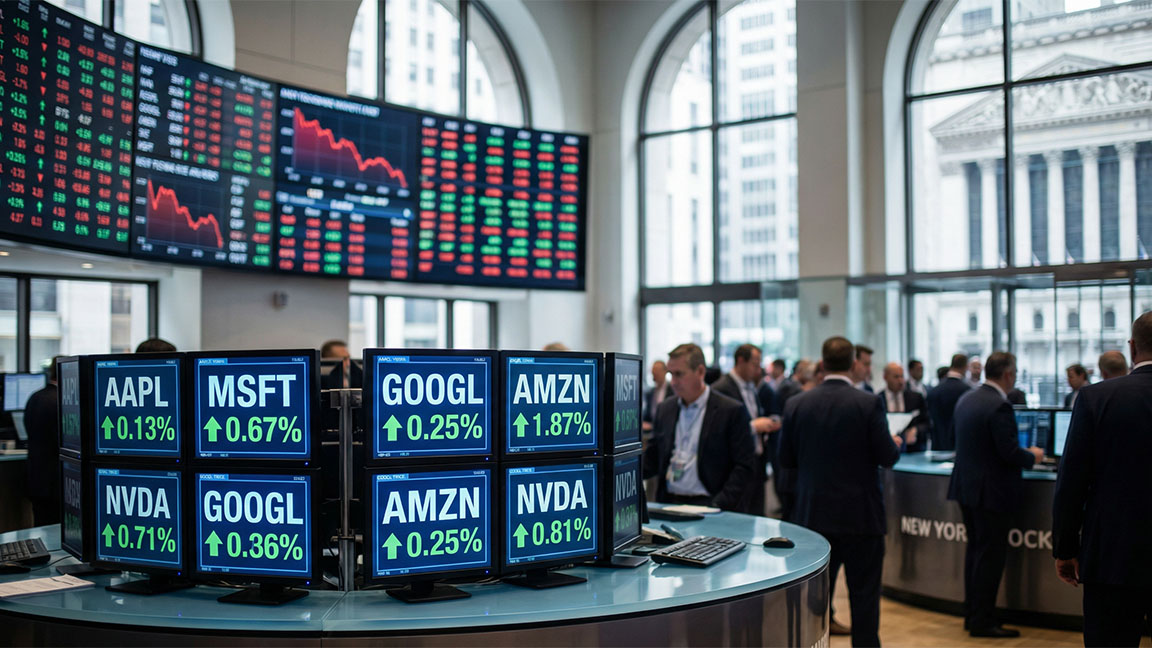
S&P 500 concentration risk is becoming one of the most talked-about concerns on Wall Street as investors look beyond the powerful rally driven by a handful of mega-cap stocks and prepare for 2026. With just seven to ten companies accounting for an outsized share of index gains and earnings growth, market professionals are increasingly questioning how sustainable this structure really is—and what it means for portfolios going forward.
The debate is not about whether the largest stocks are strong. Their earnings remain solid, balance sheets are healthy, and their leadership in artificial intelligence continues to fuel optimism. The issue, instead, is whether the market has become too dependent on too few names, leaving the rest of the S&P 500 struggling to keep up.
Why S&P 500 Concentration Risk Matters Right Now
The dominance of the so-called “Magnificent Seven” has made it exceptionally difficult for active and multi-asset investors to match the performance of the S&P 500. Many portfolio managers acknowledge that unless they own enough of these top stocks, keeping pace with the index has been a challenge—outperforming it has been even harder.
This S&P 500 concentration risk is not just about stock prices. Earnings growth for the coming year is also heavily skewed toward the largest companies. Recent analysis from major Wall Street firms highlights that a significant share of projected earnings expansion is expected to come from the biggest names in the index, reinforcing investor dependence on a narrow group of leaders.
At the same time, betting against these companies has proven costly. Their business models are tied to long-term secular trends, particularly AI-driven productivity gains, making many investors reluctant to reduce exposure in a meaningful way.
Looking Ahead: 2026 May Shift the Market Narrative
While 2025 was largely defined by valuation expansion among the top stocks, strategists increasingly believe that 2026 could tell a different story. Instead of relying on multiple expansion, attention may shift toward earnings growth across the broader market.
The remaining 490-plus companies in the S&P 500—often overlooked during the AI-led surge—are expected by some analysts to see an acceleration in earnings growth. If that happens, S&P 500 concentration risk could begin to ease naturally as market breadth improves.
This potential broadening did not fully materialize this year, despite repeated expectations. However, investors are watching closely to see whether improving fundamentals, easing financial conditions, or sector rotation could finally bring more balance to the index.
Are Recent Sell-Offs a Warning Sign?
Recent pullbacks in high-profile technology-related stocks, including names tied closely to AI infrastructure and cloud computing, have sparked fresh questions. Some investors wonder whether these moves are early signals to lighten exposure to the biggest winners.
Market professionals caution against interpreting these declines as a clear sell signal. Instead, they see them as part of a seasonal rebalancing process. After strong gains, some investors are locking in profits and waiting for better entry points, rather than abandoning the long-term AI narrative altogether.
Valuations, however, remain a sensitive topic. Many agree that prices moved to levels that require a recalibration of expectations. While not necessarily irrational, current valuations leave little room for disappointment, especially when company guidance fails to meet the market’s high bar.
AI Optimism Continues to Anchor Investor Confidence
A major reason S&P 500 concentration risk has persisted is the deep conviction around artificial intelligence. Wall Street remains bullish on the idea that AI-driven efficiency gains will support revenue growth and margins over time, particularly for the largest technology platforms.
These companies are not just investing heavily in AI—they are already generating meaningful earnings from it. That distinction matters to investors, who see real cash flows rather than speculative promises. As a result, even critics of market concentration admit it is hard to argue against businesses that continue to deliver accelerating earnings.
Still, guidance has become increasingly important. In recent quarters, some stocks have underperformed not because results were weak, but because future outlooks did not justify elevated expectations. This dynamic has introduced more differentiation within the top tier of the market.
Shifts Within the Market Leaders
Interestingly, leadership within the mega-cap group itself has started to change. Over the past few months, certain companies have outperformed their peers as investors reassess which AI strategies are most likely to deliver sustainable returns.
This internal rotation suggests that even within a concentrated market, investors are becoming more selective. Companies perceived as executing more efficiently or offering clearer monetization paths for AI investments have gained favor, while others have faced tougher scrutiny.
Such shifts could play a role in moderating S&P 500 concentration risk over time, especially if leadership becomes less uniform and more performance-driven.
What It Means for Multi-Asset and Long-Term Investors
For diversified investors, the current environment remains challenging. With so much of the index’s performance tied to a small group of stocks, traditional diversification benefits have been harder to achieve.
Many portfolio managers are responding by maintaining exposure to market leaders while gradually increasing allocations to undervalued or overlooked areas of the market. The idea is not to fight the trend, but to position for a potential broadening that could reward patience.
If earnings growth does spread more evenly across the index in 2026, investors who prepared early may find themselves better positioned. Until then, S&P 500 concentration risk is likely to remain a defining feature of the market landscape.
Conclusion
As investors look toward 2026, S&P 500 concentration risk stands at the center of strategic discussions. The dominance of a few mega-cap stocks has delivered strong returns but also raised questions about balance, resilience, and future opportunity.
While the AI-driven growth story remains intact and difficult to bet against, expectations are rising that the next phase of the market could depend more on earnings growth across the broader index. Whether that shift materializes will play a key role in shaping investor outcomes in the years ahead.
For now, Wall Street appears cautiously optimistic—aware of the risks, respectful of the trends, and closely watching for signs that the rest of the market is finally ready to join the rally.