

Key Points
Russian oil at sea is building into a growing bottleneck, even as Moscow’s seaborne crude exports climb to their strongest pace in more than two and a half years. In a twist that underscores how difficult deliveries have become, more cargo is leaving Russia—yet more of it is struggling to reach shore.
In the four weeks to Dec. 21, Russia shipped an average 3.87 million barrels a day of crude, the most since May 2023, according to vessel-tracking data compiled by Bloomberg. But delays in offloading have pushed a larger share of those barrels onto tankers that are now effectively acting as floating storage.
Russian oil at sea jumps as exports hit a post-2023 high
The headline numbers point to momentum on exports. The four-week average rose by about 200,000 barrels a day compared with the period to Dec. 14, aided by a rebound in weekly shipments from the Baltic port of Primorsk.
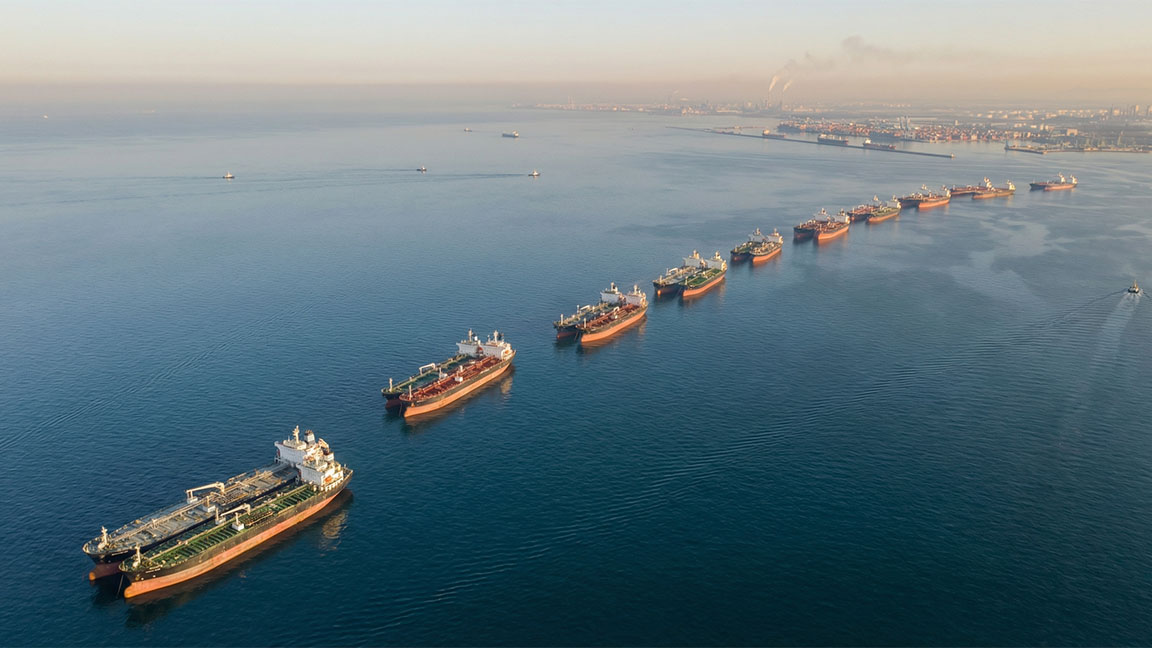
At the same time, Russian oil at sea has swelled sharply. More than 185 million barrels of Russian crude is sitting in tankers, up by 48% since the end of August, based on vessel-tracking data compiled by Bloomberg.
That build-up reflects the growing friction between shipping volumes and the practical ability to discharge cargoes—especially in Asia, where a cluster of tankers has been waiting for port access.
Tanker queues expand off India and China
The most visible sign of the strain is the growing number of vessels stuck in limbo near key buyers.
At least 20 tankers hauling Moscow’s crude are awaiting permission to dock at Chinese and Indian ports, while other ships have taken months to deliver their cargoes. The result is that Russian oil at sea continues to rise even in weeks when exports pick up.
Four-week average shipments have been on an upward trend through December, recovering losses from the prior month, with some volatility that may be linked to weather-related disruptions. But the delivery bottleneck has remained, turning the export story into two tracks: strong loadings, slower discharges.
Why Russian oil at sea is growing despite higher loadings
Several factors in the latest data help explain why the pile-up is happening now.
Sanctions pressure and “unknown” destinations
Russia’s exports dipped in November after the US blacklisted Russia’s two biggest exporters, Rosneft PJSC and Lukoil PJSC. In December, volumes recovered—but tougher constraints appear to be shaping how cargoes move and how clearly they declare their final destination.
A large and growing portion of shipments is now traveling without a firm endpoint in public signals. Observed shipments to Russia’s Asian customers—including those showing no final destination—jumped to a record 3.7 million barrels a day in the 28 days to Dec. 21.
Flows on tankers signaling Chinese ports averaged 950,000 barrels a day over that four-week period, down from 1.01 million in the period to Dec. 14. The amount destined for India fell to 840,000 barrels a day from 900,000. Offsetting that decline: about 1.9 million barrels a day sat on vessels yet to show a final destination.
There is now more crude on tankers yet to show a final destination than the combined amount on ships signaling that they are heading to China, India or Turkey—another driver of Russian oil at sea.
The build-up also coincides with the US stepping up actions against tankers headed to or from Venezuela, which President Donald Trump accuses of hauling sanctioned crude. Those actions may be raising concerns among shippers and buyers of Russian barrels, who worry their cargoes could also be targeted.
Longer voyages, diversions, and offshore waiting
Vessels are spending longer at sea, with several tankers diverting from initial destinations on India’s west coast or in Turkey. Others are being held up waiting to discharge at Chinese ports.
Those delays don’t just slow delivery—they trap supply in transit, lifting Russian oil at sea and amplifying the appearance of “floating inventories.”
Ship-to-ship transfers and tracking gaps
Another feature in the latest shipping picture is the rise of ship-to-ship activity and the fading visibility of some voyages.
Numerous ships have disappeared from tracking systems in the Riau archipelago, northeast of Singapore, a location used for transferring sanctioned Iranian barrels between vessels and increasingly used among carriers of Moscow’s crude seeking to disguise cargo origins. Tracks suggest at least six Russian cargo switches have taken place there since November, with another six fully-laden tankers disappearing in the area so far this month.
Other switches have been observed close to the Suez Canal and near the Russian port of Kozmino in the Pacific.
Bloomberg classifies ship-to-ship transfers as clandestine if automated position signals appear to be switched off or falsified—a tactic known as spoofing—to hide the two vessels involved coming together to make the cargo switch. In practical terms, the more opaque these voyages become, the harder it is for the market to map where barrels are going—and the more Russian oil at sea appears to sit in a gray zone.
Refinery disruptions may be freeing up more crude for export
Supply dynamics inside Russia also appear to be shifting.
A sharp reduction in processing likely freed up more crude for export. Refinery runs remain below the seasonal average amid Ukrainian drone attacks, with one strike damaging the Yaroslavl plant north of Moscow. The plant’s daily processing capacity of about 300,000 barrels makes it one of Russia’s top-10 fuel-producing facilities.
Less domestic processing can mean more crude available for seaborne shipment. But as exports rise, delivery constraints can still leave more Russian oil at sea rather than in refinery tanks or end-user storage.
Weekly shipments jump, led by Primorsk
Looking at the most recent week in the dataset, loadings accelerated notably.
A total of 38 tankers loaded 28.31 million barrels of Russian crude in the week to Dec. 21, up sharply from a revised 22.73 million barrels on 29 ships the previous week, according to vessel-tracking data and port-agent reports.
On a daily average basis, shipments in the week to Dec. 21 rose to 4.04 million barrels a day, up by about 800,000 barrels a day and reversing most of the slump seen the previous week.
The jump in flows was driven by a sharp climb in shipments from the Baltic port of Primorsk—one of the key levers behind the broader increase in exports that, paradoxically, has coincided with more Russian oil at sea.
Separately, three cargoes of Kazakhstan’s KEBCO grade were shipped from Novorossiysk during the week. One of two working moorings at the nearby CPC terminal was damaged in a sea-drone attack, which may have resulted in some Kazakh barrels being diverted to Novorossiysk until the loading buoy is replaced. (All figures cited for Russian seaborne crude exports exclude cargoes identified as Kazakhstan’s KEBCO grade.)
Prices fall again, pushing shipment values near a three-year low
Volumes are rising, but pricing is moving in the opposite direction.
A 12th straight drop in crude prices has added to Moscow’s difficulties, with declines in Russian grades steeper than those seen in global benchmarks. The need to offer big discounts has driven Urals down by about $25 a barrel, or 40%, from its mid-July peak, with prices falling as low as $34 a barrel by the end of the week. Pacific-loading ESPO has performed somewhat better, losing about 30% of its value over the same period.
On a four-week average basis, the gross value of Moscow’s exports edged up to $1.13 billion a week in the 28 days to Dec. 21, rising 2% from the revised figure for the period to Dec. 14. Higher quantities were largely offset by the 12th straight drop in average prices, keeping the value close to the lowest since January 2023.
Using Bloomberg’s measure (multiplying weekly average Argus prices by export volume), export prices of Russia’s Urals from the Baltic fell about $1.30 a barrel to $38.73. Black Sea cargoes were down about $0.90 a barrel to $36.55. The price of Pacific ESPO dropped about $1.60 to average $49.33 a barrel. Delivered prices in India also fell, down by $1 to $56.03—another new low for the period since March 2023. All prices are according to numbers from Argus Media.
Even with higher export volumes, weaker pricing can pressure revenue, which helps explain why Russian oil at sea matters: delays and uncertainty can reinforce discounting, while also complicating logistics for both sellers and buyers.
Destination picture shifts toward “unknown,” while Turkey slips
Asia remains the core market in the observed data, but the way shipments are labeled is changing.
In the four weeks to Dec. 21, flows to Turkey slipped to about 140,000 barrels a day from 230,000 barrels a day in the period to Dec. 14. No Russian crude has been shipped to Syria since September, and tankers hauling crude there rarely signal their destination and often disappear from automated tracking systems when south of Crete, making advance estimates difficult.
For Asia, the biggest story is the surge in barrels without a declared endpoint. Of the roughly 1.9 million barrels a day on vessels yet to show a final destination, about 1.68 million barrels a day is tied to ships from Russia’s western ports showing destinations such as Port Said or the Suez Canal, or to Pacific ships with no clear delivery point. Another 230,000 barrels a day sits on tankers yet to signal a destination.
In the past, those cargoes have almost all ended up in India or China, but tougher US sanctions are keeping that oil on the water while Russia and its buyers seek workarounds—another reason Russian oil at sea continues to climb.
Reactions and latest signals from the market
The current pattern is sending mixed signals.
On one hand, export loadings have rebounded strongly in December, culminating in the 3.87 million barrels-a-day four-week average through Dec. 21 and a sharp week-over-week jump in daily shipments.
On the other hand, the delivery side is showing visible stress: at least 20 tankers waiting near India and China, longer voyages, diversions, and an expanding pool of cargoes with “unknown” destinations. Combined with the 12th straight drop in crude prices and deeper discounts for Russian grades, the overall picture is of growing complexity.
The build-up in Russian oil at sea also lands at a moment when enforcement actions elsewhere—specifically US steps targeting tankers tied to Venezuelan flows—may be adding to caution among shippers and buyers involved in Russia-linked trade.
Conclusion
Russian oil at sea has become one of the clearest indicators of how sanctions pressure, logistics friction, and shifting shipping practices are reshaping energy trade routes. Russia is shipping more crude—3.87 million barrels a day on a four-week average through Dec. 21, the highest since May 2023—but getting that oil off the water is proving harder.
With more than 185 million barrels on tankers, up 48% since late August, and at least 20 vessels waiting to dock off India and China, the near-term focus will stay on whether discharge delays ease—or whether Russian oil at sea continues to rise even as exports remain elevated and prices keep sliding.