

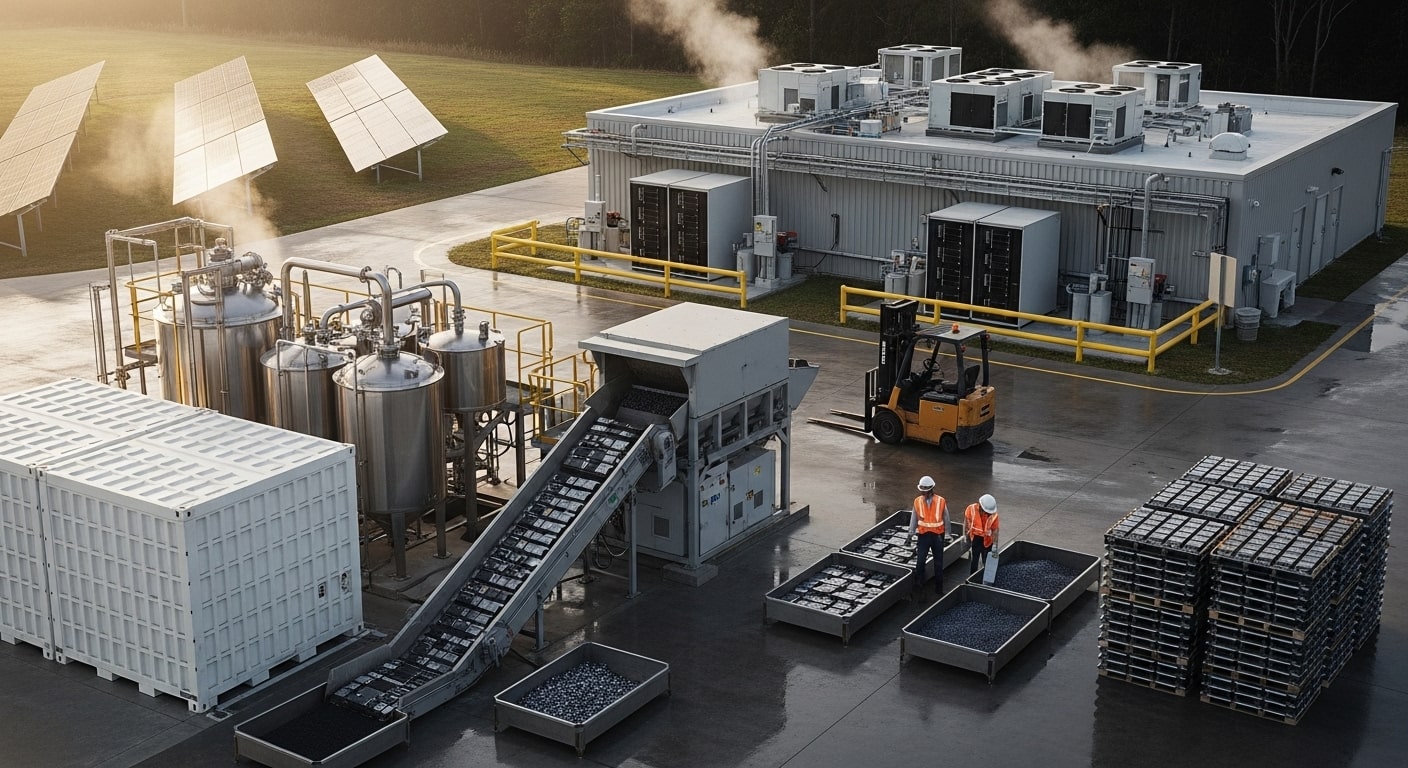
Redwood Materials’ critical minerals production is officially underway in South Carolina, as JB Straubel’s battery‑recycling startup brings a core system online at its $3.5 billion campus to recover up to 20,000 metric tons a year.
Key Points
The milestone marks a strategic pivot for one of the most closely watched U.S. clean‑tech companies. Founded to close gaping holes in the electric‑vehicle battery supply chain, Redwood Materials is repositioning for a world where EV demand cools, incentives change, and U.S. policy prioritizes onshoring strategic resources.
Straubel says the company’s output will increasingly serve customers beyond automakers. “The nickel and cobalt markets are largely not driven by batteries,” he noted, pointing to stainless steel, specialty alloys, and jet‑engine components as large end uses that can absorb supply as the EV cycle resets.
Inside the South Carolina Launch
The new facility, located in South Carolina, has started operations on a system designed to recover 20,000 metric tons of critical minerals annually. While the company did not disclose a ramp‑up timeline or a breakdown by material, the start of production adds a new domestic node to a supply chain dominated by overseas sources.
Combined with Redwood’s original recycling plant in Sparks, Nevada—where capacity stands at roughly 60,000 tons a year—the firm says it is now the only major U.S. source of cobalt and produces nickel and lithium at volumes comparable to the largest mines in the country. Those claims, if sustained through ramp‑up, would make Redwood Materials’ critical minerals a meaningful factor in domestic sourcing strategies.
The company emphasized that the South Carolina site is not yet at full capacity and declined to provide a detailed output mix. That underscores a familiar reality in new‑energy manufacturing: scaling is as much about operational learning and market alignment as it is about engineering design.
Why Redwood Materials’ critical minerals matter for U.S. onshoring
America’s energy transition hinges on reliable access to nickel, cobalt, and lithium. Policymakers have pushed to onshore or “friend‑shore” these links, citing national security and price stability. Redwood Materials’ critical minerals offer a path to reduce reliance on foreign supply while raising recycled content in future battery chemistries.
The company’s model—recovering metals from end‑of‑life packs, manufacturing scrap, and industrial feedstock—can lower lifecycle emissions and shorten logistical chains. That appeals to manufacturers navigating tighter sustainability rules and to customers concerned about geopolitical risk embedded in raw materials.
From EV‑centric to diversified demand
Initially, Redwood’s business plan centered on EVs. By 2022, the company projected enough material output for one million EVs annually by 2025 and five million by 2030, backed by agreements with Ford, Toyota, and Volvo. Market conditions shifted. A moderating EV adoption curve, the winding down of federal incentives in September, and the cancellation of grants to several recyclers created headwinds.
In response, Redwood Materials’ critical minerals are increasingly flowing to non‑EV buyers. Straubel says the firm now sells to roughly 20–30 companies, including large industrial manufacturers and mining groups that process and refine metals. That breadth gives Redwood more demand stability across cycles, mitigating the risk of being tied to a single end market.
- Nickel: A primary input for stainless steel, specialty alloys, and chemicals that support industrial processes and infrastructure.
- Cobalt: Critical in high‑performance alloys used in aerospace and energy applications, beyond its role in certain battery chemistries.
This diversified customer base expands optionality, helping Redwood ride out EV slowdowns while maintaining throughput that is vital for recycling economics.
Execution challenges: cathodes and copper foil
Not every milestone has arrived on time. Redwood’s commercial cathode production facility in Nevada—once slated to open in 2024 with 100 GWh of components by 2025—remains under construction with no new start date. The company also halted copper foil production in Nevada and no longer plans to make copper foil in South Carolina, signaling a sharper focus on core metal recovery and market‑ready outputs.
Investors will watch how Redwood balances capital discipline with long‑term integration goals. A tighter product slate, paired with the growing output of Redwood Materials’ critical minerals, suggests the company is prioritizing near‑term cash flow, supply assurance, and customer diversification over building every component in‑house.
Policy crosswinds: headwinds and tailwinds
Redwood’s strategic reset is unfolding against a policy backdrop that cuts both ways.
- Onshoring push: The administration has emphasized domestic control of critical materials deemed essential to national security. That favors projects like Redwood’s in South Carolina and Nevada.
- Grant uncertainty: The recent cancellation of hundreds of millions of dollars in grants to other battery recyclers underlined federal funding volatility.
- EV incentives: The winding down of federal EV subsidies in September cooled parts of the consumer market, reinforcing the logic of serving broader industrial demand.
In this environment, a recycling‑led, multisector approach gives Redwood Materials critical minerals a political and commercial hedge: the business aligns with onshoring goals while being less exposed to a single regulatory lever.
Energy storage pivot: data centers come into view
One of Redwood’s most notable moves is the creation of “Redwood Energy,” a unit that repurposes degraded EV batteries into grid‑scale storage. Retired packs often still retain significant capacity and, when aggregated, can provide dependable power for less demanding duty cycles.
In June, Redwood unveiled a 63 megawatt‑hour storage system paired with 12 megawatts of solar at its Nevada campus, enough to help support a 2,000‑GPU data center. The link to artificial intelligence is clear: as AI workloads balloon, so do the power demands and peak‑load management needs of data center operators. Grid‑scale storage can smooth consumption and lower costs.
This strategy reframes the company’s mission. Redwood Materials’ critical minerals remain the backbone, but second‑life batteries and storage projects create another monetization path for recovered materials and a service model that extends beyond commodity sales.
Financing the transition
To support the pivot, Redwood raised a $350 million Series E last month at a valuation above $6 billion. The infusion is earmarked to accelerate energy storage deployments and scale recycling operations at both sites. For investors, the raise signals confidence in a business model that blends materials supply, infrastructure support, and circularity.
As Redwood scales, the key will be turning Redwood Materials’ critical minerals into contracted, predictable revenue streams—whether via long‑term offtakes, indexed pricing, or integrated storage projects that use the company’s recovered metals.
Market impact: competition, pricing, and partnerships
Redwood’s ramp could influence pricing and procurement strategies across several industries.
- Automakers: More recycled supply can help meet content requirements, lower emissions, and diversify away from volatile international sources.
- Aerospace and industrials: Access to domestically recovered nickel and cobalt could de‑risk production and shorten lead times for high‑performance alloys.
- Mining and refiners: Redwood’s role as a supplier to processors underscores a hybrid ecosystem where recycling complements primary mining rather than replaces it.
Expect partnerships to deepen as buyers seek traceability, sustainability metrics, and secure allocations of Redwood Materials’ critical minerals through multi‑year agreements.
Governance and transparency
Investors will want clarity on three fronts:
- Ramp timing: The company has not provided a detailed timeline for full‑capacity operations in South Carolina. Progress markers—run‑rate tonnage, yield improvements, and customer deliveries—will be critical.
- Product mix: Without a public breakdown of nickel, cobalt, and lithium output, modeling margins is difficult. Future disclosures could unlock better valuation visibility.
- Capital allocation: With cathode timelines extended and copper foil shelved, Redwood’s capex cadence and priorities bear watching.
Strengthening disclosures as Redwood Materials’ critical minerals output scales would help align expectations and reduce uncertainty.
Regional and workforce implications
South Carolina’s manufacturing corridor is drawing heavy investment across autos and clean energy. Redwood’s facility adds skilled jobs in materials processing, engineering, and energy systems—roles that tend to anchor regional ecosystems. In Nevada, Redwood’s growth complements a battery and data‑center cluster that leverages abundant solar and growing grid resources.
Training programs tied to recycling and storage can deepen labor pools and support a broader industrial renaissance connected to onshoring and decarbonization.
What to watch next
- Output milestones: Quarterly updates on tonnage, recovery rates, and delivered volumes of Redwood Materials’ critical minerals.
- Customer reveals: Named contracts in aerospace, stainless, chemicals, or data‑center infrastructure would validate the diversified demand thesis.
- Storage deployments: Additional grid‑scale projects, especially those co‑located with data centers or industrial sites, would mark progress for Redwood Energy.
- Policy developments: Any new tax credits, grant frameworks, or procurement mandates for recycled content could shift demand curves.
- Cathode timeline: A revised schedule for Nevada’s cathode facility would indicate if integration remains a medium‑term priority.
The bottom line
Redwood’s South Carolina launch is more than a plant opening—it’s a pivot to resilience. By broadening its customer base, prioritizing metals recovery, and seeding an energy‑storage platform, Redwood Materials’ critical minerals move from an EV‑dependent niche to a cross‑sector backbone of U.S. industrial strategy. Execution will matter. So will transparency. But with capital in hand and systems online, Redwood has given itself multiple ways to win as the energy transition enters its next phase.
FAQ’s
Who founded Redwood Materials, and what does it do?
Redwood Materials was founded by Tesla co-founder JB Straubel. It recycles used batteries and industrial scrap to recover critical minerals like nickel, cobalt, and lithium, and supplies them back into U.S. supply chains.
Where is the new Redwood Materials plant, and what’s its capacity?
The new site is in South Carolina and has begun operations on systems capable of recovering up to 20,000 metric tons of critical minerals annually. It’s not yet at full capacity, and the company hasn’t provided a ramp timeline.
Why is Redwood Materials shifting beyond EVs, and who buys its minerals?
With EV demand cooling and policy shifts, Redwood is selling more output to non-EV sectors such as stainless steel, aerospace, and chemicals. Straubel says the firm supplies roughly 20–30 customers, including large industrials and refiners.
What is Redwood Energy, and why does it matter?
Redwood Energy repurposes retired EV batteries into grid-scale storage. A 63 MWh system paired with 12 MW of solar is already helping power a 2,000‑GPU data center, positioning Redwood to serve surging data-center and grid reliability needs.
Article Source: Bloomberg
Image Source: