

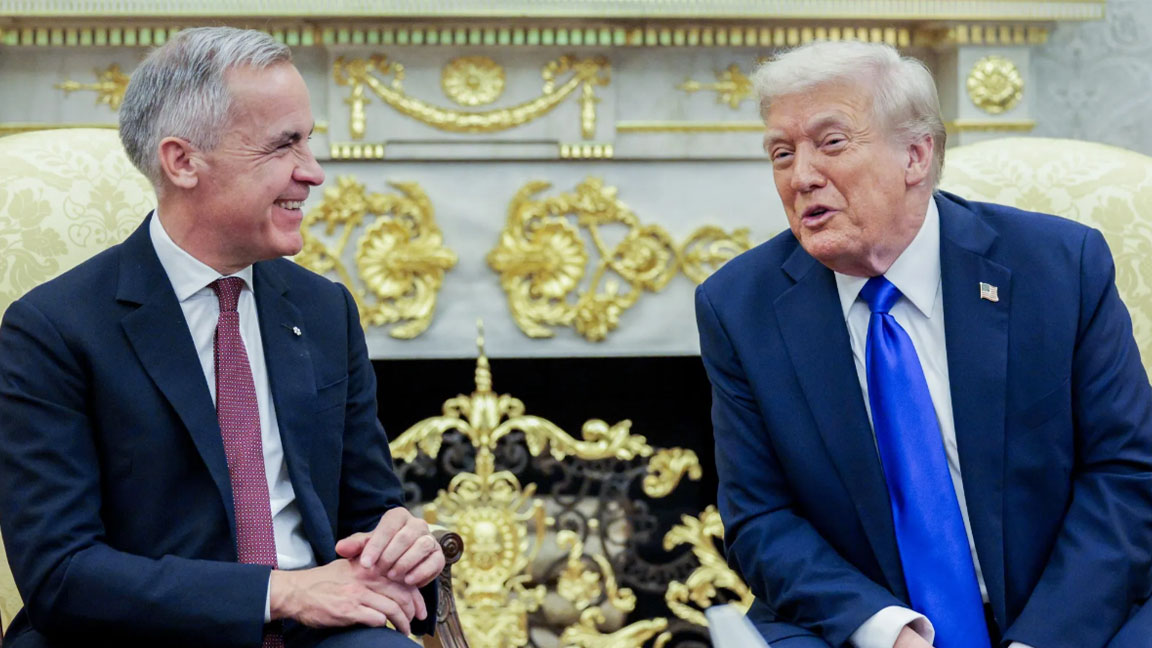
Mark Carney chose the G-20 summit in Johannesburg to deliver one of his clearest messages yet: the global economy no longer needs to wait for Washington to act.
Key Points
The Canadian Prime Minister said the world can continue making progress on major issues even without U.S. participation, after President Donald Trump’s administration boycotted the meeting and attempted to limit its formal outcome. Speaking at a press conference on Sunday in Johannesburg, Mark Carney argued that the consensus forged at the summit still carries real weight.
His comments underscored how Canada is trying to reposition itself, and how a large group of countries is willing to move ahead together — even as the United States sits on the sidelines.
Mark Carney’s G-20 message from Johannesburg
At the end of the leaders’ meeting in Johannesburg this weekend, Mark Carney described the summit as a powerful reminder of how the balance of power in the global economy is shifting.
He noted that the G-20 gathering “brought together nations representing three-quarters of the world’s population, two-thirds of global GDP and three-quarters of the world’s trade,” even without the U.S. formally at the table. For Mark Carney, that attendance alone was proof that the group’s decisions matter.
The Canadian leader pushed back against any suggestion that the absence of the U.S. rendered the summit meaningless. Instead, he framed the outcome as evidence that major economies can still coordinate and agree, despite Washington’s boycott.
South Africa, as this year’s G-20 host, chose to release a full declaration from the meeting. That move went directly against the Trump administration’s position. Washington had insisted that in the absence of U.S. participation, only a chairman’s summary should be issued.
By defying that demand, the host nation set the stage for Mark Carney and other leaders to argue that the G-20 can function and take collective positions, even when the United States refuses to endorse them.
“It’s a reminder that the center of gravity in the global economy is shifting,” Mark Carney said, pointing to the scale of the countries that did attend and sign on to the joint declaration.
U.S. boycott and rising tensions
The Trump administration’s decision to stay away from Johannesburg formed the backdrop to Mark Carney’s remarks.
President Trump ordered the boycott after again repeating a debunked claim that White Afrikaner farmers in South Africa are facing a “genocide.” Against that backdrop, U.S. officials told the G-20 that only a chairman’s summary should be released if Washington was not represented.
South Africa’s government, however, went ahead with a full declaration, signaling that it was prepared to push back against the U.S. position. That act of defiance allowed leaders like Mark Carney to claim that the body remains credible and relevant without an American signature.
The standoff added to a series of clashes between the Trump administration and other major economies. For Canada, it also fit into a broader pattern of friction that helped shape Mark Carney’s rise to power.
Mark Carney’s push to reduce Canada’s U.S. dependence
Mark Carney became prime minister earlier this year after running a campaign that directly challenged Trump’s approach to Canada.
On the trail, he pushed back against U.S. tariffs imposed on Canadian goods and against suggestions that Canada could effectively be absorbed into U.S. territory. Those moves from Washington hardened public opinion and opened space for a candidate promising a more independent economic path.
Since taking office, Mark Carney has focused on reducing his country’s heavy reliance on the U.S. market. The G-20 summit in Johannesburg offered him a high-profile platform to spell out how he intends to do that by deepening ties with a wider range of partners.
At the press conference, he described a string of recent meetings with leaders from South Africa, India, China and the United Arab Emirates as part of a broader effort to diversify Canada’s trade and investment relationships.
New deals and investors: From Abu Dhabi to the Indo-Pacific
One of the clearest examples of that diversification strategy is a record investment pledge from the United Arab Emirates.
After a Nov. 20 meeting in Abu Dhabi with UAE President Sheikh Mohamed bin Zayed, Mark Carney announced that the Gulf nation had committed to investing C$70 billion ($50 billion) in Canada. He did not provide specific project details, but said the package is the largest investment pledge Canada has ever received.
For Mark Carney, the deal is at the heart of his plan to reshape Canada’s economic future.
“We’re signing new deals and finding new investors to fuel our plans for Canada’s economic ambition,” he told reporters in Johannesburg.
He said the UAE commitment would help Canada expand trade and attract investment in several areas, including artificial intelligence and energy. Those efforts, he added, would stretch across the Indo-Pacific and Europe, suggesting a strategy that reaches well beyond North America.
The scale of the pledge allowed Mark Carney to point to concrete benefits from his outreach beyond the U.S., and to argue that Canada can secure major capital flows by working more closely with partners in the Gulf and beyond.
Deepening ties with South Africa
Johannesburg was also a venue for strengthening Canada’s relationship with the G-20 host.
On Saturday, Mark Carney met with South African President Cyril Ramaphosa. According to an official statement, he congratulated Ramaphosa on holding a successful summit and reiterated Canada’s support for South Africa’s presidency of the G-20.
The two leaders also pledged to build closer economic ties. While no specific agreements were detailed in the statement, the meeting underscored how Mark Carney is trying to turn G-20 diplomacy into longer-term partnerships.
For South Africa, that support from a G-7 country comes at a moment when it has chosen to stand up to U.S. pressure over the summit declaration. Canada offers another avenue to expand trade and investment links beyond its traditional focus on the U.S.
Managing strained relations with India
India was another key stop on Mark Carney’s diplomatic agenda in Johannesburg.
The Canadian prime minister said he was due to meet Indian leader Narendra Modi on Sunday, with both sides working to improve relations that have been tested in recent years. In 2023, Canada said that Indian agents may have been involved in assassinating a Canadian citizen of Indian origin on Canadian soil. New Delhi rejected that allegation.
Those accusations cast a long shadow over ties between the two countries. By signaling that talks with Modi were on the agenda in Johannesburg, Mark Carney pointed to a desire to repair a damaged relationship while still standing by Ottawa’s earlier claims.
Details of the planned conversation were not disclosed, but the very fact that the meeting was being arranged suggested both sides saw value in engaging at the G-20. For Mark Carney, it was another indication that Canada aims to maintain open channels with key partners across Asia, even when political tensions are high.
Keeping distance from Trump while leaving the door open
Throughout his comments in Johannesburg, Mark Carney made clear that he does not intend to let President Trump set Canada’s priorities.
He told reporters that he would “speak to him again when it matters,” but stressed that he did not currently have “a burning issue” that required a conversation with the U.S. president. The line underlined his effort to show independence from Washington without entirely closing the door.
Mark Carney added that when the U.S. is ready to re-engage on trade, Canada will be prepared to talk.
“When America wants to come back and have the discussions on the trade side, we will have those discussions,” he said.
That position reflects a careful balance. On one side, Mark Carney is signaling to voters and to international partners that Canada can chart its own course and build new alliances. On the other, he is keeping open the possibility of a reset if a future U.S. administration chooses a different path.
A shifting global center of gravity
Taken together, Mark Carney’s remarks and meetings at the G-20 painted a clear picture of how he sees the world changing.
The combination of a U.S. boycott, a full summit declaration issued over Washington’s objections, a record UAE investment pledge and new outreach to countries such as South Africa and India all fed into his central argument: the global economy is no longer defined solely by what the United States decides to do.
By stressing that the Johannesburg summit brought together countries representing the majority of the world’s population, GDP and trade, Mark Carney framed the G-20 as a platform where major decisions can be made, even if Washington stays away.
For Canada, that means betting on a broader network of partners and reducing its dependence on a single neighbor. For the rest of the world, it signals that a large group of countries is willing to press ahead on shared priorities, regardless of U.S. participation.
What happens next will depend in part on whether the U.S. chooses to re-engage and on how quickly the investment and trade commitments discussed in Johannesburg turn into concrete projects. But for now, Mark Carney has used the G-20 stage to send a clear and deliberate message: the world, and Canada, are prepared to move forward without waiting for Washington to lead.
FAQ’s
What did Mark Carney say at the G-20 summit in Johannesburg?
Mark Carney said the world can keep making progress without formal U.S. participation, arguing that the G-20 still represents most of global GDP, trade and population. He framed this as proof that global power is shifting.
Why did the U.S. boycott the G-20 summit in South Africa?
The Trump administration skipped the summit after the president repeated a debunked claim about White Afrikaner farmers facing “genocide” in South Africa. Washington also opposed issuing a full G-20 declaration without U.S. backing.
What is the significance of the UAE’s C$70 billion investment pledge to Canada?
The C$70 billion ($50 billion) pledge from the UAE is the largest investment commitment Canada has ever received. It strengthens Canada’s efforts to diversify away from U.S. dependence and channel new capital into sectors like AI and energy.
How is Mark Carney trying to reduce Canada’s reliance on the United States?
Carney is courting new partners, including South Africa, India, China and the UAE, to expand trade and investment. His strategy is to build broader global ties so Canada’s growth is not tied so closely to the U.S. market.