

Key Points
The Doug Ford Canada China trade deal has quickly become one of the most consequential—and controversial—economic policy shifts Canada has faced in years, exposing deep divisions between regional economic priorities, industrial strategy, and geopolitical alignment.
Ontario Premier Doug Ford issued a sharp rebuke of Ottawa’s newly announced agreement with China, arguing that reduced tariffs on Chinese electric vehicles could undermine Canada’s auto manufacturing base and place thousands of jobs at risk. His remarks underline growing concerns that the deal’s short-term agricultural gains may come at a long-term cost to Canada’s most industrialized province.
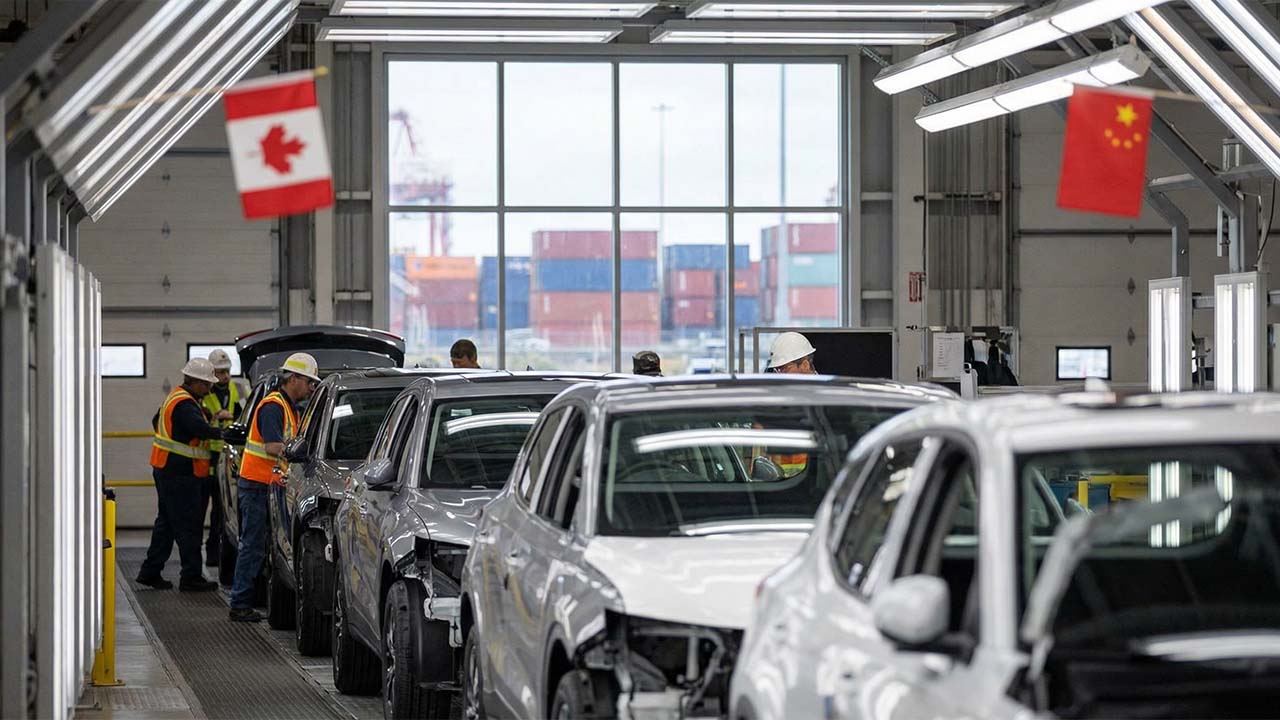
The agreement marks a thaw in relations between Canada and China after years of escalating trade tensions. Under the deal, China will slash tariffs on Canadian canola from as high as 85% to roughly 15% by March 1, while Canada will lower its tariff barrier on Chinese electric vehicles, allowing up to 49,000 EVs to enter the Canadian market at a rate of about 6%, down from the previous 100%.
While the federal government describes the move as a strategic reset, Ford views it as an unbalanced concession that risks weakening Canada’s auto sector at a sensitive moment.
What the Canada-China Trade Deal Includes
At its core, the agreement is a trade-off between agriculture and advanced manufacturing.
China’s steep tariffs on Canadian canola, imposed during a period of diplomatic strain, have weighed heavily on western provinces. Lowering those duties offers immediate relief to farmers and exporters. In exchange, Canada has agreed to ease restrictions on Chinese EV imports, opening the door to vehicles that are often significantly cheaper than North American-made alternatives.
Prime Minister Mark Carney framed the agreement as an opportunity to restore trade balance and attract new investment. He said the government expects Chinese joint ventures in Canada within three years, particularly in electric vehicle supply chains, clean technology, and advanced manufacturing.
For Ontario, however, the timing and structure of the deal raise alarms.
Why Doug Ford Is Pushing Back
Ontario is the heart of Canada’s auto industry, home to multiple assembly plants and a complex supply chain that supports tens of thousands of direct and indirect jobs. The province has already endured production disruptions linked to U.S. tariffs and global supply shortages.
Ford warned that lowering EV tariffs without firm guarantees on domestic investment could flood the Canadian market with lower-cost imports, putting pressure on local manufacturers that are still scaling up EV production.
In a statement, he argued that China now has a strategic foothold in Canada’s EV market and will use it aggressively. More critically, Ford said the deal risks closing the door on Canadian automakers’ access to the U.S. market—the country’s largest export destination—if Washington views the agreement as misaligned with North American trade policy.
Canada had previously matched the Biden administration’s 100% tariff on Chinese EVs to maintain policy alignment. Stepping away from that stance introduces new uncertainty for cross-border trade.
The U.S. Factor Looms Large
Any discussion of the Doug Ford Canada China trade deal inevitably circles back to the United States.
A review of the North American trade agreement is scheduled for later this year, and officials in Washington have been urging Canada and Mexico to maintain firm tariff walls against Chinese imports. How Donald Trump and his advisers respond remains unclear, but the potential for friction is evident.
Ford’s concern is not theoretical. If U.S. policymakers conclude that Canada is serving as an indirect entry point for Chinese EVs into North America, they could impose new restrictions or retaliatory measures—placing Canadian-built vehicles at a disadvantage.
For Ontario’s auto sector, which relies heavily on U.S. exports, that risk carries real economic consequences.
Federal Government’s Defense of the Deal
Ottawa insists the agreement is neither rushed nor one-sided.
Carney has emphasized that the deal is designed to unlock Chinese investment in Canada, particularly through joint ventures with trusted domestic partners. The government argues this approach will help build out Canada’s EV supply chain while protecting domestic jobs.
In addition to trade concessions, China has agreed to offer visa-free travel to Canadians, signaling a broader normalization of relations that could benefit tourism, education, and business travel.
From the federal perspective, maintaining a diversified set of trade relationships is increasingly important as global economic alliances shift.
Divided Regional Interests
The reaction to the deal highlights a fundamental tension within Canada’s economy.
Agriculture-focused western provinces, including Saskatchewan, have been pressing Ottawa to remove EV tariffs in exchange for relief on canola and other food exports. Saskatchewan Premier Scott Moe accompanied Carney on the trade mission to Beijing, reflecting the urgency felt in farming regions.
Ontario, by contrast, bears the brunt of potential downside risk. Its economy is more exposed to manufacturing competition and U.S. trade dynamics, making Ford’s opposition both politically and economically consistent with provincial interests.
Market and Economic Impact
From a market perspective, economists see modest but uneven benefits.
Derek Holt, an economist at Bank of Nova Scotia, said the deal offers immediate gains concentrated in agriculture and seafood, with broader benefits dependent on follow-through in investment commitments. He also noted that economic necessity—not ideology—is driving Canada’s pivot as U.S. trade policy grows more unpredictable.
Similarly, Noah Buffam of Canadian Imperial Bank of Commerce highlighted improved prospects for Canadian commodity exports, including oil seeds, pork, and potentially energy.
For investors, the message is nuanced. Agricultural exporters may see near-term upside, while automakers and suppliers face a more complex competitive environment that will depend on policy coordination with the U.S.
What This Means for Businesses and Consumers
For Canadian businesses, the deal reshapes competitive dynamics.
Automakers must now contend with the possibility of cheaper EV imports entering the market faster than anticipated. That could pressure pricing, margins, and investment timelines—especially for firms still transitioning from internal combustion engines to electric platforms.
Consumers, on the other hand, could benefit from greater EV choice and potentially lower prices, at least in the short term. Whether those savings translate into long-term benefits depends on how domestic production evolves.
Agricultural producers are the clearest winners so far, gaining improved access to a critical export market after years of uncertainty.
Forward-Looking Perspective
The Doug Ford Canada China trade deal underscores the complexity of modern trade policy, where regional economies, global alliances, and industrial strategy collide.
The agreement’s ultimate success will hinge on execution—particularly whether promised investments materialize and whether Canada can maintain alignment with U.S. trade priorities. For now, the deal offers immediate relief to some sectors while introducing new risks for others.
As Canada navigates this reset with China, policymakers face a delicate balancing act: capturing new economic opportunities without undermining the industries that anchor its domestic economy.