

Key Points
The copper tariffs impact has emerged as one of the most consequential forces reshaping global metal markets in 2025, pushing prices to their strongest annual performance since 2009 and fundamentally altering how copper moves around the world. What began as a policy expectation has quickly translated into real-world supply dislocations, inventory imbalances, and pricing distortions that now affect manufacturers, investors, and consumers alike.
Copper, a critical metal for electrification and infrastructure, surged more than 40% this year on the London Metal Exchange, marking its best annual gain in over a decade. While supply disruptions and long-term demand trends have played important roles, the most immediate driver has been the race to ship copper into the United States ahead of potential future import tariffs.
What Happened: Copper Floods Into U.S. Warehouses
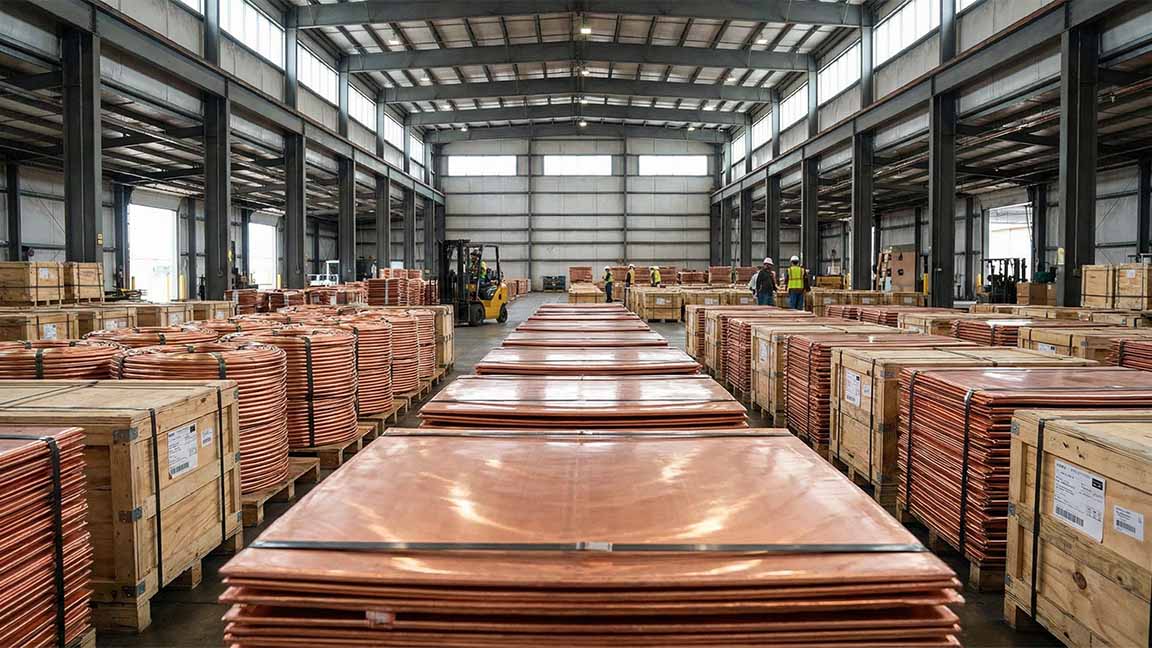
Throughout 2025, traders accelerated shipments of refined copper into the U.S. market as anticipation grew around possible tariffs on primary copper imports beginning in 2026. This front-running behavior triggered a sharp buildup of inventories in U.S.-registered warehouses, particularly those tied to COMEX.
More than 650,000 tons of copper entered the United States this year, according to market analysts, dramatically reshaping global inventory distribution. Two-thirds of all visible global copper stocks are now held within COMEX facilities, an unusually high concentration that has drained availability elsewhere.
This surge in U.S. inventories coincided with tightening supply conditions across other regions, creating localized shortages even as overall global demand showed signs of softening—particularly in China.
The result has been a sharp divergence between physical availability and underlying consumption trends, underscoring how the copper tariffs impact is now influencing pricing beyond traditional supply-and-demand fundamentals.
Why This Matters Now
Copper markets are uniquely sensitive to logistical flows. Unlike energy commodities, copper inventories are finite, slow-moving, and vulnerable to sudden reallocation. The prospect of tariffs changed incentives overnight, making it economically attractive to move metal early—even at the cost of tightening supply elsewhere.
This dynamic matters now for three reasons:
First, the copper market entered 2025 with limited buffer stocks. Years of underinvestment in new mining capacity had already constrained supply growth.
Second, copper plays a central role in electrification, renewable energy systems, and power grid expansion. Any disruption in supply availability has outsized economic consequences.
Third, policy uncertainty—rather than enacted regulation—proved sufficient to move markets. The copper tariffs impact demonstrates how expectations alone can trigger real economic outcomes.
Supply Disruptions Amplify the Tariff Effect
Tariff-driven flows have collided with a series of unexpected supply setbacks that further strained availability.
A deadly accident at Indonesia’s second-largest copper mine, flooding at underground operations in the Democratic Republic of Congo, and a fatal rock blast in Chile all reduced global output during a period of heightened logistical stress. These incidents compounded the supply squeeze created by copper’s migration into U.S. warehouses.
With copper increasingly concentrated inside one market, spot availability outside the U.S. tightened sharply, supporting higher global prices despite uneven demand conditions.
Market Impact: Prices, Volatility, and Arbitrage
Copper prices reached a record high of $12,960 per ton in late December before easing slightly toward year-end. Even with modest pullbacks, the metal remains one of the top-performing industrial commodities of 2025.
The copper tariffs impact has revived arbitrage trades between U.S. and international markets, echoing earlier disruptions seen during previous tariff cycles. Traders have exploited pricing differentials by redirecting physical supply, reinforcing tightness abroad.
This has introduced greater volatility into copper pricing, complicating procurement planning for industrial users and increasing risk exposure for manufacturers reliant on steady supply.
Business Impact: Rising Costs and Procurement Challenges
For businesses, the copper tariffs impact is not an abstract policy issue—it directly affects operating costs, supply reliability, and strategic planning.
Manufacturers in construction, electronics, automotive, and renewable energy face higher input costs as copper prices rise. Firms with global supply chains must now navigate uneven availability across regions, increasing logistical complexity.
Companies that rely heavily on copper wiring, plumbing, or components may experience margin pressure if higher prices persist. While some firms can hedge exposure through futures contracts, smaller manufacturers often lack the scale or expertise to do so effectively.
The inventory buildup in the U.S. also creates uncertainty around future pricing once tariff clarity emerges. Businesses must prepare for potential price corrections if stockpiled copper is released back into the market.
Investor Impact: Signals Beyond the Price Rally
For investors, the copper tariffs impact offers insight into broader structural shifts within commodity markets.
The rally highlights copper’s sensitivity to policy risk and its growing strategic importance in energy transition themes. Copper’s performance in 2025 reflects not only immediate supply constraints but also long-term expectations that demand will continue to outpace production.
However, the concentration of inventories inside the U.S. introduces downside risks. If tariffs are delayed, softened, or abandoned, the arbitrage that drove shipments could unwind, potentially pressuring prices.
Investors must therefore distinguish between structural demand growth and temporary distortions created by trade policy expectations.
Consumer Impact: Indirect but Meaningful
While consumers do not buy copper directly, the copper tariffs impact ultimately filters down through higher prices for goods that rely on the metal.
Home construction costs, appliance pricing, electric vehicle components, and renewable energy installations are all sensitive to copper input costs. Over time, sustained price increases can contribute to broader inflationary pressures, particularly in housing and infrastructure-related spending.
Consumers may not feel the effects immediately, but prolonged tightness in copper markets raises costs across multiple sectors.
China’s Role: Demand Softens, But Long-Term Importance Remains
China, the world’s largest copper consumer, has shown signs of near-term demand weakness. A prolonged property market downturn reduced demand for copper-intensive plumbing and wiring, while sluggish consumer spending weighed on electronics and appliance production.
Despite this softness, China remains central to copper’s long-term outlook. Structural demand tied to electrification, grid expansion, and clean energy remains intact, even if short-term consumption fluctuates.
The copper tariffs impact underscores that supply-side dynamics can overwhelm demand signals in the short run, particularly when trade policy intervenes.
Long-Term Outlook: Structural Demand Meets Policy Risk
Looking ahead, the copper market sits at the intersection of long-term demand growth and near-term policy uncertainty.
BloombergNEF estimates global copper consumption could rise by more than a third by 2035, driven by renewable energy, electric vehicles, and grid modernization. This structural demand backdrop provides long-term support for the market.
At the same time, the copper tariffs impact serves as a reminder that policy decisions can reshape flows rapidly, creating winners and losers across regions.
Businesses and investors must now factor trade policy risk into copper strategies, alongside traditional considerations like mining output and end-user demand.
Conclusion: A Market Redefined by Policy Expectations
The copper tariffs impact has transformed 2025 into a defining year for the metal. By pulling vast quantities of copper into U.S. warehouses, traders reshaped global supply balances, fueled a historic price rally, and exposed how sensitive commodity markets are to policy signals.
For businesses, the shift raises costs and complicates planning. For investors, it highlights both opportunity and risk. For consumers, it quietly increases the price of electrification-driven goods.
As copper continues to anchor the global energy transition, the lessons of 2025 are clear: in today’s markets, expectations can be as powerful as regulation itself.