

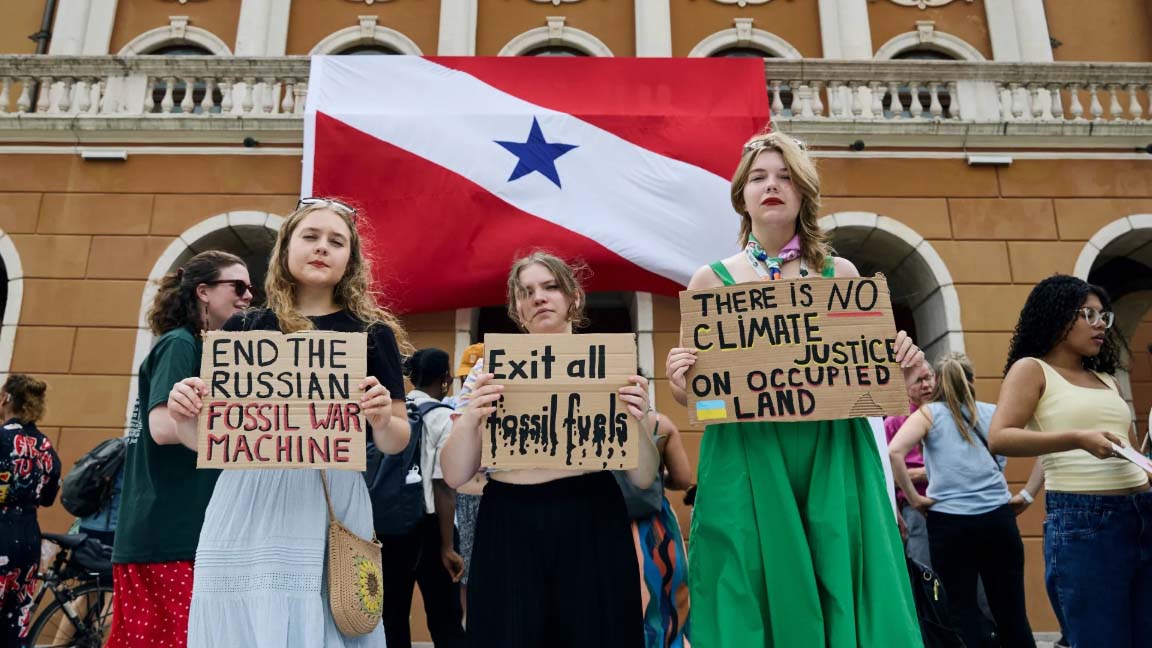
COP30 climate summit in Belem, Brazil, brought tens of thousands of delegates, activists and officials to the mouth of the Amazon River for two weeks of tense talks, dramatic setbacks and modest breakthroughs.
Key Points
On paper, this United Nations gathering marked a milestone: the 10th anniversary of the Paris Agreement, and the moment when countries’ climate plans for 2035 were put under the microscope. In practice, it exposed how slowly global climate diplomacy moves — and how much it depends on politics far beyond the negotiating halls.
Reporting from the ground, Bloomberg Green’s Akshat Rathi and Jennifer Dlouhy described a summit that mixed rainforest symbolism, street protests and last-minute diplomacy over fossil fuel “roadmaps” and forest finance, all while a major player stayed away entirely.
Inside the COP30 Climate Summit in Brazil
Belem, a city of roughly 2 million people at the mouth of the Amazon, was never an obvious choice to host a gathering of this scale. In the run-up to COP30, officials and observers worried openly about whether the city had the infrastructure to cope.
There was talk of delegates being housed on docked cruise ships and in repurposed shipping containers. Concerns ranged from basic security, to flooded walkways at a hastily built venue, to how heavy rain might interact with the site’s electrical wiring.
Once the COP30 climate summit began, those fears did not fully disappear — but the worst-case scenarios did not materialize. Delegates managed the long daily commutes from cruise ships and found last-minute beds when talks pushed into overtime. Negotiations carried on, despite the weather.
The biggest scare came late in the summit. On the penultimate official day, a fire broke out at one of the pavilions. For a few minutes, thick smoke and confusion suggested the incident could escalate quickly. Fire crews and officials moved fast with extinguishers and gear, containing the blaze but forcing a roughly six-hour shutdown of parts of the venue while inspections were carried out.
All of this played out against the backdrop of tropical heat and humidity. With COP30 back in the southern hemisphere in November, delegates finally felt, quite literally, the warmth they were trying to discuss.
For many, the Amazon itself was more than a symbol. Rathi, Dlouhy and other attendees visited a nearby island, just a short boat ride from Belem. There they walked through lush rainforest and met cacao farmers experimenting with diverse plantings rather than a single crop. Those farmers said they were already noticing changes in weather patterns and harvests they linked to climate change.
The combination of a relatively poor host city, daily downpours and encounters with rainforest communities gave negotiators a vivid sense of what is at stake when climate policy is debated in air‑conditioned rooms.
A Paris Anniversary Under Pressure
Substantively, COP30 carried the weight of the Paris Agreement’s 10th anniversary. Most of the rulebook for that accord has already been hammered out at earlier meetings, so negotiators arrived in Belem with a more technical agenda — but a daunting political reality.
Countries were expected to lay the groundwork for updated climate plans stretching to 2035. When all those national plans are added up, they still point to a world warming well beyond the Paris goal of 1.5°C, with estimates around or above 2.5°C.
That gap between stated ambition and scientific necessity framed much of the debate. Brazil, as host, emphasized forests from the outset, seeking to leverage the setting in the Amazon. President Luiz Inácio Lula da Silva and his team wanted deforestation to sit alongside energy as a central test of climate credibility.
Beyond forests, the official COP agenda featured several technical but significant items linked to the Paris Agreement’s work program:
- A “global goal on adaptation” that required negotiators to narrow a sprawling list of more than 1,000 possible indicators down to under 100.
- Parallel work streams on mitigation — cutting emissions — and on what a “just transition” away from fossil fuels should look like.
- Discussions around gender and climate, which remain a standing item in the UN process.
From the start, some countries also pressed for a serious conversation about trade measures they see as raising the cost of decarbonization. While Donald Trump’s tariffs loomed in the background, much of the criticism at COP30 targeted the European Union’s carbon border adjustment mechanism. Developing nations argued the policy acts as a unilateral trade barrier, and the EU spent considerable time defending it.
As in every COP, climate finance remained a fault line. Developing countries insisted they needed predictable support from wealthier nations to both cut emissions and adapt to damage already being felt. Richer countries, in turn, stressed that any new money would need to be matched by stronger actions to curb fossil fuel use.
Brazil’s Dual Push: Forest Money and Fossil Fuel Roadmaps
Against this complex backdrop, the Brazilian presidency tried to carve out a signature achievement for COP30 climate summit: linking forest protection and fossil fuel transition through a pair of “roadmaps.”
Two days before the summit officially opened, President Lula stunned many observers by calling for detailed pathways to:
- Move away from oil, gas and coal, and
- Halt deforestation in tropical forests.
On forests, Brazil proposed a new Tropical Forest Forever Facility aimed at directing large-scale funding toward countries willing to protect their trees. Early hopes were high. Supporters initially talked about raising around $25 billion, before quietly trimming that target to $10 billion as negotiations wore on.
By the end of COP30, pledges for the facility stood at roughly $6 billion, some of it conditional on others joining in. While short of original ambitions, Brazilian officials could still point to the creation of a dedicated fund and a pipeline of potential future contributions.
The second plank of Lula’s plan pushed directly into the heart of global energy politics. Two years earlier, at the climate talks in Dubai, countries agreed to language backing a “just, orderly transition” away from fossil fuels. Since then, many governments have struggled to turn that vague phrase into real-world policy.
Delegates in Belem wanted answers to some basic, but politically charged, questions:
- Should coal be phased out first, before oil and gas?
- What role, if any, should natural gas play as a so‑called bridge fuel?
- Over what time frame should fossil fuel use decline?
Brazil’s idea was to establish a formal UN process to develop roadmaps that would guide national decisions on those questions. Environment Minister Marina Silva reinforced Lula’s call with an impassioned appeal midway through the summit.
From there, the issue quickly grew in significance. Colombia launched its own declaration backing roadmaps. The UK and EU lined up behind the idea, and what began as an unexpected proposal two days before COP30 opened gradually became one of its defining battles.
How Consensus Diluted Ambition at COP30
As the end of the COP30 climate summit approached, those roadmaps collided with the core rule that governs every UN climate conference: nothing is agreed until everyone agrees.
In the final 36 hours, the UK and EU signaled they were ready to draw a red line. Without stronger language on the fossil fuel transition, officials warned, they were prepared to block the overall outcome. That stance captured a wider frustration with the growing gap between climate science and national commitments.
Behind closed doors, however, resistance hardened from major oil and gas producers including Saudi Arabia and Russia, along with several allies. They opposed anything that could be interpreted as a detailed or accelerated plan to wind down fossil fuel production and use.
Given how late Lula’s roadmap push had arrived — just before the summit began — Brazil lacked the months of advance diplomacy that helped secure, for example, the first reference to coal in a UN climate decision at the Glasgow conference. In that earlier case, it still took an additional two years before a broader commitment to transition away from all fossil fuels was finally agreed in Dubai.
With that history in mind, negotiators in Belem settled for a compromise that fell short of what roadmap advocates wanted but moved the discussion slightly forward:
- The final COP30 text pointed countries back to their Paris Agreement pledges, stressing that upcoming national climate plans should reflect the Dubai decision to transition away from fossil fuels.
- Separately, the Brazilian presidency announced its own initiative to continue developing roadmaps on both forests and fossil fuels over the next year.
In other words, COP30 did not deliver the detailed global pathways Lula first sketched out. Instead, it created a procedural foothold that Brazil and its allies hope to build on at future meetings.
A Leadership Void: The US, EU and China at COP30
The closing hours of a UN climate summit often feature frantic “huddles” as big powers broker last‑minute bargains in the corridors. This time, according to Dlouhy, the final plenary in Belem involved fewer of those scenes than in previous years, largely because the core deal had been pre‑negotiated in the early morning hours.
Even so, one absence loomed large: the United States.
President Donald Trump has repeatedly disparaged climate change and international efforts to tackle it, calling the system a hoax and a scam. In line with that stance, his administration chose not to send a formal delegation to COP30 — not even lower‑level negotiators.
That decision marked a sharp break from earlier years, when US diplomats worked closely with the EU and China to shape the Paris Agreement itself and other landmark deals. The lack of an official US presence in Belem was widely felt in negotiating rooms.
Some attendees, though, quietly welcomed Washington’s no‑show. Only a month before COP30, the US had used its clout at the International Maritime Organization to delay a vote on a global carbon tax on shipping. For certain observers — including unofficial US visitors in Belem who wanted to signal that “America is still in” — keeping the Trump administration away from COP30 reduced the risk of similar disruption.
If the US stepped back, expectations rose that either the EU or China might step forward. But both faced their own constraints.
In Europe, far‑right parties have recently gained strength across several governments, injecting new political uncertainty into climate policy. EU negotiators arrived at COP30 only after a difficult internal process to approve their own climate plan, limiting their room to push others far beyond that line.
Attention then turned to China. In the absence of a fully engaged US, some imagined Beijing would assume a more visible leadership role in the talks. Instead, Chinese negotiators kept a relatively low profile inside the formal negotiations.
Outside those rooms, China’s presence was unmistakable. Its pavilion sat prominently at the entrance to the venue, branded with pandas and drawing crowds for side events and discussions. But in the official bargaining over texts like the fossil fuel roadmaps, Beijing largely stayed out of the spotlight.
Dlouhy and Rathi linked that choice to China’s growing preoccupation with trade measures affecting its clean‑energy exports. From Trump’s tariffs to Europe’s border carbon plans, Chinese officials have become increasingly concerned about what they see as obstacles to selling the solar panels, wind turbines, batteries and electric vehicles the country produces at massive scale.
At COP30, those trade worries appeared to rank higher on China’s list of priorities than taking on a central public role in shaping the final deal.
What COP30 Leaves Behind
By the time gavel struck in Belem, COP30 climate summit had delivered a mixed legacy.
On the tangible side, negotiators:
- Narrowed a sprawling list of adaptation indicators to under 100, giving countries a more focused way to assess how they are coping with climate impacts.
- Established the Tropical Forest Forever Facility, with about $6 billion in initial pledges and scope for more, to support nations that protect rainforests.
- Formally tied upcoming national climate plans to the earlier global commitment to transition away from fossil fuels, albeit in cautious language.
- Launched a presidency initiative to keep working on detailed roadmaps for energy and forests in the year ahead.
Less tangibly, COP30 forced delegates to confront climate politics in a place where the consequences of inaction are already visible — from cacao farmers tracking shifting rains to a city grappling with heat, floods, and limited resources.
It also highlighted the structural limits of the UN climate process: consensus rules that often produce the lowest common denominator, shifting geopolitical alliances, and domestic politics that can remove key players from the field.
Whether COP30 is remembered as a turning point or another incremental step will depend on what countries do with the fragile compromises it produced — especially on fossil fuel roadmaps and forest finance — before they meet again.
FAQ’s
What is the COP30 climate summit and why was it held in Brazil?
COP30 is the 30th UN climate conference, where nearly all countries meet to negotiate global climate action. Brazil hosted it in Belem, at the mouth of the Amazon, to spotlight the role of tropical forests and deforestation in climate change.
What were the main outcomes of the COP30 climate summit?
Key outcomes included a new Tropical Forest Forever Facility with initial funding pledges, progress on global adaptation indicators, and language linking future climate plans to the agreed transition away from fossil fuels, plus a Brazilian-led push for detailed “roadmaps.”
How did COP30 address fossil fuels and the energy transition?
Countries debated how to turn the Dubai pledge to “transition away from fossil fuels” into concrete steps. While a full global roadmap was not agreed, the final text nudged nations to reflect that transition in their next climate plans and backed further work on energy roadmaps.
What is the Tropical Forest Forever Facility announced at COP30?
The Tropical Forest Forever Facility is a new funding mechanism aimed at supporting countries that protect tropical forests. It launched at COP30 with around $6 billion in initial, partly conditional pledges and is intended to scale up long-term finance for halting deforestation.