

Key Points
Chevron Venezuela is suddenly at the center of one of the most consequential oil stories in the world, after nearly two decades of sticking with a country where politics and petroleum have rarely mixed safely.
For years, Chevron’s persistence in Venezuela looked like a costly gamble, with billion-dollar investments repeatedly exposed to the tug-of-war between Caracas and Washington. Now that same strategy has put the world’s biggest petroleum prize within reach: access to Venezuela’s immense crude reserves, described as the largest known.
But the payoff comes with real risk. As US-Venezuela tensions rise, Chevron is also the global oil major most exposed to the fallout if the standoff hardens into a shutdown.
Chevron Venezuela Operates in a Narrow Window as the Standoff Escalates
Chevron Venezuela holds a uniquely valuable position: it is the only global oil company with access to Venezuela’s vast reserves during the current confrontation.
That advantage is also why the company has landed directly in the spotlight as President Donald Trump increases pressure on Nicolás Maduro’s government. Trump has deployed a fleet of warships to the Venezuelan coast, and the US move to blockade parts of the southern Caribbean is already squeezing the wider Venezuelan oil industry.
Against that backdrop, Chevron’s operations have continued.
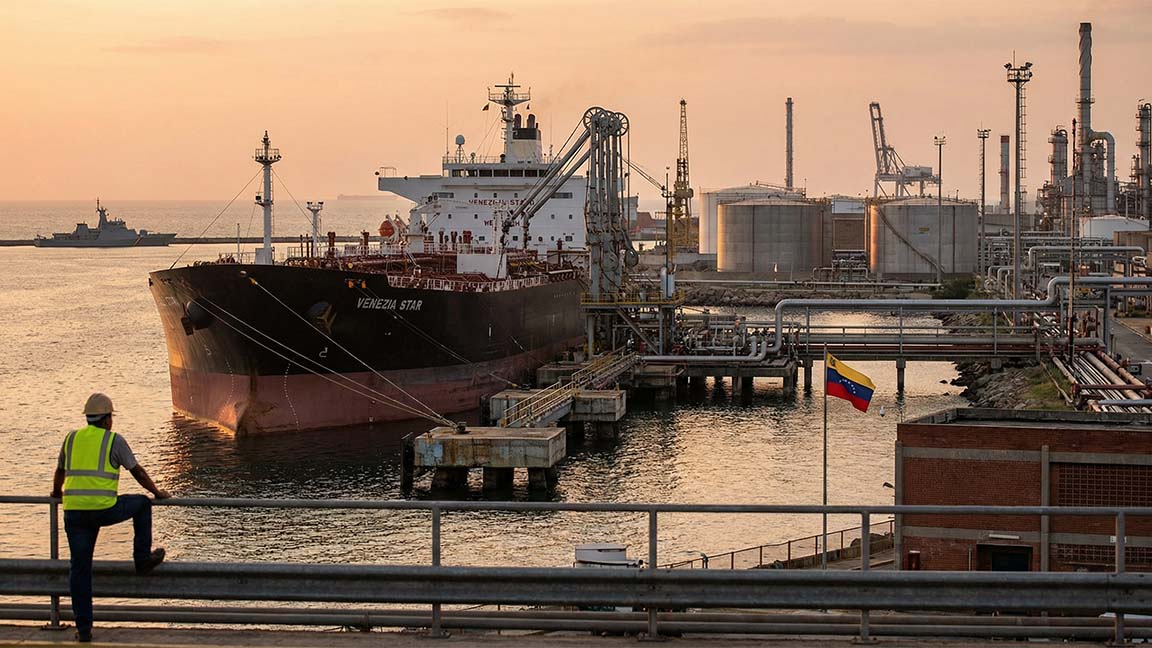
As of Thursday, the company was preparing to export 1 million barrels of Venezuelan crude, according to Bloomberg tanker tracking. That activity came a day after Trump labeled Venezuela’s government a “foreign terrorist organization.”
Chevron produces about 200,000 barrels per day through multiple joint ventures with Venezuela’s national oil company and exports its share of production to US refineries on the Gulf Coast.
The broader picture inside Venezuela’s oil sector looks increasingly strained. The US blockade means the state oil company can no longer export crude to China using its “shadow fleet” of “ghost vessels,” and the loss of those routes could force the country to start shutting in wells within 10 days.
Compounding the disruption, a cyberattack hit Venezuela’s main export terminal in December. Air travel in and out of the country has also largely halted after signal jamming and US warnings of heightened military activity.
In that environment, Chevron’s steady operations stand out—not because conditions are easy, but because the company still has the licenses and positioning to keep moving barrels.
Chevron Venezuela Keeps Exports Flowing While Others Face a Clampdown
Chevron Venezuela has remained active in a market where others have been forced out, blocked, or left exposed.
Its share of production continues to head to Gulf Coast refineries, which Chevron has argued are set up to process the heavy crude that Venezuela produces. And while the rest of the Venezuelan system faces logistics and enforcement pressure, the company’s ongoing exports show why both governments may still see value in keeping Chevron’s channel open, at least for now.
Why Both Washington and Caracas See Chevron Venezuela as Useful
Chevron Venezuela sits in a place where outcomes could swing in different directions, yet still end with the company playing a central role.
If Trump attacks and overthrows the Maduro government, the country’s battered oil industry would need rebuilding—and Chevron would be well positioned to help restart and scale operations because it already has working joint ventures and on-the-ground experience.
If Trump and Maduro strike a deal, Venezuela would need to export as much oil as possible to generate cash. That, too, could benefit Chevron’s existing export pathways.
Francisco Monaldi, director of Latin American energy policy at Rice University in Houston, described the challenge bluntly: “These are very tough waters to navigate.” But he also said Chevron is “a very attractive partner for Venezuela and the US government,” adding that it is “a very strong strategic position in almost any possible scenario.”
That doesn’t mean the situation is safe. The company’s unique placement carries meaningful risks, including risks to personnel, if hostilities break out. It could also still be shut out by either government, a fate that has hit multiple foreign oil companies in Venezuela over the years.
Even so, neither Trump nor Maduro has moved to halt the company’s operations during the current showdown, reinforcing the idea that Chevron’s presence is seen as strategically convenient—even by political opponents.
Chevron Venezuela’s Unusual Arrangement Draws Fire on Both Sides
Chevron Venezuela operates under a setup that has created critics in Caracas and Washington at the same time.
In the US, some critics have accused the company of funneling billions of dollars to what they call a brutal, corrupt regime. Those critics have at times included Secretary of State Marco Rubio.
Inside Venezuela, some hardliners in the ruling party view Chevron as a symbol of US imperialism and want to curb foreign influence in the country’s biggest industry.
Chevron’s response has been to frame its role differently. The company says its Venezuela operations help stabilize the local economy and the broader region, while complying with US sanctions and laws.
People familiar with internal discussions said Chevron executives have not welcomed the increased public scrutiny tied to its Venezuela position, but still view the long-term approach as worth it given the potential upside. They also see the strategy as a signal to other oil-rich governments that Chevron stays committed even when conditions are difficult.
Chief Executive Officer Mike Wirth underscored that stance this month on Bloomberg TV, pointing to Chevron’s long-view approach in countries where politics can shift quickly.
The Long Game: How Chevron Venezuela Stayed When Others Left
Chevron Venezuela did not stumble into this position overnight. It reflects a decision to stay put as Venezuela’s oil sector became far more state-controlled and politically charged.
Chevron began exploring for oil in Venezuela in 1923. But the investment climate changed dramatically after Hugo Chavez won the presidency in 1998.
Chavez pushed laws requiring the state to own 51% of any joint venture with foreign companies, a move that amounted to nationalizing Venezuela’s oil industry.
Major international players balked. ConocoPhillips, then the largest foreign investor in Venezuela, refused the new terms and exited in the early 2000s. Exxon Mobil also left.
Chevron chose to stay.
Ali Moshiri, Chevron’s Latin America chief at the time, had a close relationship with Chavez and sought partnership rather than departure. In a mid-2000s industry moment that became part of Chevron lore, Chavez noticed Moshiri didn’t have a chair and offered his own; Moshiri accepted amid embraces and back slaps.
Moshiri summed up the philosophy in 2005: “We have to go where the oil is.”
For a time, the bet looked smart. Oil prices climbed from $25 a barrel in 1999 to a record $146 in 2008, expanding the value of production even as Chevron accepted a smaller ownership slice. The relationship continued under Maduro after Chavez’s death in 2013.
Sanctions, Licenses, and the Debate Over Chevron Venezuela’s Role
Chevron Venezuela has also navigated years of US sanctions as relations between Maduro and Washington deteriorated.
Trump’s first administration placed sanctions on Venezuela’s oil industry, and President Joe Biden maintained them. That period triggered intense Chevron lobbying in Washington, with the company arguing that Venezuelan crude supported US energy security and that exiting would leave assets to Maduro while opening the door for Russian and Chinese companies to expand influence.
In 2022, after Russia’s invasion of Ukraine and a spike in gasoline prices, the Biden administration relaxed sanctions and allowed Chevron to ramp up production.
The public waiver included a key restriction: it expressly forbade Chevron from paying taxes or royalties to Venezuelan state-owned entities. But a separate private license, later revealed by Bloomberg News in March, allowed those payments.
The episode highlighted the uncomfortable reality that the US benefited from Chevron’s continued presence and oil flows, even while trying to pressure Maduro.
Rubio has been among the most vocal critics. “Companies like Chevron are actually providing billions of dollars of money into the regime’s coffers,” he said in January, arguing the regime did not keep promises it made.
Chevron has continued to say it is following US laws and sanctions requirements while operating in Venezuela.
What the Trump-Maduro Pressure Campaign Means for Chevron Venezuela
Chevron Venezuela is operating as the US increases pressure and as oil prices sit near their lowest level in four years.
Carlos Bellorin, an executive vice president at Welligence Energy Analytics, said Trump “can afford to disrupt Venezuelan flows with far less risk of a price spike, especially one that would hit US gasoline prices.”
Bellorin also pointed to the logic of the blockade strategy: blockading sanctioned oil tankers in the southern Caribbean helps cut off a key revenue stream from Maduro’s government, which has used “dark fleet” vessels that turn off or spoof transponder signals to export oil despite sanctions.
For Chevron, the stakes are tied to decisions it cannot control.
If political shifts open Venezuela more broadly, Chevron would likely face fresh competition. Exxon CEO Darren Woods said last month Exxon would look at potential opportunity but would be cautious because its assets in Venezuela were expropriated in the past.
“I wouldn’t put it on the list or take it off the list,” Woods said. “We’d have to see what the circumstances are at the time.”
Wirth has taken a steadier line, arguing that resource locations dictate where energy companies operate—even when governments are difficult to deal with.
“We don’t choose where the resource is,” Wirth said at the Wall Street Journal CEO Council Summit earlier this month. “If we left every time we had a disagreement with the government, we would be leaving everywhere — including this country.”
Conclusion
Chevron Venezuela now represents one of the clearest examples of how persistence in a politically unstable oil state can swing from looking reckless to looking strategic.
The company’s decades-long decision to stay has left it as the lone global oil major with meaningful access as the US and Venezuela enter a sharper, higher-pressure phase. That positioning could turn into a major advantage if either side chooses a path that requires a functioning export outlet and an experienced operator.
But the same exposure that creates opportunity also creates risk. As the blockade tightens and scrutiny rises, Chevron’s presence in Venezuela remains a high-stakes balancing act—one where the next move is political, not corporate.