

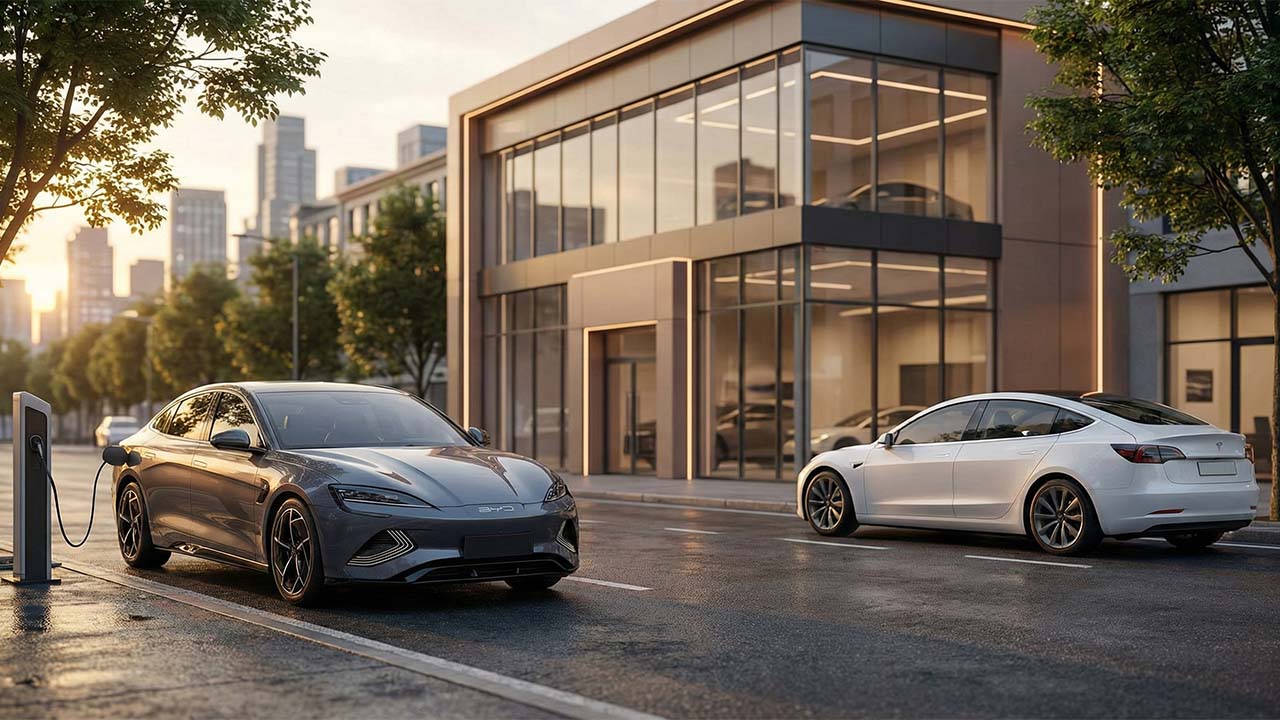
The BYD vs Tesla global EV market rivalry is entering a decisive new phase as the world’s largest electric-vehicle manufacturer sharpens its focus beyond China. BYD Co. is aiming to sell 1.3 million vehicles outside China in 2026, a nearly 25% increase from last year, underscoring how global expansion is becoming essential—not optional—for major EV players.
The target, disclosed at a media briefing in Shanghai, reflects both opportunity and pressure. While overseas growth helped BYD overtake Tesla as the world’s top EV seller, conditions in China—still the company’s largest market—are becoming more challenging. Reduced government incentives and intensifying domestic competition are reshaping the landscape, forcing Chinese automakers to rely more heavily on international demand.
For investors, businesses, and consumers, this shift highlights how the global EV race is no longer just about technology or pricing—it is about geographic diversification, regulatory resilience, and long-term demand stability.
What Happened: BYD Raises the Stakes Overseas
BYD Co Ltd said it plans to deliver 1.3 million vehicles outside China in 2026, according to Li Yunfei, general manager of the company’s brand and public relations division. That compares with 1.05 million overseas deliveries last year, marking a significant step-up in international ambition.
The announcement came as BYD continues to solidify its position at the top of the EV industry. Strong international sales were a key factor in BYD surpassing Tesla Inc as the world’s No. 1 EV maker last year—a symbolic milestone in the BYD vs Tesla global EV market competition.
However, the new target fell short of earlier expectations. Citigroup Inc previously said BYD had internally discussed a goal of 1.5 million to 1.6 million overseas units for 2026. The revised figure suggests a more measured approach amid shifting market realities.
Why This Matters Now
The timing of BYD’s overseas push is critical. China’s EV market, long supported by generous government incentives, is entering a more mature phase. As some subsidies and policy supports are scaled back, demand growth at home is showing signs of pressure. At the same time, competition among domestic EV makers is intensifying, compressing margins and increasing price sensitivity.
Against that backdrop, overseas markets have become a strategic pressure valve. Europe, Southeast Asia, Latin America, and other regions offer growth potential that can offset slower momentum in China. For BYD, expanding abroad is no longer just about growth—it is about protecting scale, profitability, and global leadership.
This context reframes the BYD vs Tesla global EV market not as a single-company rivalry, but as a broader contest over who can adapt fastest to a less subsidy-driven, more competitive global EV environment.
The Competitive Dynamic: BYD vs Tesla Global EV Market
Tesla remains the most recognized EV brand globally, but BYD’s rapid ascent has altered competitive assumptions. BYD’s strength lies in volume, manufacturing scale, and a broad product lineup that spans multiple price points. Overseas expansion allows the company to leverage those advantages more fully.
At the same time, Tesla’s established presence in key international markets means BYD is not expanding into empty territory. Each additional overseas sale places BYD in more direct competition with Tesla across pricing, distribution, and brand perception.
What makes this phase especially important is that global demand conditions are diverging. While China slows, international markets remain fragmented, each with its own regulatory standards, infrastructure readiness, and consumer preferences. Success in the BYD vs Tesla global EV market will increasingly depend on execution rather than headline growth numbers.
Business Impact: Why Companies Are Watching Closely
For businesses across the automotive and supply-chain ecosystem, BYD’s overseas target signals sustained global competition in EV manufacturing and distribution.
Automakers face continued pricing pressure as BYD scales production for export markets. Suppliers, particularly those linked to batteries and components, may benefit from higher international volumes but must also navigate geopolitical and regulatory complexity. Dealerships and distributors outside China are likely to see more Chinese-branded EVs entering mainstream channels.
The broader message is clear: global EV competition is intensifying, and scale-driven players like BYD are not retreating despite headwinds at home.
Market Impact: What Investors Are Reading Between the Lines
From a market perspective, BYD’s target carries mixed signals. On one hand, a nearly 25% increase in overseas deliveries reinforces confidence in the company’s global footprint and long-term growth strategy. On the other, the lower-than-expected target suggests management is recalibrating expectations amid tougher conditions.
For investors tracking the BYD vs Tesla global EV market, the announcement highlights a shift from aggressive expansion narratives toward more disciplined, achievable growth goals. That may reduce near-term upside expectations but could also signal a more sustainable trajectory.
Importantly, the reliance on overseas markets increases exposure to foreign exchange risk, regulatory changes, and trade dynamics—factors that investors will increasingly factor into valuations.
Consumer Impact: More Choice, More Competition
For consumers outside China, BYD’s push means greater availability of EV options and intensified competition among manufacturers. Increased supply often translates into sharper pricing and faster feature adoption, especially as companies vie for market share.
The expanding presence of Chinese EV brands also challenges traditional perceptions around quality and value. As BYD grows internationally, consumers will encounter a broader range of electric vehicles competing directly with established global brands, including Tesla.
In the long run, this competition could accelerate EV adoption by making electric vehicles more accessible across different income levels and regions.
Official Perspective and Industry Signals
BYD’s announcement was delivered at a media briefing in Shanghai, reinforcing management’s emphasis on transparency around strategic priorities. The contrast with earlier expectations cited by Citigroup underscores how quickly conditions in the EV sector can shift.
The fact that overseas growth remains a central pillar—despite a moderated target—signals confidence in global demand, even as the domestic Chinese market becomes less supportive.
Looking Ahead: What This Means for the Global EV Race
The next chapter of the BYD vs Tesla global EV market will be defined less by headline leadership changes and more by execution across diverse international markets. BYD’s 1.3 million overseas sales target reflects both ambition and realism, shaped by slowing domestic demand and intensifying global competition.
For businesses, investors, and consumers, the message is consistent: the global EV market is entering a more competitive, less subsidy-driven phase where adaptability matters as much as scale. How effectively BYD converts overseas ambition into sustained profitability will help define not just its own future—but the trajectory of the global electric vehicle industry.