

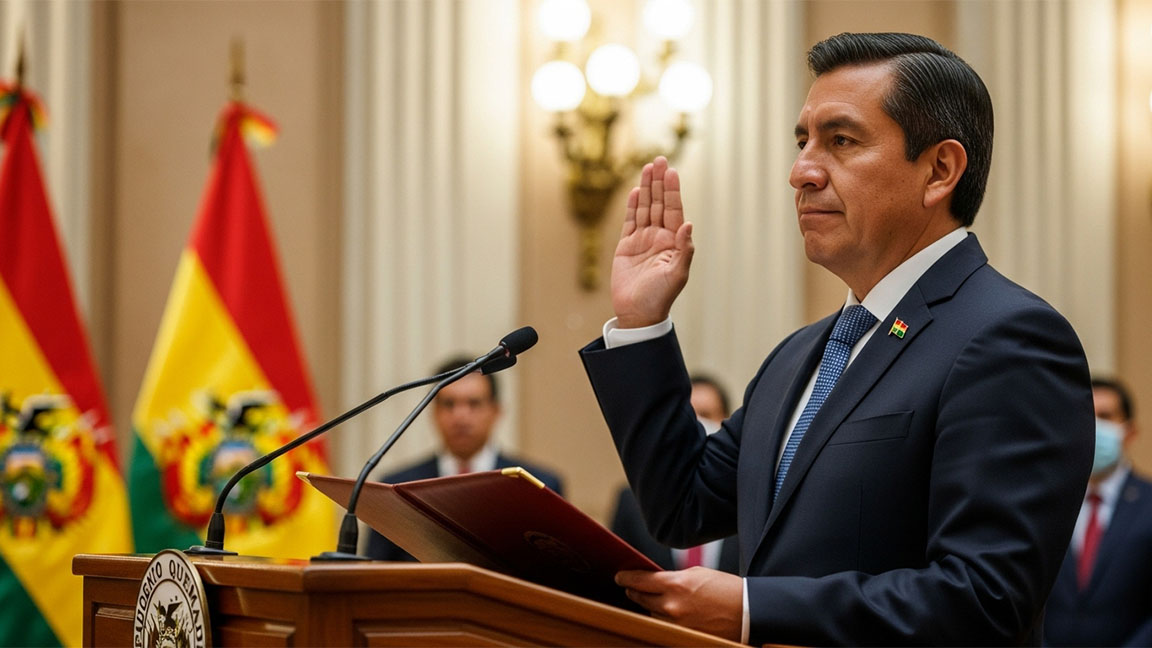
Bolivia’s finance minister, José Gabriel Espinoza, took the oath of office on Sunday in La Paz, stepping into a difficult brief as the nation battles high inflation, product shortages, and thinning foreign reserves. The economist and former central bank director enters President Rodrigo Paz’s cabinet with a clear promise: restore confidence, invite investment, and put stable rules back at the center of economic policy.
Key Points
Espinoza’s appointment marks an early statement of intent from the new administration. He has criticized the prior policy mix and is now tasked with steadying the public finances, clarifying the exchange-rate regime, and rebuilding credibility with businesses at home and abroad. The change comes as the country turns the page on nearly two decades of state-led management across strategic sectors.
Bolivia’s finance minister sets out a pro‑investment agenda
At a business summit in Santa Cruz days before the ceremony, Bolivia’s finance minister said the door is open to outside capital—provided investors get legal certainty and predictable rules. “We want investments to return and Bolivia’s doors open to the world,” he told attendees, adding that the government aims to be “a trusted partner, not an investment adversary.”
As Bolivia’s finance minister, Espinoza underscored that contracts will be honored and private enterprise will receive full institutional backing. The emphasis signals a practical shift from heavy state intermediation toward a clearer, rules‑based framework meant to lower risk premiums and attract long‑term capital.
He also highlighted the need to repair macroeconomic fundamentals so confidence can follow policy, not precede it. That means cleaner public accounts, transparent financing, and monetary coordination designed to cool prices without stalling activity.
Who is José Gabriel Espinoza?
Espinoza is an economist who previously served on the board of Bolivia’s central bank. From that vantage point, he often questioned the sustainability of deficit financing and warned about the long‑term costs of relying on the monetary authority to fund the budget.
Politically, Bolivia’s finance minister has charted an independent path. He initially supported businessman Samuel Doria Medina in the first round of the presidential election, then joined Rodrigo Paz’s team in the runoff. Since aligning with Paz, he has consistently promoted opening the economy under clear, predictable rules that protect both investors and the public interest.
That profile—technocratic with a market‑friendly tilt—positions Espinoza to bridge two audiences: a private sector eager for stability and a public that wants reliable access to goods, jobs, and credit after months of strain.
Paz’s four pillars for an economic reset
In his inaugural remarks, President Rodrigo Paz outlined four pillars to guide the new government:
- Position Bolivia more actively in the world.
- Promote “capitalism for everyone” as a production model.
- Reduce the state’s role as an obstacle to growth.
- Empower regions to drive development closer to communities.
Paz also flagged a “ministerial restructuring” to be announced in the coming days. The move suggests the administration plans to streamline decision‑making and align institutions with its pro‑investment, pro‑production agenda.
Cabinet lineup signals change
The president named 16 ministers alongside Espinoza. Among them: Fernando Hugo Aramayo as foreign affairs minister, José Luis Lupo as presidency minister, and Sergio Mauricio Medinacelli Monroy as hydrocarbons and energy minister—a role he previously held two decades ago.
The appointments aim to bring seasoned hands to critical portfolios just as the new team revisits rules across hydrocarbons and mining. According to officials, the administration plans to submit bills to Congress in the coming months to modernize regulations and attract foreign capital to sectors that underpin exports, jobs, and energy security.
That agenda caps a long cycle of stronger state control. Bolivia’s finance minister’s mandate dovetails with a broader pivot toward competition, investment, and regional initiative—without retreating from social commitments or macroprudential safeguards.
Policy priorities: fiscal discipline, FX stability, and debt management
Espinoza has vowed to restore fiscal discipline and end central bank financing of government spending. For Bolivia’s finance minister, the objective is straightforward: reduce reliance on short‑term fixes and rebuild a sustainable path for the budget that can withstand external shocks.
On currency policy, he has called for stabilizing the exchange rate based on market demand. A transparent, credible FX framework would aim to ease pressure on the boliviano, improve price discovery, and help prevent shortages that arise when parallel markets flourish.
Debt servicing will continue, according to Espinoza, though future negotiations may prefer market‑friendly tools—such as asset swaps, maturity extensions, or currency changes—over formal rescheduling. That stance signals continuity with obligations while seeking flexibility that protects reserves and supports growth.
These policy tracks respond to urgent realities. Inflation and supply bottlenecks have strained households and small businesses, while dwindling reserves have limited the state’s room to maneuver. Bolivia’s finance minister framed the solution as a mix of fiscal order, monetary coherence, and a better climate for investment.
What it means for businesses and markets
For companies, the core message is predictability. The new leadership promises clear rules, legal security, and support for private contracts. If delivered, that would lower uncertainty for long‑term projects—especially in capital‑heavy sectors like energy, mining, and infrastructure.
Bolivia’s finance minister also emphasized a “partner” approach to foreign investment. That means enabling capital inflows while anchoring them in transparent agreements aligned with national goals—job creation, productivity, and sustainable development.
- Energy and resources: Expect proposed updates to hydrocarbons and mining laws aimed at mobilizing exploration and production with public‑private collaboration.
- Manufacturing and services: A more stable exchange‑rate framework could improve import planning and inventory management, easing shortages and costs.
- SMEs: Reduced inflation pressure and better credit conditions would help small firms manage working capital and restore hiring plans.
Markets will watch near‑term signals: fiscal measures that curb deficits without undercutting essential services; steps to clarify the FX mechanism; and early legal proposals that put the “capitalism for everyone” theme into practice.
Legislative roadmap and institutional changes
In the coming months, the administration plans to introduce bills modernizing sector regulations. The aim is to set long‑term ground rules, standardize permits, and streamline dispute resolution. That would align with Bolivia’s finance minister’s pledge of legal certainty and help rebuild a pipeline of projects.
Paz’s planned ministerial restructuring could reassign functions to improve policy execution—particularly where overlap has slowed investment approvals. A cleaner institutional map would also support inter‑agency coordination on fiscal, monetary, and regulatory policy.
Regional empowerment and national cohesion
Empowering regions is a core pillar of the new government. In practice, that could translate into more voice for provincial and city‑level authorities in development planning, especially in hubs like Santa Cruz. Regional buy‑in matters for logistics, workforce development, and land‑use decisions that shape project timelines.
Bolivia’s finance minister’s outreach to business leaders in Santa Cruz signals an early focus on consensus-building. If national and regional agendas align, implementation of reforms can move faster and with fewer political bottlenecks.
What to watch in the first 100 days
- Fiscal roadmap: A credible plan to narrow the deficit without derailing recovery.
- Exchange‑rate clarity: Steps that anchor expectations and reduce reliance on parallel markets.
- Legal proposals: Drafts modernizing hydrocarbons and mining rules to catalyze investment.
- Debt strategy: Communication that reassures creditors while preserving policy flexibility.
- Institutional reform: Details of the ministerial restructuring and how it expedites approvals.
Each milestone will reveal how the new economic model balances market dynamism with social stability—and whether the state’s role becomes more enabling and less obstructive, as promised.
Outlook
The handover brings a new tone to economic policy. Bolivia’s finance minister is signaling discipline, transparency, and engagement with private enterprise, while the president frames growth as a national project “for everyone.” Execution will determine credibility: supply relief, price stability, and a visible investment pipeline are the yardsticks that matter most to households and firms.
For now, the message is clear. The government wants to reopen Bolivia to capital and ideas under the protection of the law. If reforms land as outlined—fiscal order, market‑based FX, modernized sector rules—confidence can rebuild, shortages can ease, and growth can regain traction.
Conclusion
Bolivia is entering an economic reset driven by stability and openness. With José Gabriel Espinoza sworn in as Bolivia’s finance minister and Rodrigo Paz outlining four governing pillars, the path forward centers on rules, investment, and regional empowerment. Early policy moves—on the budget, exchange rate, and sector frameworks—will show whether the administration can turn intent into impact and deliver a steadier economy for businesses and families alike.
FAQ’s
Who is José Gabriel Espinoza, Bolivia’s new finance minister?
He’s an economist and former central bank director known for advocating predictable rules, fiscal discipline, and a pro‑investment agenda. He previously criticized deficit financing and backs opening to foreign capital.
What are the priorities for Bolivia’s finance minister?
Espinoza plans to restore fiscal discipline, end central bank financing of the budget, clarify a market‑based exchange rate, and support legal certainty to attract investment. He also aims to modernize hydrocarbons and mining rules.
How could the policies impact inflation and the exchange rate?
A credible, market‑based FX framework is intended to reduce parallel‑market pressure and stabilize prices. Fiscal consolidation and better coordination with the central bank could help ease inflation and rebuild reserves.
What does this mean for foreign investors?
The government is signaling legal security, contract protection, and predictable rules, with bills to modernize key sectors. The approach seeks to welcome capital as a partner while aligning projects with national development goals.
Article Source: Bloomberg