

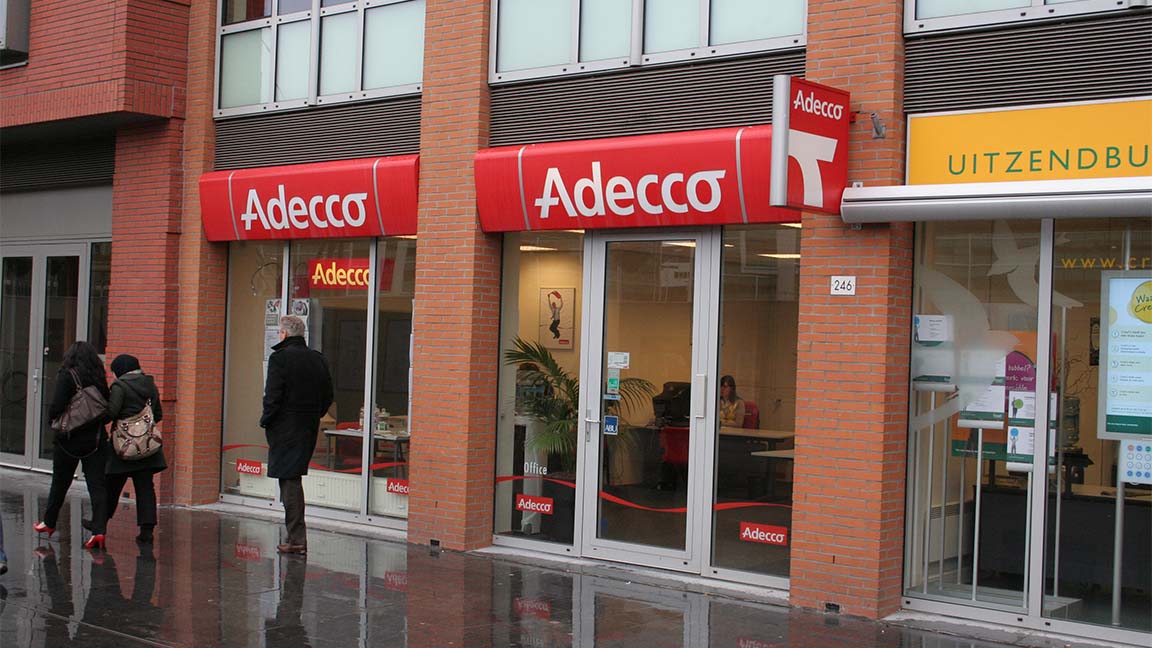
Adecco stock plunged on Wednesday after the staffing giant laid out a new strategy that raised more questions than answers about its future dividend and leverage. The sharp slide underscored how sensitive investors are to any hint that payouts may come under pressure as the company works to cut debt.
Key Points
Adecco Stock Sinks After Capital-Markets Day
Adecco stock dropped as much as 10% in Zurich trading, the steepest intraday decline since April, after the company’s capital-markets day presentation failed to reassure shareholders. By 2:42 p.m. local time, the shares were still down about 9.4%.
During the event, the Zurich-based staffing group reiterated its financial targets and highlighted how artificial intelligence could support its business over time. Management confirmed a through-the-cycle earnings before interest, taxes and amortization (EBITA) margin goal of 3% to 6%.
Yet the market reaction showed that, for now, investors are more focused on near-term cash returns and the balance sheet than on long-term technology tailwinds. Concerns that Adecco stock could be exposed to further payout cuts weighed heavily on sentiment throughout the session.
Dividend Doubts Overshadow AI Growth Pitch
While Adecco emphasized the potential benefits of artificial intelligence for matching workers and employers more efficiently, the investor discussion quickly turned to the company’s ability to sustain its dividend while bringing net debt down.
Analysts and shareholders questioned whether the current financial framework can support both priorities at once. Gian Marco Werro, an analyst at Zuercher Kantonalbank, said the company’s debt reduction target effectively points to a lower dividend. That comment crystallized fears that Adecco stock holders may face more conservative payouts going forward.
The anxiety is rooted in recent history. Adecco already cut its dividend to 1 Swiss franc per share in February, explicitly linking the move to the need to reduce debt. That decision signaled a shift toward strengthening the balance sheet, and investors listening to the latest update appeared unconvinced that another adjustment is off the table.
Chief Executive Officer Denis Machuel reiterated on a media call that the company is aiming for a payout ratio of 40% to 50%. However, he stressed that the ultimate decision on the dividend will be made by the board in February 2026. The timing and conditional nature of that decision left room for market skepticism, adding further pressure on Adecco stock.
Economic Headwinds in Europe Weigh on Adecco Stock
The broader business environment is also complicating the picture for Adecco stock. As a global staffing provider that places workers across industries, the company is often viewed as an economic bellwether. When hiring slows or companies pull back on permanent roles, Adecco tends to feel it quickly.
In some of its most important markets, including Germany and France, Adecco is contending with clear headwinds. Both countries are navigating economic weakness and subdued labor markets, limiting demand for higher-margin placements.
On a call, Machuel noted that periods of uncertainty tend to push companies toward temporary hiring. Businesses facing an unclear outlook often prefer flexibility, increasing their reliance on short-term contracts instead of adding permanent staff.
For Adecco, that shift brings trade-offs. While more temporary roles can support volumes, they typically come with lower margins. As a result, even if activity remains steady or improves, profitability may be squeezed. That dynamic adds another layer of complexity to the company’s 3% to 6% EBITA margin target and, by extension, to the cash available for dividends — a key issue for anyone holding Adecco stock.
Balancing Debt Reduction and Shareholder Returns
The tension between deleveraging and rewarding shareholders sits at the heart of the current debate around Adecco stock. Management has made clear that reducing net debt is a strategic priority, and the earlier dividend cut underscored that commitment.
At the same time, many investors in a mature staffing group look for stable or growing payouts as part of their total return. When those expectations come into conflict with balance-sheet goals, confidence can erode quickly — especially when the macroeconomic backdrop is fragile.
By confirming its margin guidance, Adecco sought to show that it can navigate the cycle and still deliver acceptable profitability. The emphasis on AI benefits was designed to signal that the business is evolving and investing for the future. But without a firmer line on how those elements translate into sustainable cash generation and payouts, the market reaction suggests investors remain cautious.
For now, Adecco stock is caught between two narratives: one of long-term operational improvement and technological enhancement, and one of near-term pressure on margins and dividends amid slower European economies and a focus on debt reduction.
What Adecco’s Payout Stance Means for Investors
For current and prospective holders of Adecco stock, the company’s reiterated payout ratio of 40% to 50% provides a framework but not a guarantee. The board’s role in setting the dividend in February 2026 means that any change in the operating environment, earnings trajectory or leverage profile between now and then could influence the final decision.
Investors must therefore weigh several factors:
- The company’s ability to stay within its 3% to 6% EBITA margin range, even as temporary hiring pressures profitability.
- The pace of net debt reduction and how aggressively management wants to strengthen the balance sheet.
- The resilience of demand in key markets like Germany and France, where weak economies and muted job markets are already evident.
- The timing and impact of AI-driven efficiencies, which may take time to fully translate into margins and free cash flow.
If Adecco can show steady progress on margins and debt while keeping its payout ratio intact, confidence in Adecco stock could recover. However, any sign that further cuts are needed to meet leverage goals would likely rekindle volatility.
Outlook: Can Adecco Rebuild Market Confidence?
The sharp reaction to the capital-markets day underlines how finely balanced sentiment is around Adecco stock. A 10% drop — the biggest one-day fall since April — signals that investors were looking for clearer reassurance on cash returns than they received.
In the months ahead, management will need to bridge the gap between its strategic vision and shareholder expectations. Demonstrating that the business can withstand weak conditions in Germany and France, manage the mix shift toward lower-margin temporary hiring, and continue to reduce debt without further eroding payouts will be crucial.
For now, Adecco stock reflects a market that is unconvinced but still watching for evidence. The company’s next updates on trading conditions, margins and leverage — along with the eventual dividend decision in early 2026 — will determine whether this latest selloff proves to be a short-lived reaction or a more lasting repricing of its prospects.
FAQ’s
Why did Adecco stock drop 10%?
Adecco stock slumped after its capital-markets day, where the company confirmed margin targets but raised concerns about whether it can maintain dividends while reducing net debt. Investors reacted by selling on fears of further payout pressure.
What did Adecco announce about its dividend policy?
Adecco reiterated a payout ratio target of 40%–50%, but said the board will decide the exact dividend in February 2026. That uncertainty, combined with its debt reduction goals, led many to worry about potential future cuts.
How does Adecco’s debt reduction plan affect shareholders?
The push to lower net debt may limit cash available for dividends in the near term. For shareholders, this creates a trade-off between a stronger balance sheet and the risk of weaker or flat payout growth.
Why is Adecco seen as an economic bellwether?
As a major global staffing firm, Adecco’s business tracks hiring trends and labor demand. Weakness in key markets like Germany and France, and a shift toward lower-margin temporary hiring, can signal broader economic softness.