

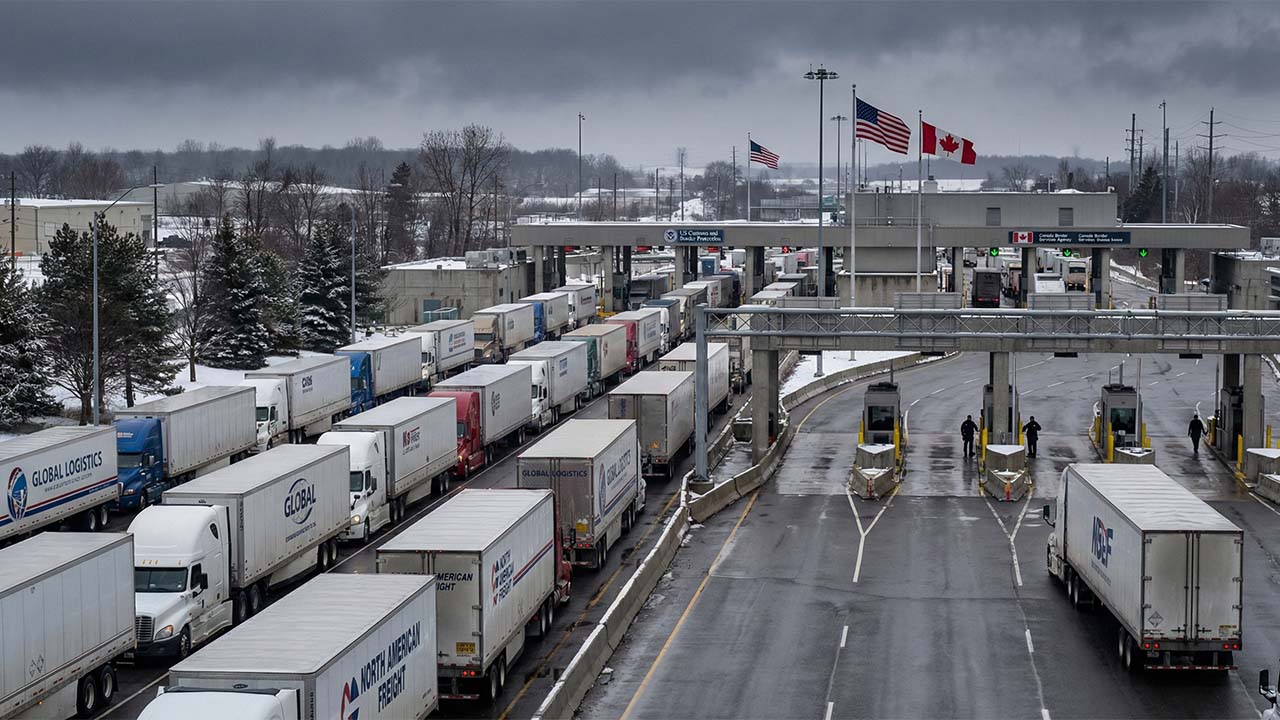
President Donald Trump’s latest warning to Canada — threatening 100% retaliatory tariffs on all Canadian exports to the United States — has injected new uncertainty into North American trade relations at a moment when global supply chains are already under strain. The Trump Canada tariff threat follows Canada’s decision to reset its trade relationship with China, signaling a shift away from Washington’s preferred trade posture and toward a more diversified foreign economic strategy.
The episode is more than political theater. It directly challenges long-standing assumptions that U.S.–Canada trade is largely insulated from sudden disruption and forces businesses, investors, and policymakers to reassess cross-border risk exposure.
What Happened and Who Is Involved
The warning came via a social media post from Donald Trump, who said Canada would face a blanket 100% tariff if it proceeds with a trade agreement with China. Trump criticized Ottawa for allowing greater Chinese electric vehicle imports and suggested that Canada was jeopardizing its economic independence by deepening ties with Beijing.
Trump also targeted Canadian Prime Minister Mark Carney, dismissively referring to him as “Governor Carney” and repeating his long-standing rhetoric about Canada’s reliance on U.S. economic and military support. The comments follow weeks of deteriorating relations between Washington and Ottawa since Trump’s return to the White House.
Canada, for its part, finalized a wide-ranging agreement with China aimed at reducing trade barriers and restoring bilateral ties. As part of that deal, Ottawa agreed to allow 49,000 Chinese electric vehicles into the Canadian market at a tariff rate of roughly 6%, reversing a previous 100% surtax. China also signaled it would ease restrictions on Canadian agricultural exports, including canola, and introduce visa-free travel for Canadians.
Carney confirmed progress after meeting Chinese President Xi Jinping during the first visit by a Canadian leader to Beijing in eight years.
Why This Matters Now
The Trump Canada tariff threat lands at a delicate moment for global trade governance. Canada’s outreach to China represents a deliberate attempt to reduce overdependence on the U.S. market, which historically absorbs the majority of Canadian exports. That strategy accelerated after Trump’s earlier tariff increases triggered consumer boycotts and cutbacks in cross-border travel.
At the same time, Trump has framed tariffs not merely as economic tools but as leverage in broader geopolitical disputes. His warning underscores how trade policy is increasingly being used to influence allies’ foreign relationships, not just to protect domestic industries.
Carney reinforced this concern in a pointed speech at the World Economic Forum in Davos, where he warned against “coercion by great powers” and criticized the use of tariffs and supply chains as instruments of pressure. While he did not name Trump directly, the message was widely interpreted as a rebuke of Washington’s approach.
How Businesses Are Affected
For businesses on both sides of the border, the immediate issue is uncertainty. The United States and Canada share one of the world’s most integrated trading relationships, with supply chains spanning autos, energy, agriculture, and manufacturing.
A 100% tariff threat — even if not enacted — complicates planning for exporters, logistics firms, and manufacturers that rely on predictable cross-border flows. Companies may delay investment, reassess sourcing strategies, or seek alternative markets to hedge against potential disruption.
Canadian exporters are particularly exposed. Although most goods traded under the USMCA are currently tariff-free, Trump’s remarks raise questions about whether exemptions could be withdrawn or reinterpreted. Non-exempt goods already face tariffs as high as 35%, with higher sector-specific rates for steel and aluminum.
U.S. businesses are not immune either. Many American manufacturers depend on Canadian inputs, from auto parts to energy products. Higher tariffs could raise costs, squeeze margins, and ultimately feed through to consumer prices.
Market and Economic Impact
From a market perspective, the Trump Canada tariff threat introduces a new layer of geopolitical risk into North American assets. While no immediate market shock followed the comments, investors tend to discount future earnings when trade policy becomes unpredictable.
Currency markets are particularly sensitive. Any sustained escalation could pressure the Canadian dollar, reflecting concerns about export competitiveness and capital flows. Bond markets may also react if trade frictions are seen as dampening growth or complicating inflation dynamics.
For the broader economy, the risk lies less in a single policy move and more in the signal it sends. The threat reinforces the idea that trade relationships — even among close allies — are subject to abrupt political shifts. That perception can weigh on long-term investment decisions, especially in capital-intensive sectors.
Political and Official Responses
The White House did not immediately clarify what would qualify as a prohibited “deal” with China or how such a threshold would be enforced. Treasury Secretary Scott Bessent said Trump had asked Canada to participate in the administration’s proposed “Golden Dome” missile-defense project, contradicting Trump’s claim that Ottawa opposes it.
Carney pushed back against Trump’s assertions of Canadian dependence, rejecting claims that the country “lives because of the United States.” He has instead emphasized diversification, with Canada actively expanding trade ties eastward to Europe and westward to Asia, including renewed engagement with China and outreach to India.
Canada’s stance reflects a broader recalibration among middle powers seeking to balance relationships with competing global giants rather than aligning exclusively with one.
What Comes Next for Investors and Consumers
For investors, the key takeaway from the Trump Canada tariff threat is not the likelihood of an immediate 100% tariff, but the elevated policy risk surrounding North American trade. Portfolio exposure to sectors with heavy cross-border integration may warrant closer scrutiny.
Consumers could eventually feel indirect effects if tariffs raise production costs or disrupt supply chains. Even the threat of trade barriers can prompt companies to adjust pricing or inventory strategies as a precaution.
A Turning Point in North American Trade Relations
This episode highlights how trade policy has become inseparable from geopolitical strategy. Canada’s decision to re-engage with China challenges Washington’s expectations of alignment, while Trump’s response signals a willingness to use tariffs as a deterrent — even against close allies.
Whether the threat materializes or fades, it underscores a new reality for businesses and markets: North American trade is no longer insulated from global power politics. For companies, investors, and consumers alike, adaptability and diversification are becoming essential strategies in an increasingly fragmented global economy.