

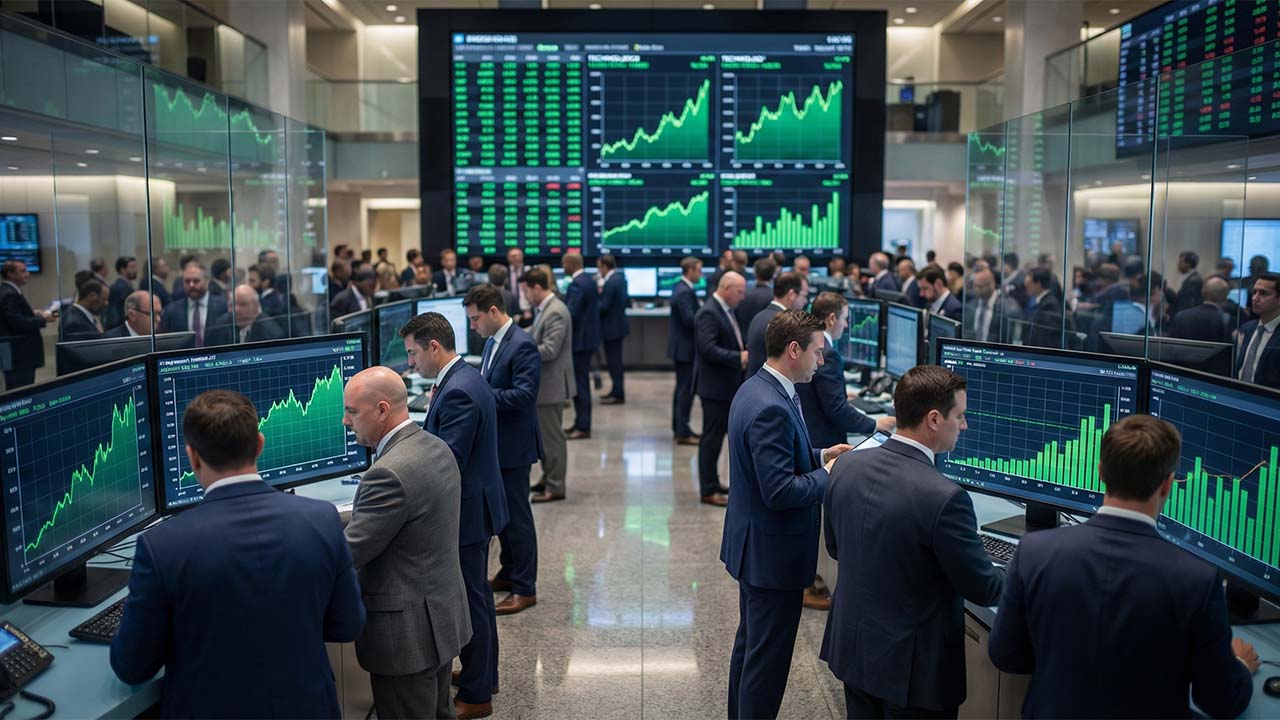
Global equity markets are entering 2026 with renewed confidence, and few forces are shaping investor behavior more decisively than the Federal Reserve rate pause impact on stocks. As fresh U.S. economic data underscored the economy’s resilience and geopolitical tensions cooled, stocks advanced while bonds fell—highlighting a clear shift in market leadership and risk appetite.
The latest rally reflects more than a short-term bounce. It signals a recalibration across asset classes as investors digest what steady interest rates mean for earnings, valuations, and capital flows at a time when artificial intelligence spending remains robust and economic growth refuses to stall.
Stocks Extend Gains as Rate Pause Expectations Firm
U.S. equities rose for a second consecutive session, with the S&P 500 climbing 0.5% and global markets broadly higher. The gains followed strong signals that the Federal Reserve is likely to hold interest rates steady in January, reinforced by firm economic data and stabilizing labor conditions.
Short-dated Treasury yields moved higher after the release of revised third-quarter growth figures showing the U.S. economy expanded at a 4.4% annualized pace—the fastest in two years. Jobless claims also steadied at historically low levels, underscoring ongoing labor market strength.
For equity investors, this combination matters. The Federal Reserve rate pause impact on stocks is most pronounced when growth remains strong enough to support corporate earnings, yet not overheated enough to force tighter policy. That balance has pushed investors back toward equities, particularly sectors with visible earnings power.
Why the Fed’s Pause Matters More Now
A rate pause does not automatically guarantee rising stock prices. Its significance depends on context—and the current backdrop is unusually supportive.
Strong growth, steady employment, and cooling inflation pressures allow the Federal Reserve to step back without signaling concern about economic weakness. That distinction has critical implications for markets. When rates are paused due to economic stress, equities typically struggle. When rates are paused because policy is sufficiently restrictive, stocks often benefit.
This is why the Federal Reserve rate pause impact on stocks is being interpreted positively by investors. Higher yields may weigh on bond prices, but they also reflect confidence in growth—an environment that historically favors equities over fixed income.
AI Trade Reignites Market Leadership
Technology megacaps were among the strongest performers, with AI-linked stocks leading gains. Comments from Nvidia’s chief executive reinforced investor conviction that artificial intelligence spending remains in an early, investment-heavy phase rather than a speculative bubble.
That view was echoed by major asset managers, who emphasized the scale of capital required to build AI infrastructure. For equity markets, this narrative is critical. AI-driven revenue growth provides earnings visibility at a time when higher interest rates make profitability—not speculation—essential.
As a result, the Federal Reserve rate pause impact on stocks is amplified in technology and semiconductor names, where investors are more willing to look past near-term valuation concerns in exchange for long-term growth clarity.
Small Caps and Trend-Following Funds Gain Traction
Beyond megacaps, smaller companies also outperformed, with small-cap stocks beating the broader market for a 14th consecutive session. This reflects growing confidence that borrowing costs have peaked and that economic momentum can sustain business investment.
At the same time, trend-following funds, including commodity trading advisors (CTAs), posted their second-strongest start to a year in decades. These strategies thrive on sustained price movements, and the current mix of rising equities, resilient commodities, and currency shifts has created favorable conditions.
For investors, this underscores a broader effect of the Federal Reserve rate pause impact on stocks: capital is rotating toward strategies and assets that benefit from stability rather than volatility.
Bonds Retreat as Equities Gain the Upper Hand
While stocks climbed, bonds moved in the opposite direction. Yields on U.S. Treasuries rose across the curve, with the 10-year yield advancing to around 4.27%. Short-dated bonds underperformed as traders scaled back expectations for near-term rate cuts.
This divergence between stocks and bonds highlights an important dynamic. When rates are expected to remain on hold amid strong growth, bonds lose appeal relative to equities. Investors demand higher yields to compensate for opportunity cost, pushing prices lower.
The Federal Reserve rate pause impact on stocks therefore extends beyond equities themselves—it reshapes asset allocation decisions across portfolios, reducing the traditional defensive role of bonds in the short term.
Geopolitical Cooling Supports Risk Assets
Market sentiment was further supported by a de-escalation in geopolitical tensions surrounding U.S. comments on Greenland. After initial volatility, markets stabilized as diplomatic progress eased fears of broader economic retaliation.
Investors have become increasingly skeptical of headline-driven market swings, a point emphasized by several strategists who warned against reacting to political noise. In this environment, fundamentals—growth, earnings, and monetary policy—have reasserted dominance.
That shift reinforces the constructive reading of the Federal Reserve rate pause impact on stocks, as reduced geopolitical risk allows monetary policy signals to carry more weight in market pricing.
What This Means for Businesses
For corporate leaders, the current market environment offers both opportunity and discipline. Stable interest rates reduce uncertainty around financing costs, enabling companies to plan capital expenditures with greater confidence.
However, elevated yields mean access to cheap debt is no longer guaranteed. Businesses with strong cash flows and pricing power stand to benefit most, while highly leveraged firms may face tighter financial conditions despite the rate pause.
The Federal Reserve rate pause impact on stocks also places a premium on execution. Investors are rewarding companies that can convert growth into earnings rather than relying on future promises.
Implications for Investors and Consumers
For investors, the message is clear: markets are rewarding quality, resilience, and earnings visibility. Equity exposure—particularly in sectors tied to AI, infrastructure, and productivity—has regained appeal relative to bonds.
At the same time, higher yields provide opportunities for income-focused strategies, particularly for those willing to accept selective credit risk. Diversification remains essential, as rate stability does not eliminate volatility.
Consumers may feel mixed effects. While borrowing costs remain elevated, a stable rate environment reduces the risk of further increases. Strong employment and steady growth support spending, but tighter credit standards may limit access to financing.
Forward-Looking Perspective
The early weeks of 2026 illustrate how quickly market leadership can shift when monetary policy expectations stabilize. The Federal Reserve rate pause impact on stocks is not a one-day story—it reflects a broader adjustment as investors recalibrate risk in a world where rates are no longer rising, but not yet falling.
As long as economic data remains solid and earnings expectations hold, equities are likely to retain an advantage over bonds. The challenge for markets will be navigating that balance without reigniting inflation or forcing the Fed back into action.
For now, the pause itself has become the catalyst—reshaping portfolios, redefining leadership, and setting the tone for the year ahead.