

Key Points
Global oil market supply risks have returned to the forefront of investor and business attention as crude prices climb on renewed disruptions in Kazakhstan and heightened geopolitical tension involving the United States and Europe. While oil markets have spent much of the past year focused on demand uncertainty and surplus forecasts, recent events underscore how fragile supply conditions can still move prices — even in a market that expects oversupply.
West Texas Intermediate crude traded above $60 a barrel after Kazakhstan’s largest oil producer halted output at two major fields, tightening flows from a region critical to global energy supply. The move comes at a time when traders are already navigating political uncertainty tied to U.S. foreign policy, adding another layer of complexity to oil pricing and risk management.
What Happened: Supply Disruptions Tighten the Market
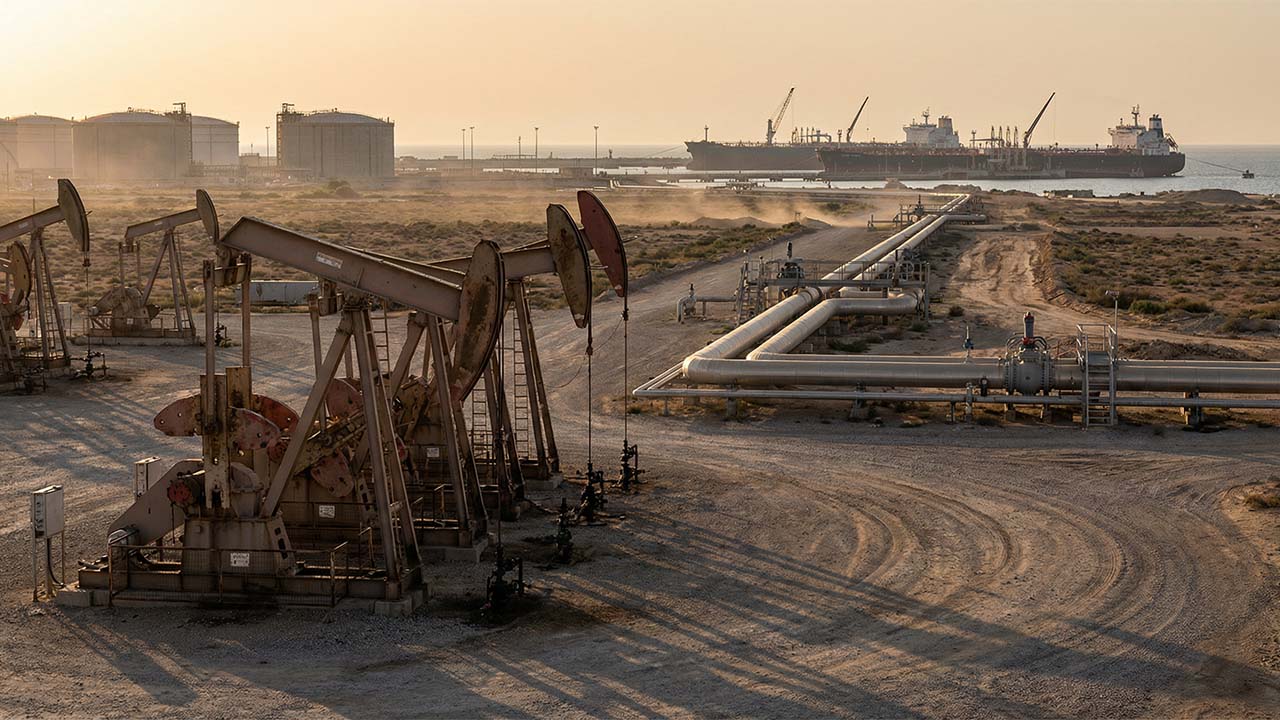
The immediate driver behind rising prices is a production halt at Kazakhstan’s Tengiz and Korolev oil fields. Operations were suspended following two fires at power generators, forcing the country’s largest producer to shut down output. According to reports cited by market participants, the Tengiz field is expected to remain offline for another seven to 10 days.
These outages follow earlier production cuts in Kazakhstan after drone strikes disrupted operations at the Caspian Pipeline Consortium terminal in Russia. That pipeline is a vital export route, handling roughly 80% of Kazakhstan’s crude shipments to global markets.
The cumulative effect of these disruptions has sharpened global oil market supply risks, particularly for traders who had assumed steady flows from the Black Sea region despite ongoing geopolitical instability.
West Texas Intermediate futures responded quickly, rising more than 2% as traders reassessed near-term supply availability. Brent crude followed suit, climbing toward the mid-$60 range.
Why Global Oil Market Supply Risks Matter Now
The timing of these disruptions is critical. Oil markets entered 2026 with widespread expectations of oversupply, driven by forecasts from the International Energy Agency that global production could exceed demand by more than 3.8 million barrels a day this year.
Against that backdrop, supply interruptions — even temporary ones — take on outsized importance. They do not eliminate the surplus outlook, but they complicate short-term pricing, inventory management, and hedging strategies for market participants.
At the same time, geopolitical risk has returned as a market variable. President Donald Trump’s renewed push to assert U.S. control over Greenland has strained relations with European allies. European leaders have signaled potential retaliation, including tariffs, raising fears of a broader trade conflict that could dampen global economic growth.
This mix of physical supply disruption and political uncertainty is forcing traders to balance conflicting signals — tight near-term supply versus weaker longer-term demand prospects.
Market Impact: Prices Rise, Confidence Stays Cautious
From a market perspective, the price response reflects caution rather than panic. Oil prices moved higher, but not explosively, suggesting traders see the Kazakh disruptions as significant yet manageable.
Rebecca Babin, a senior energy trader at CIBC Private Wealth Group, noted that concerns around Caspian Pipeline Consortium loadings have remained a key support for crude prices following recent attacks. At the same time, broader geopolitical risks are keeping traders highly sensitive to headlines.
That sensitivity is visible across asset classes. Stock markets have come under pressure, while gold and silver touched record highs as investors sought protection from political uncertainty. Oil, by contrast, has reacted more modestly, reflecting its dual exposure to both supply risk and growth concerns.
As UBS Group AG analyst Giovanni Staunovo observed, tariff threats and geopolitical tensions weigh on overall risk sentiment, and oil is not immune to those forces.
Business Impact: Planning in a Volatile Energy Environment
For businesses, rising global oil market supply risks translate into higher uncertainty around energy costs.
Energy-intensive industries — including transportation, manufacturing, and logistics — are particularly exposed. Even short-lived price spikes can disrupt budgeting and compress margins, especially for firms without robust hedging strategies.
Refiners are also adjusting. Diverging prices for Middle Eastern crude grades have made heavier barrels cheaper relative to lighter ones, encouraging Asian refiners to favor medium and sour crudes to improve margins. This shift highlights how supply disruptions in one region can ripple through refining and procurement strategies worldwide.
Meanwhile, cold weather in the United States has driven diesel prices sharply higher, adding another cost pressure for freight and industrial users.
Investor Impact: Balancing Supply Risk and Surplus Forecasts
For investors, the current environment demands careful interpretation. Global oil market supply risks are clearly rising in the short term, but they coexist with structural concerns about oversupply later in the year.
Strategists at ING Groep NV have warned that the prospect of a large crude surplus suggests prices should trend lower over time. They also caution that any escalation in U.S.–EU tensions could further weigh on demand and investor sentiment.
This push and pull helps explain why oil’s rally has been measured rather than dramatic. Investors appear unwilling to price in a sustained supply crunch without clearer evidence that disruptions will persist or widen.
For portfolio managers, this reinforces the importance of distinguishing between temporary supply shocks and longer-term structural trends when allocating capital to energy assets.
Consumers: Indirect but Real Effects
For consumers, the impact of rising oil prices is typically indirect and delayed. Gasoline and diesel prices do not move instantly with futures markets, but sustained increases can filter through to transportation costs and, ultimately, consumer prices.
Higher diesel prices are particularly relevant, as they affect shipping and logistics costs across the economy. Over time, that can influence the price of goods, even if crude prices remain well below historical peaks.
At the same time, expectations of oversupply may limit how far prices can rise, providing some reassurance that energy-driven inflation pressures will remain contained unless disruptions escalate.
Geopolitics and the Limits of Oil’s Rally
Political tensions linked to Greenland and potential U.S.–EU trade disputes add complexity but have not yet overwhelmed oil fundamentals. While such tensions have pressured equities and boosted safe-haven assets, oil has remained caught between supply fears and demand skepticism.
That balance reflects a market increasingly disciplined by data. Traders are watching field outages, pipeline flows, and inventory levels closely, rather than reacting solely to political rhetoric.
Conclusion: A Market on Alert, Not on Edge
Global oil market supply risks have intensified, lifting prices and refocusing attention on the fragility of energy flows from key producing regions. Kazakhstan’s disruptions and geopolitical uncertainty have reminded markets that supply shocks can still matter — even in a year expected to see surplus production.
For businesses, investors, and consumers, the message is one of vigilance rather than alarm. The oil market is navigating a narrow path between short-term disruption and long-term oversupply, with prices reflecting caution, not crisis. How long that balance holds will depend less on headlines and more on whether supply constraints persist or fade.