

Key Points
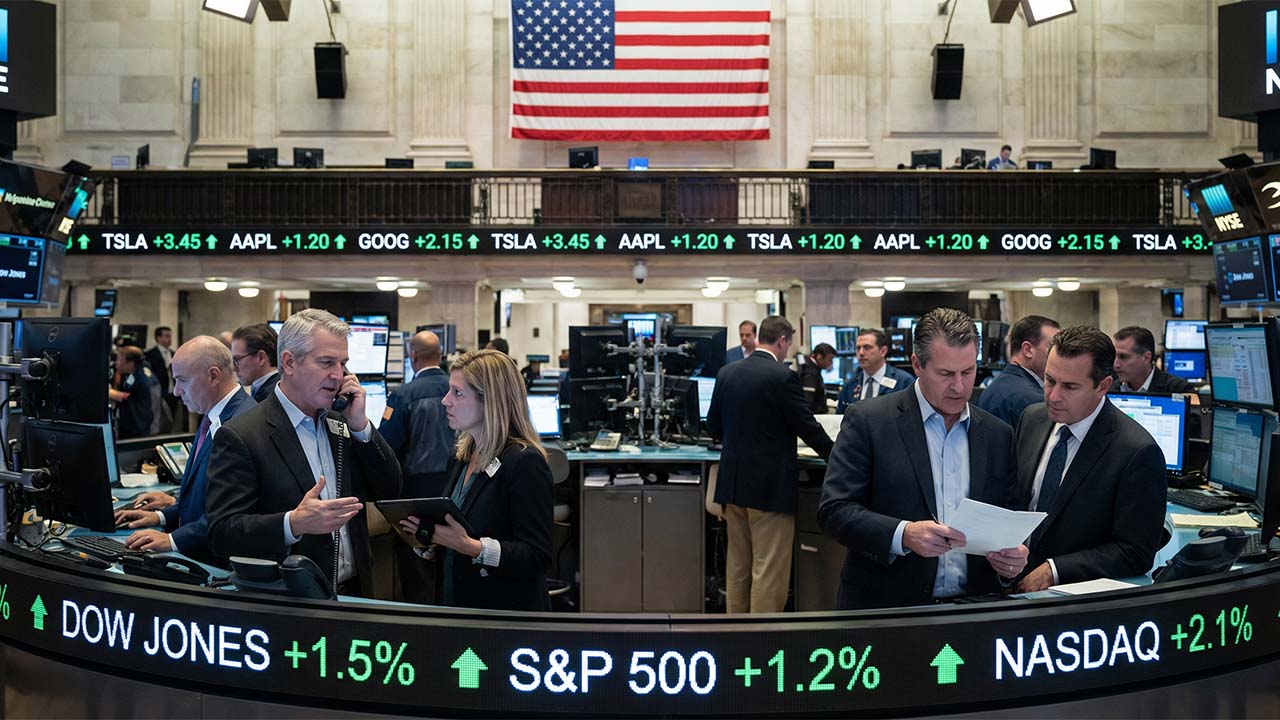
After two consecutive sessions of losses, the U.S. stock market rebounds with renewed momentum, signaling a recalibration of investor expectations rather than a full-scale risk rally. Thursday’s advance across major indexes reflected a combination of strong semiconductor earnings, selective bank optimism, and a sharp pullback in oil prices following softer geopolitical rhetoric from Washington.
The Dow Jones Industrial Average climbed nearly 300 points, while the S&P 500 and Nasdaq both posted modest gains. Although the moves were not dramatic, they marked an important shift in tone for markets grappling with earnings uncertainty, geopolitical stress, and persistently elevated interest rates.
For businesses, investors, and consumers alike, the rebound offers critical insight into what is currently driving — and restraining — U.S. financial markets.
Main Story: What Happened on Wall Street
Thursday’s recovery was broad but uneven. The U.S. stock market rebounds as leadership came primarily from semiconductors and select financial institutions, while commodities and safe-haven assets retreated.
The Dow Jones Industrial Average rose 0.6%, the S&P 500 gained 0.3%, and the Nasdaq Composite added 0.3%. Trading volumes suggested measured optimism rather than aggressive risk-taking, a pattern consistent with markets still digesting mixed corporate earnings and macroeconomic signals.
Early in the session, Taiwan Semiconductor Manufacturing Co. reported a 35% year-over-year increase in fourth-quarter profit. The results exceeded market expectations and reinforced confidence in global chip demand, particularly tied to artificial intelligence and advanced computing.
U.S.-listed shares of TSMC rose 4.5%, while ASML, a key supplier to the chip industry, surged 5.4%. The rally spilled over into broader technology sentiment, helping stabilize the Nasdaq after recent weakness.
At the same time, bank stocks delivered mixed signals. While earlier in the week major lenders had weighed on markets, Thursday brought relief rallies in firms that exceeded earnings expectations. BlackRock, Morgan Stanley, and Goldman Sachs all posted strong gains following their fourth-quarter reports.
Why This Matters Now
The timing of this rebound is critical. Markets are navigating three overlapping pressures: the start of earnings season, elevated bond yields, and geopolitical uncertainty in the Middle East.
Oil prices played a decisive role in shaping Thursday’s sentiment. West Texas Intermediate crude fell roughly 5%, dropping below $59 per barrel after President Donald Trump indicated he may delay or avoid military action against Iran. Earlier in the week, heightened rhetoric had pushed energy prices higher and fueled inflation concerns.
For equity markets, falling oil prices ease pressure on corporate margins and consumer spending. Lower energy costs can help stabilize transportation, manufacturing, and retail sectors — particularly at a time when businesses are already contending with higher financing costs.
This geopolitical cooling, even if temporary, gave investors room to refocus on fundamentals rather than headline risk.
Semiconductor Strength and the U.S.–Taiwan Deal
Beyond earnings, policy developments added another layer of support. The United States and Taiwan finalized a trade agreement that commits Taiwanese semiconductor and technology firms to invest at least $250 billion in U.S. production capacity, including domestic chip manufacturing.
In exchange, U.S. tariffs on Taiwanese goods will be capped at 15%, according to the Commerce Department.
For markets, this agreement reinforces a longer-term shift toward supply-chain localization and strategic investment in advanced manufacturing. It also helps explain why the U.S. stock market rebounds were led by chip-related stocks rather than consumer or cyclical sectors.
For U.S. businesses, particularly in technology and industrial manufacturing, the deal signals greater supply stability and reduced exposure to overseas disruptions. For investors, it strengthens the case for sustained capital spending in semiconductors despite near-term market volatility.
Banking Sector: Earnings Still Divide the Market
While some financial stocks advanced, the broader banking picture remains uneven. Earlier in the week, JPMorgan Chase shares declined sharply following its earnings release, pulling down peers including Citigroup, Bank of America, and Wells Fargo.
Investors remain cautious about net interest margins, loan growth, and credit quality as higher interest rates persist. While investment banks benefited from stronger trading and advisory revenue, traditional lenders face a more challenging environment.
This divergence highlights why Thursday’s rebound should be viewed as selective rather than comprehensive. The U.S. stock market rebounds even as investors continue to differentiate sharply between business models within the same sector.
Market Impact: Bonds, Commodities, and Currencies
Beyond equities, other markets offered important signals.
The 10-year U.S. Treasury yield rose above 4.17%, reflecting stronger-than-expected labor market data. Weekly jobless claims came in at 198,000, well below forecasts, reinforcing the view that the U.S. economy remains resilient despite tighter financial conditions.
Higher yields influence everything from mortgage rates to corporate borrowing costs. For businesses, this means capital investments remain more expensive, even as equity markets stabilize.
Commodities moved in the opposite direction. Gold prices slipped 0.6% after hitting record highs earlier in the week, while silver pulled back from fresh peaks. These moves suggest reduced demand for safe-haven assets as geopolitical tensions eased and risk appetite modestly improved.
In digital assets, Bitcoin traded near $95,100, off earlier highs, reflecting continued volatility rather than a decisive trend.
Technology and Export Controls Add Complexity
Technology stocks received a mixed but stabilizing signal. Shares of Nvidia rebounded 2.1% after falling the previous session, following confirmation that new U.S. security requirements apply to exports of its H200 AI chips to China.
While the stock recovered, the policy underscores ongoing regulatory risks for U.S. tech companies operating globally. Export controls remain a structural constraint, even as demand for AI hardware stays strong.
For investors, this reinforces the importance of distinguishing between short-term price rebounds and long-term regulatory headwinds.
What This Means for Businesses and Investors
The fact that the U.S. stock market rebounds after recent losses does not signal the end of volatility — but it does clarify current market priorities.
For businesses, the message is clear: earnings quality, cost discipline, and exposure to energy prices matter more than broad economic narratives. Companies tied to technology investment and infrastructure appear better positioned than those reliant on consumer credit expansion.
For investors, Thursday’s session highlights the value of sector selectivity. Broad indexes may rise, but underlying leadership remains narrow, centered on semiconductors, investment banking, and firms with global scale.
Consumers, meanwhile, could benefit indirectly if lower oil prices persist, easing inflation pressures and supporting household spending power.
Conclusion: A Reset, Not a Rally
Thursday’s advance reflects a market resetting expectations rather than embracing unchecked optimism. The U.S. stock market rebounds as investors respond to tangible earnings strength, easing geopolitical fears, and targeted policy support — not speculative enthusiasm.
With earnings season still unfolding and interest rates elevated, markets remain sensitive to data and corporate guidance. This rebound provides breathing room, but not certainty.
For now, Wall Street’s message is disciplined optimism: cautious, selective, and closely tied to fundamentals.