

Key Points
The sudden gold and silver price drop has jolted global markets, ending one of the most powerful precious metals rallies in recent years and forcing investors, businesses, and policymakers to reassess risk exposure. After silver surged above $84 an ounce and gold touched fresh record highs, both metals reversed sharply as traders rushed to lock in profits, underscoring how quickly momentum-driven markets can turn.
Silver led the decline, suffering its worst single-day drop since 2021, while gold posted its steepest fall in two months. The pullback followed weeks of aggressive buying fueled by speculative demand, particularly from China, and comes at a time when inventories remain tight and industrial demand stays structurally strong. This combination of extreme price appreciation and fragile market balance made the correction both abrupt and unavoidable.
What Happened in the Precious Metals Market
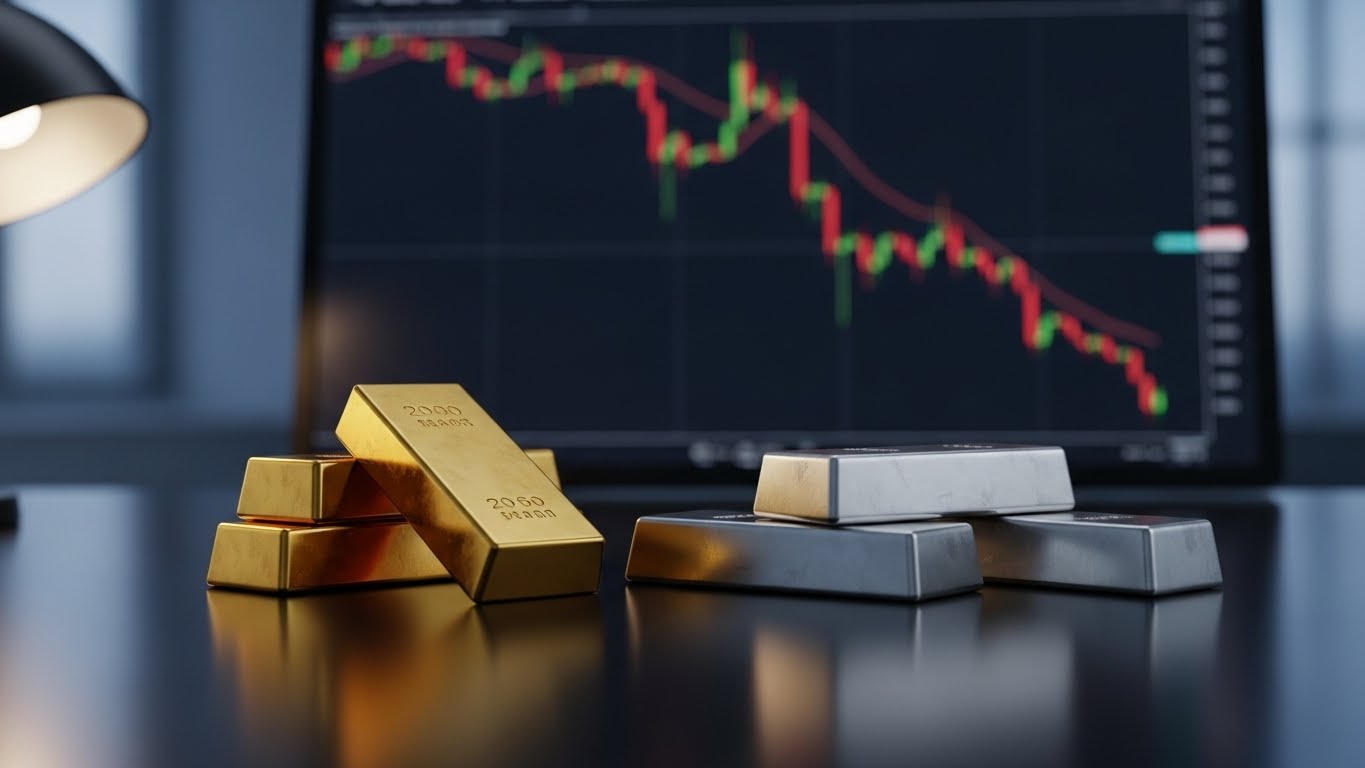
The gold and silver price drop unfolded rapidly during the latest trading session. Silver fell more than 9% intraday, retreating to around $72 an ounce after briefly trading above $84 earlier in the day. Gold declined as much as 4.5%, sliding below $4,330 an ounce after setting a record high just days earlier.
Market data showed that silver’s rally had become increasingly stretched. The metal’s 14-day relative strength index, a widely used momentum indicator, had remained above the “overbought” threshold for nearly three weeks before easing back toward the high-60s. Such readings often signal that prices have moved too far, too fast, leaving markets vulnerable to sharp reversals once buying pressure fades.
The selloff was not limited to silver and gold. Platinum plunged more than 13%, while palladium sank over 15%, marking its biggest decline since 2022. The synchronized drop across precious metals points to broad-based profit-taking rather than a deterioration in underlying fundamentals.
Why the Gold and Silver Price Drop Matters Now
This correction matters because it follows an extraordinary period of gains that reshaped investor positioning across commodities. Silver had been on track for an annual gain exceeding 150%, driven by speculative flows, exchange-traded fund demand, and aggressive buying in China. Premiums for spot silver in Shanghai surged to more than $8 an ounce above London prices, the widest spread on record, highlighting intense regional demand and supply bottlenecks.
Gold, meanwhile, benefited from its role as a hedge against inflation uncertainty, geopolitical risk, and currency volatility. The metal’s surge to record levels reflected sustained investor appetite for safety assets, even as global interest rate expectations fluctuated.
The gold and silver price drop signals that markets are entering a more cautious phase. After weeks of one-directional trading, investors are reassessing valuation risks, liquidity conditions, and the sustainability of speculative demand.
The Role of Chinese Demand and Market Structure
Chinese investment demand played a central role in driving silver to record highs. Domestic funds linked to silver contracts on the Shanghai Futures Exchange saw premiums balloon dramatically, in some cases trading more than 60% above the value of their underlying assets. Such distortions raised concerns among fund managers that late-stage buyers could face significant losses if prices reversed.
Those concerns proved well-founded. As prices peaked, selling accelerated, and thin liquidity amplified the move lower. The gold and silver price drop illustrates how regional demand imbalances can destabilize global markets, especially when inventories are already constrained.
London’s silver market had faced a squeeze just weeks earlier as ETF inflows and exports to India drained vault stocks. Although inflows have since resumed, a large share of available silver remains concentrated in New York, where traders are monitoring the outcome of a U.S. investigation that could lead to tariffs or other trade restrictions. This fragmented supply landscape adds another layer of volatility.
Impact on Businesses and Industrial Users
Unlike gold, silver has a critical industrial role, particularly in solar panels, electronics, and advanced manufacturing. With inventories near historic lows, extreme price swings can disrupt planning for manufacturers that rely on stable input costs.
The gold and silver price drop may provide short-term relief for industrial buyers who had been priced out during the rally. However, the underlying supply constraints remain unresolved. Any renewed surge in investment demand could quickly tighten availability again, keeping long-term procurement risks elevated.
For businesses operating across global supply chains, the episode highlights the importance of hedging strategies and diversified sourcing, especially for metals with both financial and industrial demand.
Market and Investor Implications
For investors, the gold and silver price drop is a reminder that even structurally bullish markets are not immune to sharp corrections. Profit-taking is a natural part of commodity cycles, particularly after parabolic price moves.
Margin adjustments also played a role in cooling speculation. The CME Group announced increases to margin requirements for some Comex silver futures contracts, a move designed to reduce excessive leverage and curb volatility. Higher margins force traders to commit more capital, often prompting the unwinding of aggressive positions.
Portfolio managers are now reassessing exposure across precious metals, weighing long-term fundamentals against near-term technical risks. While some investors may view the pullback as a buying opportunity, others are likely to remain cautious until volatility subsides.
Consumer and Economic Effects
For consumers, the immediate impact of the gold and silver price drop is limited but not irrelevant. Jewelry prices, electronics manufacturing costs, and renewable energy components are all influenced by silver prices, though changes typically filter through with a lag.
Gold’s decline may also affect consumer sentiment in regions where the metal is widely held as a store of value. Price volatility can influence household wealth perceptions and purchasing decisions, particularly in emerging markets.
At a broader economic level, the correction underscores how speculative flows can amplify commodity price cycles, complicating inflation dynamics and policy planning for central banks.
Forward-Looking Perspective
The gold and silver price drop does not negate the structural factors that supported the rally, including tight inventories, strong industrial demand for silver, and persistent investor interest in gold as a hedge. Instead, it marks a reset in positioning after an overheated phase.
Markets are likely to remain sensitive to signals around demand from China, inventory movements in key trading hubs, and regulatory actions aimed at containing speculation. For businesses and investors alike, the episode reinforces the need for disciplined risk management in an environment where price momentum can reverse quickly.
As precious metals settle into a new trading range, attention will shift from headline price gains to market stability, liquidity conditions, and the balance between investment enthusiasm and real-world supply constraints.