

Key Points
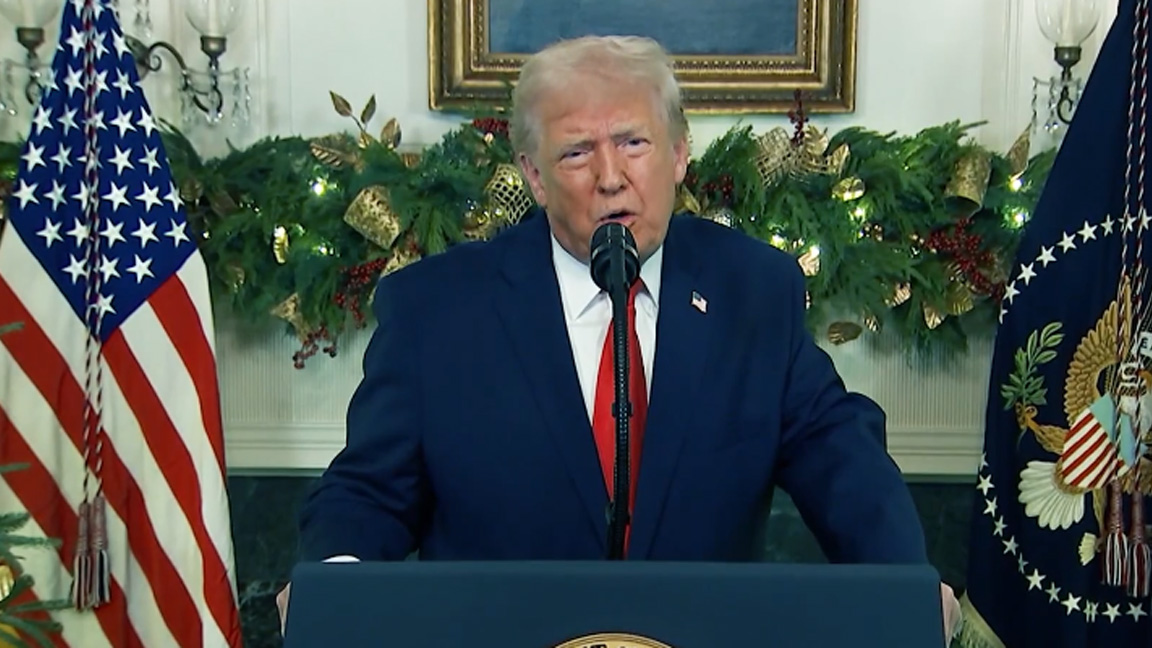
The Trump holiday speech delivered from the White House this week offered a sharp snapshot of a presidency balancing bold claims with mounting political pressure. Speaking during a rare evening address surrounded by holiday decorations, President Donald Trump highlighted what he called major victories in his first year back in office, while dismissing criticism over high prices and low approval ratings.
The address came at a delicate moment. With midterm elections less than a year away and fresh polling showing weak public confidence in his economic leadership, the Trump holiday speech was clearly designed to reset the narrative and rally supporters.
A Short Speech With a Strong Message
In the Trump holiday speech, which lasted under 20 minutes, the president struck a rapid and forceful tone. He told Americans that he inherited economic problems from his Democratic predecessor and claimed his administration is moving quickly to fix them.
“Eleven months ago, I inherited a mess, and I’m fixing it,” Trump said, placing responsibility for rising consumer prices on former President Joe Biden, past trade agreements, and immigration policies.
While Trump frequently argues that his accomplishments are overlooked, the speech introduced few new policy actions aimed at easing household costs. Instead, it focused heavily on grievances, including concerns about border security, crime, and cultural issues such as transgender rights.
Despite the confrontational tone, Trump also sought to project optimism. He told the nation that the United States would emerge stronger next year and portrayed the current period as a turning point for economic recovery.
Economic Claims Take Center Stage
The economy dominated much of the Trump holiday speech, even as the president acknowledged that prices remain high. He argued that inflation pressures are easing and insisted that conditions are improving faster than many Americans realize.
“I am bringing those high prices down and bringing them down very fast,” Trump said, adding that the country is “poised” for an economic boom.
To support that claim, Trump pointed to his tax policies, tariffs, and plans to replace Federal Reserve Chair Jerome Powell. He also said his administration has attracted $18 trillion in investments, which he claims will lead to job creation and new factory openings across the country.
“One year ago our country was dead,” Trump said during the Trump holiday speech. “Now we’re the hottest country anywhere in the world.”
However, recent government data paints a more mixed picture. While economic growth has rebounded somewhat after contracting earlier in the year, job growth has slowed, unemployment has climbed to its highest level in four years, and consumer prices remain elevated.
Approval Ratings Undercut the Message
The optimistic tone of the Trump holiday speech contrasts sharply with public opinion. A new Reuters/Ipsos poll released this week shows that only 33% of U.S. adults approve of how Trump has handled the economy.
Affordability remains a major concern for voters, particularly as inflation has edged higher after hitting a four-year low of 2.3% earlier this year. The timing of the speech, just ahead of a closely watched inflation report from the Bureau of Labor Statistics, underscored the political stakes.
Republican lawmakers, who are preparing to defend narrow majorities in Congress during next year’s midterm elections, are closely watching whether Trump can convince voters that his economic strategy is working.
Democrats, meanwhile, have already begun sharpening their attacks, arguing that the president has failed to deliver meaningful relief to families struggling with high costs.
A Surprise Policy Announcement
One of the few concrete initiatives announced in the Trump holiday speech was a direct payment to U.S. service members. Trump said his administration would issue a “warrior dividend” of $1,776 to approximately 1.45 million members of the armed forces in the coming week.
The announcement was met with immediate attention, as it marked a rare example of direct cash support outlined during the address. Trump framed the payment as recognition of military service and commitment.
He also endorsed a Republican-backed proposal to send cash directly to Americans to help cover health insurance costs, rather than continuing subsidies through the Affordable Care Act. That proposal, however, has not yet secured enough support in Congress to advance.
“I want the money to go directly to the people so you can buy your own healthcare,” Trump said during the Trump holiday speech, arguing that insurance companies would be the only losers under such a system.
Limited Focus on Foreign Affairs
Notably, the Trump holiday speech spent little time on foreign policy, an area that dominated much of his first year back in office. Trump made only a brief reference to the war in Gaza and did not mention the ongoing war in Ukraine or rising tensions involving Venezuela.
The omission stood out given recent global developments and suggested the administration’s current priority is refocusing attention on domestic issues, particularly the economy and immigration.
Political Reactions Roll In
Reaction to the Trump holiday speech was swift and divided along party lines.
Democrats criticized the address as lacking substance and failing to address everyday economic struggles. Senator Mark Warner of Virginia described the speech as “a sad attempt at distraction,” arguing that it offered few real solutions.
California Governor Gavin Newsom, widely seen as a potential 2028 presidential contender, responded on social media by repeatedly posting the word “Me,” a jab at what critics view as Trump’s self-centered messaging.
Supporters of the president praised the tone of confidence and his emphasis on border security, military support, and investment. They argue that economic improvements take time and that Trump’s policies will deliver clearer results in the year ahead.
Looking Ahead to a Critical Year
As the Trump holiday speech made clear, the president is already looking toward the political battles of 2026. His ability to persuade Americans that the economy is improving may prove decisive for Republicans hoping to retain control of Congress.
Trump rose to power by capitalizing on voter frustration over inflation during the previous administration, defeating former Vice President Kamala Harris in last year’s election. Now, he faces a similar challenge: convincing voters that his own policies are delivering relief.
With inflation still elevated, job growth slowing, and approval ratings under pressure, the months ahead will test whether the confidence displayed in the Trump holiday speech resonates beyond his political base.
For now, the address served as both a defense of his record and a preview of the arguments likely to dominate the coming election cycle.