

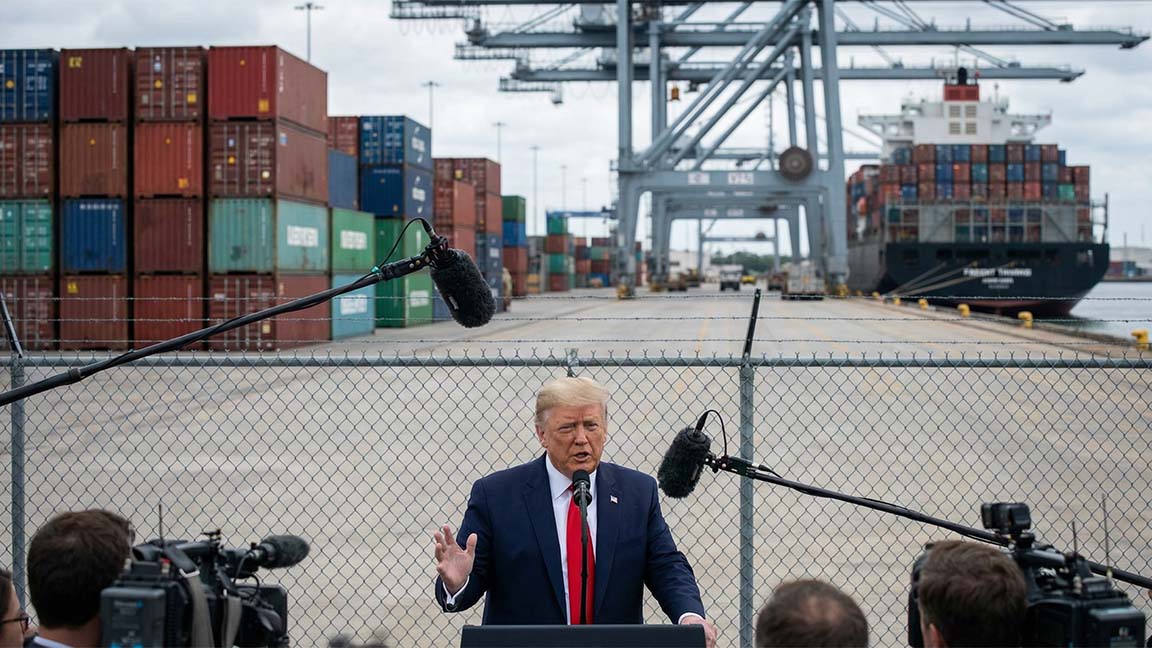
Trump tariffs are once again at the center of the U.S. economic debate, as President Donald Trump highlights ambitious plans for tariff revenue while facing slowing collections, legal uncertainty, and growing strain in global trade relationships. What began as a cornerstone of Trump’s trade policy has evolved into a complex mix of political messaging, economic consequences, and unresolved legal risks that could shape the months ahead.
Key Points
At a recent rally in Pennsylvania, Trump underscored his long-standing enthusiasm for tariffs, telling supporters he “loves” the word more than any other in the dictionary. That enthusiasm, however, is now being tested by softer revenue numbers, farmer concerns, and looming Supreme Court scrutiny that could upend the administration’s trade agenda.
Trump Tariffs Revenue Promises Face New Scrutiny
Since the 2024 presidential campaign, Trump tariffs have been linked to a wide range of spending promises. According to analysis cited by Yahoo Finance, the president has floated at least nine different uses for tariff revenue. These ideas have ranged from sending Americans $2,000 “tariff dividend” checks to helping fund Republican-backed tax cuts enacted earlier this year.
The core argument behind Trump tariffs has been that foreign exporters, rather than American consumers, would shoulder the cost, while the U.S. Treasury benefits from billions in added revenue. Yet recent figures suggest that revenue growth may be losing momentum.
Monthly collections from Trump tariffs declined to $30.76 billion last month, down from $31.35 billion in October. This marked the first drop since the administration began implementing the latest round of duties. The decline followed targeted tariff reductions on goods such as coffee, oranges, cocoa, beef, and bananas—items closely tied to everyday consumer prices.
While the drop was relatively modest, it has fueled renewed debate over whether Trump tariffs can reliably support the sweeping spending plans the president has outlined.
Supreme Court Decision Looms Over Trump Tariffs
Adding to the uncertainty is a pending Supreme Court decision that could significantly alter the future of Trump tariffs. Legal experts warn that the ruling could invalidate large portions of the tariff regime, potentially forcing the federal government to issue refunds estimated as high as $100 billion.
This risk has already prompted action from major U.S. companies. Several firms, including Costco, have filed lawsuits and claims seeking tariff refunds, arguing that the duties were improperly imposed. If the courts rule against the administration, Trump tariffs could transform from a revenue source into a major fiscal liability.
The legal challenge underscores a broader concern for businesses: policy unpredictability. Companies that have paid billions under Trump tariffs now face uncertainty over whether those funds may eventually be returned—or whether new duties could still be imposed under a different legal framework.
Trump Tariffs and the $12 Billion Farm Bailout
One of the most visible consequences of Trump tariffs has been felt in the agricultural sector. Retaliatory measures from U.S. trading partners, particularly China, sharply reduced demand for American farm exports.
Soybeans have been at the center of this disruption. China, once the largest buyer of U.S. soybeans, virtually halted purchases before a trade truce was reached in October. Although exports have shown signs of stabilization, farmers say the damage has been deep and lasting.
In response, the administration announced a $12 billion bailout fund for farmers on December 9. Trump has argued that this assistance “would not be possible without tariffs,” framing Trump tariffs as both the cause of disruption and the source of relief.
Many farmers, while welcoming the aid, say it falls short. Lower crop prices and lost export opportunities have weighed heavily on rural incomes, and farm groups have warned that more support may be needed if trade tensions persist.
Trump Tariffs and Consumer Price Concerns
As Trump tariffs ripple through supply chains, consumer prices remain a growing political issue. Tariffs on imported goods can raise costs for retailers, which may then pass those increases on to shoppers.
In a recent interview, Trump acknowledged public concern over prices and said he may consider “some” additional carveouts. This follows earlier decisions to ease tariffs on select food items, moves aimed at limiting inflationary pressure on household budgets.
These selective rollbacks highlight a balancing act within the Trump tariffs strategy: maintaining pressure on foreign trade partners while minimizing the impact on American consumers, especially as inflation remains a sensitive topic nationwide.
US-UK Tech Deal Suspended Amid Trade Frustrations
Trump tariffs have also intersected with broader trade diplomacy. The United States has suspended implementation of a proposed “technology prosperity deal” with the United Kingdom, according to reports cited by the Financial Times.
The agreement was intended to deepen cooperation in advanced fields such as artificial intelligence and quantum computing. However, frustration over stalled negotiations and unresolved trade issues led Washington to pause the effort.
The suspension signals that Trump tariffs and trade demands are influencing not only traditional goods but also strategic technology partnerships. For allies like the UK, the pause raises questions about how tariff policy may complicate long-term collaboration in emerging industries.
Trump Tariffs and Asia-Pacific Trade Dynamics
Beyond Europe, Trump tariffs continue to shape relations across the Asia-Pacific region. Indonesia has said it hopes to finalize a trade agreement with the United States by the end of 2025, even as reports suggest talks were recently at risk of collapse.
These negotiations reflect a broader recalibration of U.S. trade ties, with Trump tariffs serving as both leverage and a point of contention. For countries seeking access to the U.S. market, tariff policy remains a central factor in ongoing discussions.
Meanwhile, Trump approved a limited move allowing Nvidia to sell some of its powerful H200 chips to China. The president said Chinese President Xi Jinping responded “positively” to the decision, suggesting a tactical easing of restrictions amid broader trade tensions.
While not directly a tariff issue, the decision underscores how Trump tariffs fit into a wider strategy that blends trade barriers, export controls, and diplomatic signaling.
Business Community Reacts to Trump Tariffs Uncertainty
For U.S. businesses, Trump tariffs have created a mixed landscape. Some domestic manufacturers support the duties, arguing they level the playing field against foreign competitors. Others say tariffs raise input costs and complicate long-term planning.
Retailers and importers have been particularly vocal. Companies dependent on global supply chains have warned that tariff volatility makes pricing and investment decisions more difficult. The recent decline in tariff revenue, coupled with the risk of court-ordered refunds, adds another layer of uncertainty.
Financial markets have also taken note. While tariffs are only one factor influencing investor sentiment, ongoing trade disputes and legal questions can amplify volatility, especially for companies with significant international exposure.
Trump Tariffs in the Political Spotlight
Politically, Trump tariffs remain a defining feature of the president’s economic message. Supporters view them as a strong stance against unfair trade practices and a tool to bring manufacturing back to the United States.
Critics argue that the costs outweigh the benefits, pointing to higher prices, strained alliances, and the need for costly bailouts. The Supreme Court’s forthcoming decision may intensify this debate, potentially forcing lawmakers and voters to reassess the long-term viability of tariff-driven policy.
As Trump continues to champion tariffs on the campaign trail and in public appearances, the gap between rhetoric and real-world outcomes is likely to remain under close scrutiny.
Conclusion
Trump tariffs stand at a pivotal moment. Once promoted as a reliable revenue engine and a powerful negotiating tool, they now face slowing collections, legal threats, and mounting pressure from businesses, farmers, and consumers.
With global trade talks in flux, allies expressing frustration, and courts weighing in, the future of Trump tariffs is far from settled. Whether they evolve into a lasting pillar of U.S. economic policy or are reshaped by legal and political forces will have significant implications for the economy, global trade, and American households in the months ahead.