

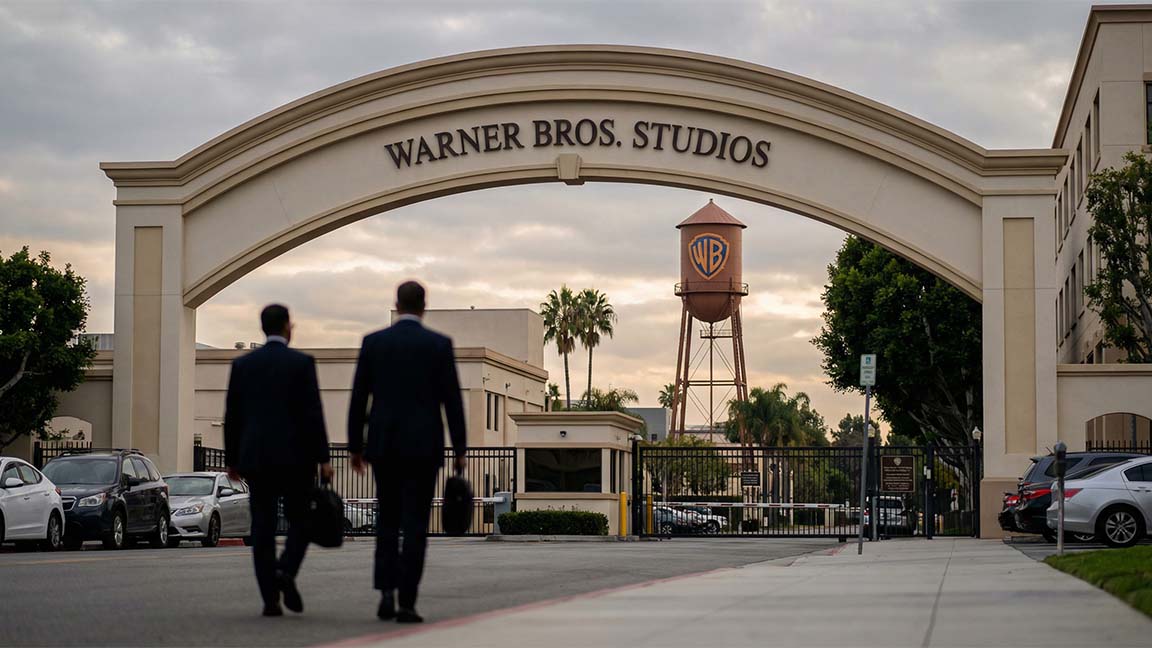
The Warner Bros. Curse is back at the center of Hollywood, as Netflix and Paramount wage a high‑stakes fight to buy the iconic studio.
Key Points
For decades, Warner Bros. has been at the heart of headline‑grabbing mergers and breakups. Again and again, grand promises of “transformative” deals have ended in write‑downs, culture clashes and embarrassed executives. The pattern is so persistent that some now talk about a Warner Bros. Curse — a corporate cautionary tale about how hard it is to make mergers and acquisitions actually work.
Economists have long warned that most corporate marriages fail. One influential Harvard Business Review article put the failure rate for mergers and acquisitions between 70% and 90%. The story of Warner Bros., from AOL Time Warner to AT&T and Discovery, offers a vivid case study of how those statistics play out in real companies.
Now, as Netflix vows it can avoid the Warner Bros. Curse, the studio finds itself in yet another contested deal that could either rewrite its history — or extend the curse into a new era.
How the Warner Bros. Curse Took Hold in the Modern Era
The most recent chapter of the Warner Bros. Curse unfolded in the late 2010s.
In 2018, after a two‑year regulatory battle, AT&T bought what was then called Time Warner for $85.4 billion and rebranded the company as WarnerMedia. Many investors believed AT&T had overpaid, and the stock market never fully embraced the deal.
Inside the new company, the problems mounted. WarnerMedia struggled to turn streaming into a large, reliable profit engine. Its movie business was hammered by the pandemic. Culturally, the telecom giant and the media group never really clicked.
The Warner Bros. Curse resurfaced when AT&T effectively unwound the deal. In a transaction that represented tens of billions of dollars in losses for shareholders, AT&T sold shares and ceded control of WarnerMedia to Discovery Inc. The two businesses formally merged in 2022, creating Warner Bros. Discovery — a name some likened to a corporate Frankenstein, borrowing from yet another Warner Bros. property.
From there, the missteps continued. The company rebranded its streaming service from HBO to HBO Max, then to Max, and then back again to HBO Max, confusing consumers and critics alike.
It also scrapped the nearly completed film “BatGirl,” despite spending close to $90 million on the production, and apparently wrote off the loss for tax purposes.
A later move to stream Mad Men on HBO Max added fresh fuel to the Warner Bros. Curse narrative. In remastering the series into widescreen 4K, the company failed to catch glaring visual problems before release. Viewers reported seeing production crew members in frame, including a technician holding a “vomit hose” for an actor. For many, the episode summed up this phase of Warner Bros. history as something close to Looney Tunes.
AOL–Time Warner: The Original Warner Bros. Curse Disaster
The most infamous expression of the Warner Bros. Curse came at the turn of the millennium, in a deal still taught in business schools as one of the worst mergers of all time.
A Dotcom‑Era Dream Deal
In October 1999, America Online CEO Steve Case called Time Warner CEO Gerald Levin with a bold proposal: the two companies should merge.
Case, then 41, had spent 15 years turning AOL into one of the most exciting companies in America, popularizing the internet for tens of millions of everyday users. The company even inspired a hit romantic comedy, You’ve Got Mail, produced and distributed by Warner Bros.
Yet Case was uneasy. He worried about intensifying competition, the possibility that the stock market was in a speculative frenzy, and the fact that AOL owned relatively few hard assets. He wanted to use AOL’s soaring share price to buy something tangible, diversify the business and secure a more durable future.
Time Warner looked like the answer. AOL was already moving into content, and Time Warner offered a deep trove of intellectual property. Just as important, Case coveted Time Warner’s vast cable network, which promised value as consumers moved from dial‑up to high‑speed internet.
Levin, for his part, was frustrated with his own company’s trajectory. Time Warner had become a sprawling media conglomerate, holding Time magazine, Warner Bros. Pictures, a record label, HBO, CNN, TBS and Sports Illustrated. Its stock lagged during the dotcom boom, and Levin feared it was missing the digital future. He longed for another “transforming transaction” to cement his legacy.
He also remembered earlier turbulence that helped cement the Warner Bros. Curse. In the late 1980s and early 1990s, when Time Inc. moved to merge with Warner Communications, a company then known as Gulf & Western — which would become Paramount Communications and is now Paramount Skydance — tried a hostile takeover of Time Inc. The effort failed, but it cost Time significant money, time and stress. Levin worried he was stepping into another saga like that.
Still, he agreed to hear Case out. The two executives met secretly in a Manhattan hotel suite near Time Warner’s headquarters. Over room‑service dinner, wine and chocolate mousse, they talked about business and life and decided they were aligned. They would combine their companies into a new media powerhouse.
The details proved thorny. AOL’s market value was nearly double Time Warner’s and growing faster, but Time Warner generated far more revenue and owned major media and cable assets. Levin initially wanted a 50‑50 split of the new company. Case refused. After months of negotiation, Levin accepted a structure giving Time Warner 45% of the merged entity.
On January 10, 2000, AOL announced it would acquire Time Warner in a deal valued at $182 billion. The combined company, AOL Time Warner, would be worth about $350 billion — a wedding of old and new media that many analysts hailed as brilliant. Expectations for profit growth were sky‑high.
When the Bubble Burst
The Warner Bros. Curse showed up almost immediately. Levin had negotiated the merger largely in secret, treating much of Time Warner’s leadership and board as rubber stamps. Many executives and employees felt blindsided and resentful.
Cultural clashes followed. Time Warner’s style was formal and structured; AOL’s was loose and chaotic. Time Warner divisions like HBO, CNN, Warner Bros. and the magazines were used to operating independently. AOL wanted tighter central control and cross‑platform ad deals. AOL leaders focused intensely on beating expectations and driving the stock price, while Time Warner executives were less driven by quarterly metrics. Each side dismissed the other’s expertise.
Then market conditions turned. The two sides had struck their deal just three months before the peak of the dotcom bubble, on March 10, 2000. As the bubble deflated, AOL’s stock price fell.
The merger depended on rapid growth at AOL. But as the market slumped and the economy weakened, advertisers cut budgets — hurting both AOL and Time Warner. AOL’s subscriber growth slowed, and its stock decline accelerated.
By January 11, 2001, when regulators finally cleared the merger, AOL Time Warner was already under serious strain. The recession that began in 2001 and the shock of 9/11 made things worse.
The company scrambled to respond. It launched share buybacks to signal confidence even as top executives sold shares. Thousands of employees were laid off. The company cut costs so deeply that it eliminated perks like free soda, making staff pay vending machine prices. Behind the scenes, AOL executives resorted to accounting tricks to make advertising revenue look stronger than it was.
Culture Clash, Scandal and Collapse
As the Warner Bros. Curse tightened its grip, internal relationships deteriorated. The once friendly partnership between Case and Levin turned into open conflict, with Case working the board against Levin.
On December 5, 2001, Levin announced he would take early retirement. He later recalled that the experience left him so shaken that he began crying frequently, something he said he had never done before.
The leadership vacuum turned into a civil war within the company. Richard Parsons, who became CEO, later told The New York Times that he could not figure out how to blend the old‑media and new‑media cultures. They were “like different species,” he said, and “inherently at war.”
In the summer of 2002, The Washington Post reported that AOL had been inflating its advertising and other revenue figures both before and after the merger. The revelations triggered lawsuits and investigations by the Securities and Exchange Commission. AOL Time Warner’s stock went into free fall.
By the end, more than $200 billion in shareholder value — over $350 billion in today’s dollars — had been wiped out. The company paid large fines. Almost all senior AOL executives were dismissed. Under pressure, Steve Case resigned as chairman.
In 2003, the company dropped “AOL” from its name, reverting to Time Warner. In 2009, it formally separated from AOL altogether. AOL survived and was eventually sold to Italian tech firm Bending Spoons for $1.5 billion.
What is now Warner Bros. Discovery still carries the scars of that failed union, including billions of dollars of debt traceable to the AOL Time Warner era — a lasting reminder of the Warner Bros. Curse.
Why the Warner Bros. Curse Keeps Coming Back
The Warner Bros. Curse also illustrates broader reasons why so many mergers and acquisitions disappoint.
Overpaying and the Winner’s Curse
Clayton Christensen and co‑authors once noted that 70% to 90% of mergers and acquisitions fail. A key driver is overpayment.
Behavioral economists describe a “winner’s curse”: in competitive bidding, the winner is often the party that most overestimates the value of the prize. In corporate deals, that means the acquirer may win precisely because it is willing to pay more than the target is truly worth.
NYU professor Melissa Schilling has pointed out that buyers in mergers almost always pay more than a firm’s current value, because otherwise existing owners would simply keep it or sell to someone else. Deals only work if the acquirer knows something the market does not, or can manage the assets far better than the current owners — a bar that is very hard to clear in practice.
The Warner Bros. Curse shows what happens when executives believe they can easily unlock “synergies” that turn out to be elusive, and when they overrate their ability to foresee what a combined company will really be worth.
Incentives, Ego and Information Gaps
Another set of forces behind the Warner Bros. Curse involves incentives and information.
In The Merger Mystery, scholars Geoff Meeks and J. Gay Meeks argue that “misaligned incentives” between executives and shareholders often push companies toward questionable deals. Leaders and advisors can make substantial personal gains from mergers and acquisitions — through pay packages, bonuses and heightened stature — even when those deals fail to improve profits or benefit employees and investors. Warner Bros. Discovery CEO David Zaslav’s deal‑making compensation has been cited as one example of these dynamics.
There is also the ego factor. Running a much larger company or controlling a high‑profile asset can be its own reward, regardless of whether the merger ultimately delivers value.
On top of that, economists emphasize asymmetric information: one side in a deal often knows more about the asset being bought or sold than the other. Insiders at AOL, for instance, may have had a clearer view of the company’s underlying problems than Time Warner did. Better due diligence or slower negotiations might have led Time Warner to walk away or structure terms differently.
Finally, the Warner Bros. Curse underscores how hard post‑merger integration really is. Turning two organizations into one means navigating culture clashes, personal rivalries and complex changes in processes and strategy. Those difficulties can sap morale and drag down performance, erasing the very synergies the merger was meant to create.
Netflix’s Bid to Break the Warner Bros. Curse
Despite this history, Netflix now argues it can defy the Warner Bros. Curse as it pursues a deal for the studio.
On a recent call with Wall Street analysts, co‑CEO Greg Peters said many past failures were driven by buyers who did not understand the entertainment business or what they were acquiring. Netflix, he argued, operates squarely in the same core businesses that matter at Warner Bros., and understands those assets well.
Peters also drew a contrast with “legacy non‑growth” firms that pursued Warner Bros. as a lifeline. Netflix, he said, is a healthy, growing company that is “super, super excited” about its own prospects, suggesting it is not seeking a rescue play.
But the next chapter of the Warner Bros. Curse is already complicated. Paramount is attempting a hostile takeover of the studio, setting up a bidding battle with Netflix. That kind of intense auction can heighten the risk of the winner’s curse, increasing the odds that whoever prevails may overpay.
For now, it is unclear whether this latest saga will end with a dark‑horse success story or yet another troubled sequel in the long franchise of Warner Bros. mergers and acquisitions. The history of the Warner Bros. Curse offers plenty of reasons for caution — even as the promise of owning one of Hollywood’s most storied studios continues to tempt ambitious buyers.