

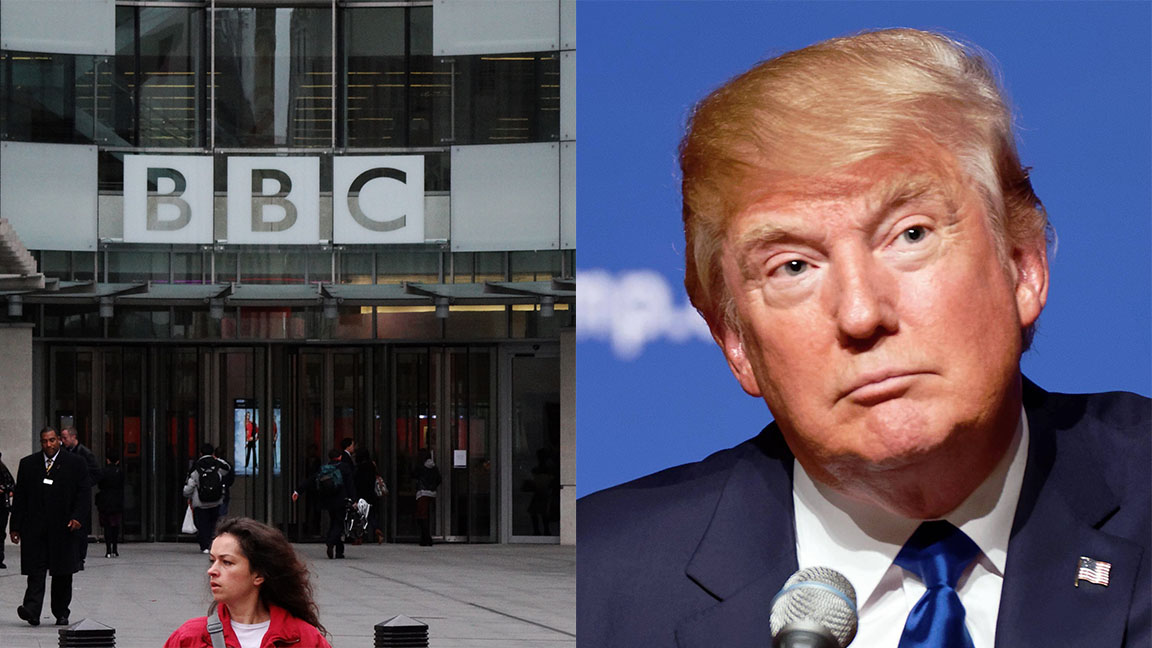
Trump BBC lawsuit faces steep legal hurdles even after the broadcaster apologized and pulled the documentary at the center of the dispute. President Donald Trump said he’s pursuing damages that could reach $5 billion over an edited clip of his Jan. 6, 2021, speech that, he argues, made it appear he directly called for violence at the U.S. Capitol.
Key Points
“I think I have to do it,” Trump told reporters on Air Force One on Friday. The threat escalates his clash with the British broadcaster after its top leaders resigned and the BBC retracted the film “Trump: A Second Chance,” which aired a week before the 2024 U.S. election.
Legal experts say the Trump BBC lawsuit would have to clear multiple barriers, from jurisdiction to proof of “actual malice,” a high standard designed to protect free speech—especially in coverage of public figures.
Why the Trump BBC lawsuit faces a high bar
The immediate question is where and how the case can be brought. The documentary did not air in the U.S. and was geo‑blocked on the BBC’s streaming service, complicating arguments for U.S. jurisdiction.
Trump’s attorney set a Nov. 9 deadline for the British Broadcasting Corp. to apologize, retract, and pay compensation or face a $1 billion defamation suit. While the BBC apologized and retracted the program, it offered no payment. The White House referred comment to Trump’s lawyer, Alejandro Brito, who did not immediately respond to an email. Trump’s team now says the complaint will be filed in Florida.
Jurisdiction questions cloud the case
Because the film was not broadcast in the U.S. and access was restricted domestically, the court will need to consider whether sufficient U.S. contacts exist. That threshold could be a hurdle before the merits are even reached.
The UK is not an option. The one‑year time limit for filing defamation claims has run out, closing off that avenue.
“Actual malice” under NYT v. Sullivan
A core challenge for the Trump BBC lawsuit is proving “actual malice”—that the BBC knew the edit was false or acted with reckless disregard for the truth. That standard, set by the U.S. Supreme Court in 1964, is intentionally demanding for cases involving public figures.
“They’ve got to meet the actual malice standard with New York Times versus Sullivan, which is a very tough standard,” said Gregory Germain, a professor at Syracuse University College of Law. Trump is “the ultimate public figure.”
Substantial truth and the edited clip
The BBC’s edit spliced two passages from Trump’s speech in a way that suggested a direct call for violence. While more than a thousand supporters later breached the Capitol and dozens of officers were injured, Trump’s remarks did not include an explicit call for an attack.
Even so, another hurdle for the Trump BBC lawsuit is the doctrine of “substantial truth,” which can shield outlets when the overall gist of a report is not materially false—even if an edit is poorly executed.
“I don’t think they should win a Pulitzer Prize for the editing, but it’s not defamatory,” Germain said. “What he’s alleging is that he doesn’t like the way they edited the video; he’s not alleging that they posted a deep fake or something.”
BBC apology and resignations change little legally
The BBC said it “sincerely regrets the manner in which the video clip was edited,” but added, “we strongly disagree that there is a basis for a defamation claim.” The apology and retraction came a day before the deadline set by Trump’s lawyer and followed the resignations of Director‑General Tim Davie and head of news Deborah Turness.
The moves met some of Trump’s demands but stopped short of compensation. Lyrissa Lidsky, a professor at the University of Florida Levin College of Law, said the damages floated are far from realistic.
“The damages he asked for were completely unrealistic, and he would be very unlikely to recover anywhere near that,” Lidsky said. “He’s claiming reputational har,m but he won the presidency afterwards.”
Trump’s legal team took a harder line after the apology, saying the network engaged in a “pattern of defamation” by “intentionally and deceitfully” editing what they called a historic speech in a way that could influence an election.
Past media clashes frame the Trump BBC lawsuit
A fresh complaint against the BBC would add to Trump’s history of litigation against media organizations, including pending multi‑billion‑dollar cases against the New York Times and the Wall Street Journal, both of which deny wrongdoing.
Other disputes have ended with settlements. CBS agreed to pay $16 million over how 60 Minutes edited a quote in an interview with Kamala Harris, and ABC reached a similar settlement over an incorrect on‑air reference involving a civil verdict.
The record shows Trump’s willingness to litigate aggressively. Whether the Trump BBC lawsuit can overcome First Amendment protections remains the central question.
Political speech protections loom large
Benjamin Zipursky, a professor at Fordham Law School, said such a case is likely to fail because U.S. courts prioritize protecting political discourse from chilling effects.
“It’s the entire foundation of the Supreme Court’s protection of free speech that threats of costly lawsuits could cause the media to censor itself, and this case is a dramatic example of that,” Zipursky said.
That concern underscores why the “actual malice” standard is so exacting. For the Trump BBC lawsuit to succeed, the complaint would need to marshal evidence that the BBC intended to defame or recklessly disregarded the truth—an uphill climb, legal scholars say.
What comes next in the Trump BBC lawsuit
Trump says he will proceed, signaling a filing in Florida. If the case moves forward, early battles will likely focus on jurisdiction and whether U.S. courts are the proper forum for a program that did not air domestically.
On the merits, the court would evaluate whether the edit materially altered the meaning of Trump’s words in a defamatory way. The BBC’s apology may be relevant for context, but it does not concede defamation and explicitly denies liability.
Any discovery fight would likely be intense, with both sides probing editorial decisions and intent. But even reaching discovery could depend on clearing initial motions centered on jurisdiction and First Amendment standards.
For now, both sides are holding position: the BBC stands by its legal defense while acknowledging a flawed edit, and Trump continues to press for accountability—and sizable damages—that legal experts say are highly unlikely.
Conclusion
The Trump BBC lawsuit highlights the tension between protecting reputations and preserving robust political speech. Despite an apology and retraction, the path through U.S. courts is narrow: jurisdiction is uncertain, “actual malice” is hard to prove, and “substantial truth” may shield the broadcaster. Unless those hurdles are overcome, the case—if filed—faces long odds.
FAQ’s
What is the Trump BBC lawsuit about?
Trump threatens to sue over a BBC edit of his Jan. 6 speech that suggested a direct call for violence. The BBC apologized and retracted the program; a filing in Florida is planned, but major legal hurdles remain.
Can Trump sue the BBC in U.S. courts if the film didn’t air here?
It’s possible but difficult. Because the documentary was geo‑blocked in the U.S., jurisdiction is contested and could be rejected at an early stage, absent strong U.S. contacts and publication.
What does “actual malice” mean in the Trump BBC lawsuit?
For public figures, he must prove the BBC knew the content was false or acted with reckless disregard for the truth. Scholars say that is a high bar, and “substantial truth” could further shield the broadcaster.
How much is Trump seeking, and are damages likely?
He floated up to $5 billion and previously demanded $1 billion. Legal experts call those figures unrealistic; the BBC denies defamation, and any Florida case would face long odds.