

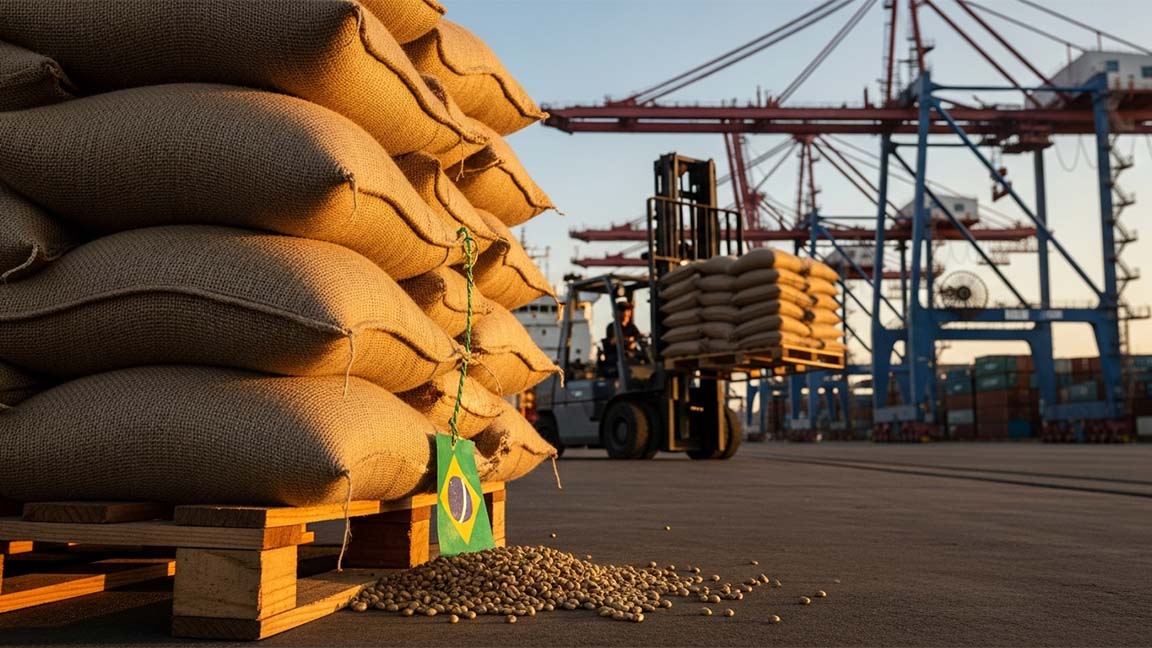
US coffee tariffs remain high, Brazil says, even after President Donald Trump ordered modest reductions that were intended to ease grocery costs. Vice President Geraldo Alckmin vowed to push for deeper relief, arguing that the extra 40% levy on Brazilian shipments “makes no sense” and continues to weigh on the United States’ largest coffee supplier.
Key Points
Brazil will keep pressing Washington after the latest move “barely impacted” its coffee exports. The government’s position is that the enduring surcharge leaves Brazilian beans at a disadvantage versus competitors, even as the White House looks to bring down prices on everyday goods.
US coffee tariffs face renewed scrutiny after limited relief
On Friday, Trump issued an order cutting reciprocal tariffs on several items, including coffee, beef, tomatoes, and bananas. The step was framed as part of a broader effort to reduce grocery bills at a time when voters are demanding lower prices. However, the change did not remove the additional 40% surcharge on Brazilian coffee, which sits on top of the reciprocal tariff.
For Brazil, that means the latest decision only nicks the edge of the problem. Since July, Brazilian coffee exports have faced the prospect of levies reaching 50%—a 10% reciprocal charge plus a further 40% penalty linked to the prosecution of former Brazilian president and Trump ally Jair Bolsonaro. While the Friday order addressed the reciprocal component, the extra 40% remains in place, limiting the practical effect for Brazilian beans headed to U.S. shelves.
Vice President Geraldo Alckmin underscored the point in Brasília on Saturday. “We’ll keep working to reduce it further,” he told reporters. “In the case of coffee, it makes no sense, 40% is still high.” His remarks signal that Brazil sees the current configuration as too steep for a key export, especially given its central role in supplying the U.S. market.
How Vietnam’s exemption reshapes competition on US coffee tariffs
Alckmin said Brazil’s position is particularly acute now that Vietnam’s coffee exports are fully exempted. That exemption gives Vietnamese producers a clear edge in the U.S. market at a moment when buyers are sensitive to price differences. With Brazil still carrying a 40% surcharge, importers weighing origins could find Vietnam a more economical option on paper.
That dynamic undercuts the intent of making groceries more affordable, at least as it relates to coffee from Brazil. The administration’s Friday move provides some relief on reciprocal rates, but for large volumes sourced from Brazil—the United States’ top supplier—the heavy extra charge persists. In practical terms, the gap hardens a competitive imbalance that Brazil wants Washington to address.
The contrast is sharp: Vietnam’s exemption removes a barrier entirely, while Brazilian shipments carry an added layer of cost. If the goal is to free up supply chains and reduce checkout prices, Brazil argues that the 40% surcharge stands in the way for the beans Americans buy most.
From July’s 50% prospect to Friday’s partial cut
The tariff path since midyear explains Brazil’s frustration. Beginning in July, exporters faced a potential 50% U.S. tariff load on coffee—10% reciprocal and an additional 40% levy tied to Brazil’s legal actions involving former president Bolsonaro. The combined rate raised the cost of Brazilian beans and clouded purchasing decisions for U.S. importers.
Friday’s order took aim at the reciprocal piece across several products, signaling a willingness to soften portions of the tariff framework as part of a broader grocery-price push. Yet the relief was partial. The 40% surcharge on Brazilian coffee remains intact, leaving the overall burden high and the practical effect limited for the market’s largest supplier.
In that context, calls from Brasília for deeper changes are unsurprising. Officials say they will keep pressing until the surcharge is rolled back further, reflecting Brazil’s view that the current regime is misaligned with market realities and consumer price goals.
Brazil’s vice president presses for deeper relief
Alckmin’s message was direct: the surcharge is too steep, and negotiations should continue. Speaking to reporters in Brasília on Saturday, he reiterated that Brazil will “keep working to reduce it further,” stressing that “in the case of coffee, it makes no sense, 40% is still high.” His comments build on Brazil’s broader push for tariff relief on coffee exports that form a cornerstone of its trade with the United States.
The administration’s latest order may have signaled a shift in reciprocal rates, but Brazil is focused on the remaining charge that keeps its beans at a premium. For importers and roasters, the distinction matters. While some origins benefit from outright exemptions, Brazilian shipments remain subject to a costly add-on that complicates purchasing and planning.
What the change means for US coffee tariffs at the checkout
The stated goal of Friday’s order was to lower the price of everyday goods. For coffee, the outcome is mixed. The tweak to reciprocal rates could marginally reduce costs on certain shipments, but US coffee tariffs still burden the flow from Brazil because the 40% surcharge endures. That leaves the biggest source of U.S. coffee only partly covered by the White House’s price-relief effort.
If Vietnam’s exemption shifts more volume its way, the market could see a rebalancing of origins in the near term. But U.S. consumers’ access to Brazilian beans—popular across blends and roasts—continues to run through a tariff structure that Brazil calls excessive. The result: any immediate pass-through of savings on coffee sourced from Brazil looks constrained as long as the surcharge remains.
What changes now for buyers and suppliers
For buyers, the policy math is straightforward. US coffee tariffs were trimmed at the edges, but the primary surcharge on Brazil persists. Importers that rely on Brazilian beans remain exposed to a higher landed cost, while Vietnam’s exemption offers a cleaner path for price-conscious procurement. That divergence is exactly what Brazil says it wants to resolve.
Brazil’s role as the United States’ largest coffee supplier underscores the stakes. The latest decision “barely impacted” that relationship, according to Brazil’s assessment, because it left the core surcharge untouched. In other words, US coffee tariffs still shape sourcing decisions in ways that do not fully align with the administration’s consumer-price goals.
On the ground, Brazil’s coffee sector continues its work. In Guaxupé, in the state of Minas Gerais, workers load harvested coffee cherries into trucks—a scene that speaks to a supply chain ready to serve the U.S. market if costs allow. The policy question is whether the tariff structure will shift enough to reflect that readiness.
The product scope of Friday’s order—coffee, beef, tomatoes, and bananas—shows the administration’s broader push to address grocery costs. Still, for coffee specifically, Brazil’s case hinges on the 40% surcharge that stands apart from the reciprocal rate cuts. Until that extra levy is reduced, US coffee tariffs will remain a flashpoint between two major trade partners.
Brazil’s message is clear: it will keep pushing. The country argues that the current setup leaves it at a disadvantage compared with Vietnam’s fully exempt shipments, and that the additional 40% charge does not reflect the realities of the coffee market or the administration’s mission to make everyday goods more affordable. For now, US coffee tariffs remain the focal point of Brazil’s outreach to Washington.
In the days ahead, attention will center on whether discussions yield any movement on the surcharge. Brazil has signaled it’s not letting up, and its position is reinforced by the size of its trade relationship with the United States. Until there is a change, US coffee tariffs will continue to weigh on Brazilian shipments, limit the impact of recent reciprocal cuts, and shape the competitive landscape in favor of exempted origins.
Conclusion
US coffee tariffs are still elevated for Brazil despite the administration’s partial relief on reciprocal rates. With a 40% surcharge intact, Brazil’s vice president says the costs “are still high” and promises to keep pressing for more. Vietnam’s full exemption deepens the urgency for Brasília, which argues that the current setup undercuts the grocery-price objective. Unless the surcharge is addressed, US coffee tariffs will remain at the center of trade discussions—and a key factor in how beans reach American consumers.
FAQ’s
What are the current US coffee tariffs on Brazil?
Brazilian exports face an additional 40% surcharge on top of reciprocal tariffs. A recent order trimmed the reciprocal piece but left the 40% levy in place.
Why does Brazil face a 40% surcharge on US coffee tariffs?
The extra 40% is tied to measures responding to Brazil’s prosecution of former president Jair Bolsonaro. It’s separate from the reciprocal tariffs adjusted on Friday.
Will the latest move lower coffee prices for U.S. shoppers?
Only slightly. While reciprocal tariffs were reduced, Brazilian beans still carry the 40% surcharge, limiting immediate pass‑through savings.
How does Vietnam’s exemption affect competition and prices?
With Vietnam fully exempt, its beans gain a cost edge in the U.S. market. That could shift sourcing toward Vietnam and pressure Brazilian suppliers.