

Sandisk stock surge capped a breakout session after the memory-chip maker beat September‑quarter estimates and guided meaningfully higher for December, powered by accelerating AI data center orders.
Key Points
The Milpitas, Calif.-based company reported adjusted earnings of $1.22 a share on revenue of $2.31 billion for the fiscal first quarter ended Oct. 3, topping consensus views of 88 cents and $2.15 billion. Shares jumped 15.3% to close at $239.48, after touching an all‑time intraday high of $239.99. For fiscal Q2, Sandisk projected adjusted EPS of $3.20 on sales of $2.6 billion at the midpoint—well ahead of Wall Street’s $1.79 and $2.23 billion expectations.
SanDisk stock surge: Earnings beat and outlook top views
The Sandisk stock surge followed a classic “beat‑and‑raise” update. Revenue climbed 23% year over year while earnings fell 33% as the industry works through mix and pricing shifts across enterprise SSDs and other memory products. Even so, the outlook reset the bar higher into year‑end.
Management attributed the upside to strengthening demand from AI‑driven data centers, where deployments require higher‑capacity, higher‑throughput storage to feed accelerated compute. Sandisk said it is engaged with five major hyperscale data‑center customers, an indicator of durable pipeline visibility across 2025.
CEO David Goeckeler said customers are increasingly selecting the company’s latest technology and products as the market tightens around AI workloads and next‑gen architectures.
AI hyperscalers and enterprise SSDs power momentum
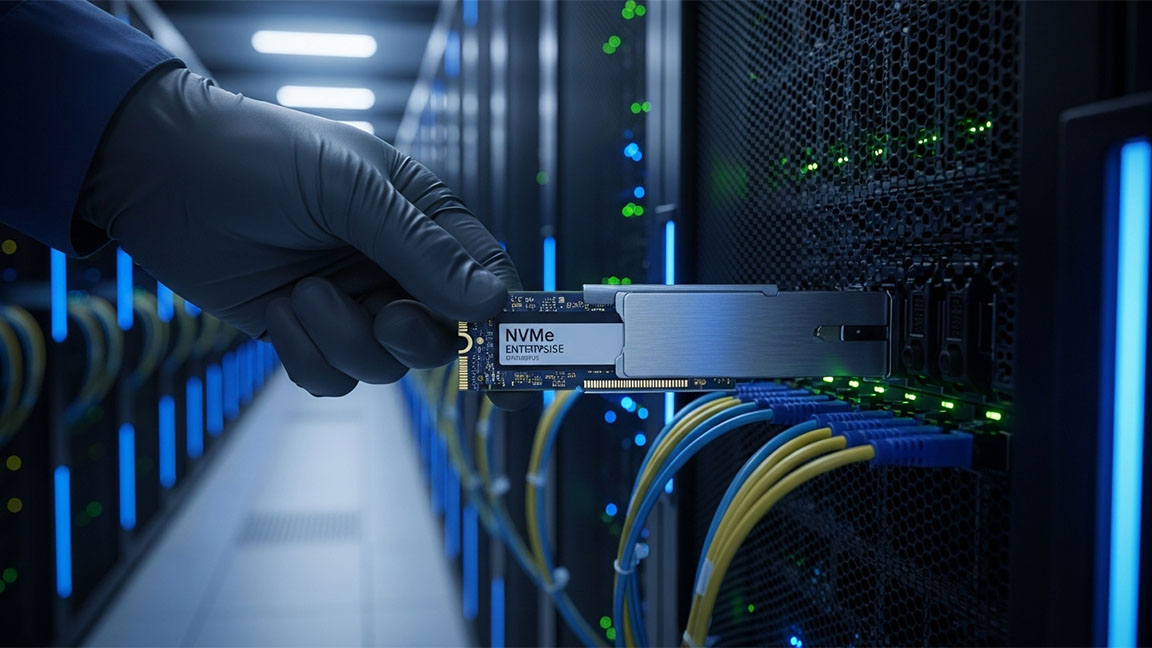
Driving the Sandisk stock surge is a surge in orders tied to AI models that process and store vast datasets. Training clusters and inference farms are adding tiers of fast storage—particularly NVMe enterprise SSDs—to reduce bottlenecks between CPUs/GPUs and data.
- Hyperscale traction: Sandisk’s engagement with five top cloud providers suggests multi‑quarter demand rather than a one‑off spike.
- Product mix: Transition to PCIe Gen4/Gen5 NVMe drives and higher‑density NAND improves performance per dollar for data‑center buyers.
- Supply discipline: With limited industry capacity growth, pricing has shown signs of stabilization, supporting gross margins as volume ramps.
Taken together, these dynamics help explain why the Sandisk stock surge arrived alongside stronger guidance despite a still‑mixed backdrop in consumer devices.
Analysts lift targets amid Sandisk stock surge
At least 11 Wall Street analysts raised price targets following the report. Morgan Stanley’s Joseph Moore reiterated an Overweight rating and boosted his target to $263 from $230, noting that upside versus already‑elevated expectations points to a data‑center strength that appears durable, particularly with constrained supply growth.
Following the Sandisk stock surge, analysts broadly highlighted three themes: improving enterprise SSD pricing, visibility from hyperscale engagements, and operating leverage if the mix continues to skew toward higher‑end products.
Market reaction and peer moves
Beyond the Sandisk stock surge, competitor Micron Technology (MU) slipped a fraction to $237.92, suggesting investors are differentiating based on product mix, execution, and exposure to enterprise storage versus other memory categories. Broadly, the group remains sensitive to signs of incremental AI infrastructure demand and any updates on supply additions.
Why AI data centers are moving the needle
- Data gravity: AI training consumes petabytes of data, and faster access to that data via NVMe SSDs can materially reduce time‑to‑insight.
- Architecture shifts: New server designs balance high‑bandwidth memory near accelerators with layers of flash storage to keep GPUs fed.
- Cost curves: As NAND technology advances, the total cost of ownership per terabyte declines, widening the use cases for flash in the data center.
Investors behind the Sandisk stock surge are betting that these secular shifts—rather than a transient cycle—are driving orders, giving Sandisk a longer runway as enterprises and clouds scale AI infrastructure.
Financial detail: what stood out
- Top‑line growth: $2.31 billion vs. $2.15 billion consensus signals stronger shipments and pricing in enterprise SSDs.
- Profitability path: While EPS was down year over year, guidance implies margin expansion as higher‑value products dominate the mix.
- Outlook reset: Fiscal Q2 guide of $3.20 EPS and $2.6 billion revenue suggests momentum into calendar year‑end, with potential operating leverage if supply remains disciplined.
For the Sandisk stock surge to sustain, investors will look for continued execution on mix improvement, margins, and supply‑chain efficiency.
Competitive landscape: execution and differentiation
AI storage demand is a rising tide, but vendor positioning varies. Sandisk’s differentiation centers on:
- Portfolio breadth in enterprise NVMe SSDs optimized for AI/ML workloads.
- Deep relationships with hyperscale buyers that co‑engineer for performance and reliability.
- Manufacturing discipline that balances growth with profitability.
Risks include faster‑than‑expected supply additions industry‑wide, macro spending pauses at hyperscalers, or competitive pricing actions that pressure margins.
Guidance checkpoints and near‑term catalysts
For the December quarter, watch:
- Shipment mix: Enterprise SSD share versus other categories, a key driver of gross margin.
- Pricing trends: Signs of stabilization or improvement as contracts renew.
- Customer concentration: Expansion beyond the five named hyperscale engagements would broaden visibility.
Catalysts in early 2026 could include product launches on PCIe Gen5, density improvements, and potential design wins tied to next‑gen AI server cycles.
What this means for investors
The Sandisk stock surge reflects growing confidence that AI‑linked data‑center demand is both real and recurring. If management sustains momentum on high‑value products and keeps supply tight, the earnings power implied by guidance could extend beyond a single quarter.
For long‑only investors, position sizing often comes down to cycle durability. For traders, the focus will be on whether the post‑earnings gap can consolidate above prior resistance while estimate revisions continue to trend higher.
Bottom line
Sandisk’s beat‑and‑raise quarter—anchored by AI data‑center strength, hyperscale wins, and tighter supply—sparked a powerful rally to record highs. With guidance well above expectations and a slate of analyst target hikes, the immediate setup is constructive.
If execution tracks guidance, the Sandisk stock surge may signal the early stages of a broader upcycle in enterprise flash tied to AI infrastructure—one where selective capacity, product leadership, and hyperscale partnerships define the winners.
FAQ’s
Why is Sandisk stock up today?
The company delivered a beat‑and‑raise quarter, citing strong AI data‑center demand. Shares jumped 15% to $239.48 after management highlighted engagements with five major hyperscalers.
What did Sandisk report for the latest quarter?
Adjusted EPS was $1.22 on revenue of $2.31B, topping estimates of $0.88 and $2.15B. Sales rose 23% year over year, while earnings declined 33% on mix and pricing dynamics.
What guidance did Sandisk give for the next quarter?
For fiscal Q2, Sandisk guided to $3.20 adjusted EPS on $2.6B revenue (midpoint), well above Street forecasts of $1.79 and $2.23B, driven by AI storage momentum.
How did Wall Street react, and what about rivals?
At least 11 analysts raised price targets; Morgan Stanley boosted to $263 and kept an Overweight. Rival Micron (MU) finished slightly lower, as investors distinguished product mix and AI data‑center exposure.